
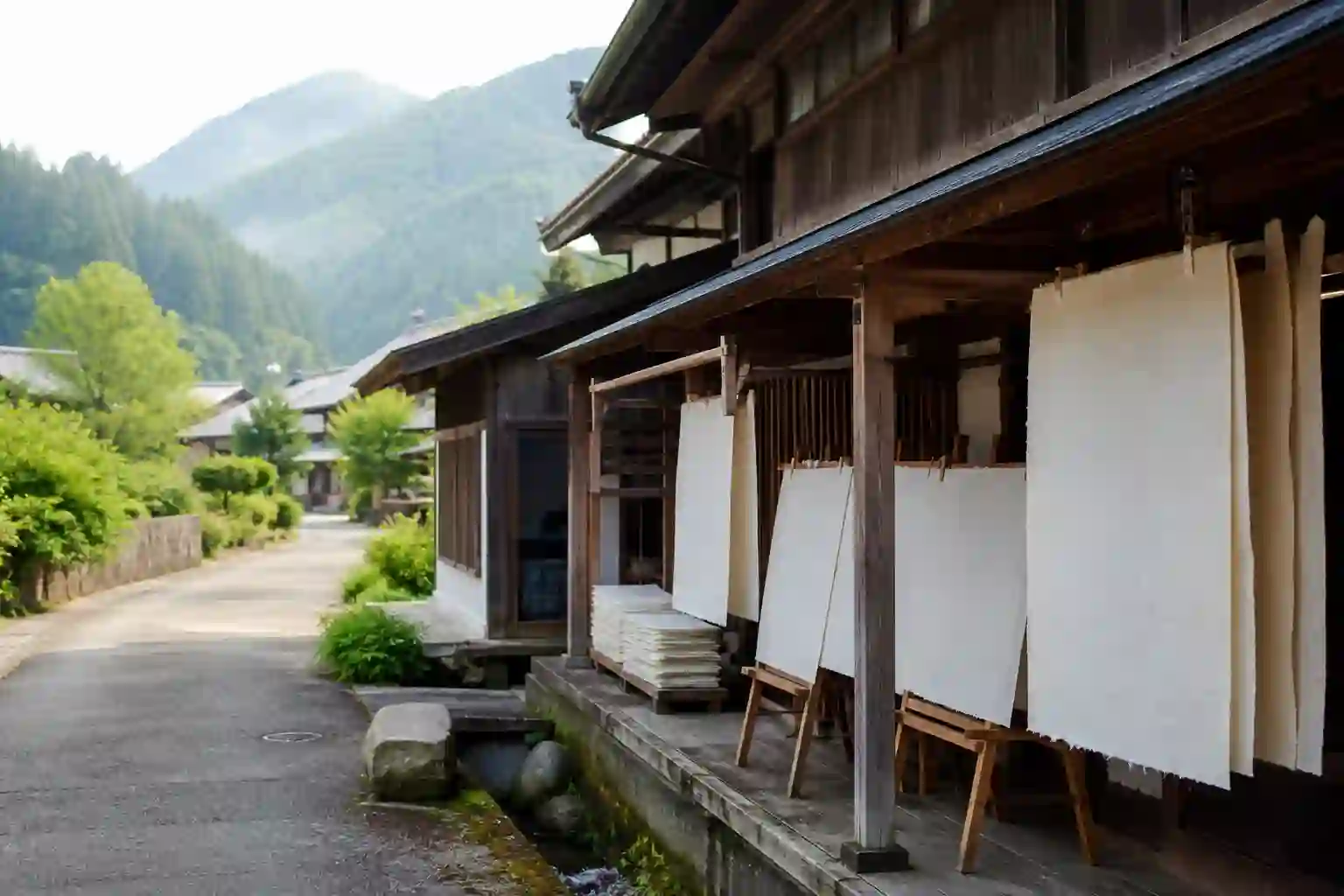
Echizen Washi Village is not a museum pretending to be a craft town. It is a working district in Fukui where paper-making families, workshops and small village streets still belong to the same landscape. If you are building a Japan trip around crafts, regional food or places with a real reason for existing, this is a much better detour than another souvenir street.
What is Echizen Washi Village?
The village sits in Echizen City’s Goka district, a group of five communities known for handmade washi paper. Fukui’s official tourism guide describes the area as Japan’s largest high-quality handmade-washi production region. The district includes Oizu, Otaki, Iwamoto, Shinzai and Sadatomo, with paper makers, workshops and small attractions spread through a rural valley rather than arranged as one theme-park entrance.
The craft has deep roots. The official regional itinerary describes Echizen washi as a tradition with around 1,500 years of history. Local legend credits a goddess with teaching paper-making to villagers who had poor land for rice, but you do not need to treat the legend as a literal founding document to understand its role. It expresses how the craft is tied to water, landscape and community survival.
Three stops that make the visit work
1. Papyrus House
Papyrus House is the practical starting point for many visitors. It is a place to try making washi rather than only looking at finished sheets behind glass. The process is physical: preparing pulp, lifting a screen, distributing the fibres and drying the paper. The details depend on the workshop and the day, so check the current schedule before making the trip.
A hands-on session also changes what you notice in the village. You begin to see why paper quality depends on water, fibre preparation, drying surfaces and patient repetition. A sheet that looks simple in a shop is the end of a chain of decisions, not a blank white souvenir.
2. The Paper & Culture Museum
Near the village entrance, the Paper & Culture Museum provides the history that a workshop cannot. The official Fukui guide says the museum displays materials on the origins and development of Echizen washi, along with artworks and installations. Visit before your workshop if you want the terminology to make sense, or afterwards if you prefer to start with the material itself and then fill in the background.
This is also the stop that helps you avoid the “craft village equals shopping” trap. The point is not to race through a row of products looking for the most photogenic notebook. The museum shows how paper has served religious, administrative, artistic and everyday purposes across centuries.
3. Udatsu Craft Center
The Udatsu Craft Center is a reconstructed papermaker’s house first built in 1748. The regional itinerary describes it as a place where visitors can watch craftspeople process pulp and dry sheets using traditional tools, and where workshops are available. The building matters as much as the demonstration: it shows the scale and working conditions of a craft household rather than presenting washi as an abstract cultural label.
Allow time to look at the structure, roofline and work surfaces. Echizen’s craft story is strongest when the architecture, water and production process are seen together.
How to plan the route
From Hapi-Line Takefu Station, the official Fukui attraction listing directs visitors to the Fukutetsu Bus Nanetsu Line and the “Washi no Sato” stop. That is the public-transport route to research first. Timetables in regional Japan can be less frequent than visitors expect, so do not arrive at Takefu with only a vague idea of the last bus home.
The village is easier as part of a two-day Echizen craft itinerary than as a frantic half-day excursion from Kyoto. Fukui’s official itinerary groups the Washi Village with the Paper & Culture Museum, Udatsu Craft Center, Echizen lacquerware, Takefu Knife Village and Echizen Pottery Village. You do not need to do all of them, but the grouping shows how spread out the craft sites are.
A car gives you more flexibility between districts. Without one, choose one or two anchors, check bus times carefully and accept that the gaps are part of the trip. The village rewards a slower pace; it does not reward trying to collect every workshop in a single afternoon.
What to buy—and what to notice first
Echizen washi makes sense as a purchase because it is connected to the place you just visited. Look for paper whose texture, fibre and weight you actually like: writing paper, envelopes, notebooks, cards or small art pieces. Ask how it was made if the shop or studio has information available. A modest sheet from a working paper region is more meaningful than a generic “Japan” print with no local connection.
Do not assume every item is handmade in the village, and do not photograph workers or workshop interiors without permission. The same respect that applies in a temple or historic street applies here: these are working spaces, not a stage arranged for visitors.
When should you go?
Echizen Washi Village is an all-seasons destination. Summer brings green mountain scenery but can be hot and humid; winter is historically important for papermaking, although snow and transport can change the plan. Spring and autumn are comfortable for walking, but workshop availability and local events still vary. Check each facility directly before you travel, especially if a hands-on experience is the main reason for your visit.
Who is this detour for?
Go if you like traditional crafts, quiet regional towns, practical demonstrations and travel that leaves you with a better understanding of how an object is made. It is particularly good for repeat Japan visitors who have already seen the major Kyoto temples and want a material culture experience rather than another viewpoint.
Skip it if you only have one free day in Kyoto and would resent the transfers. Echizen Washi Village is not a secret shortcut from Kyoto; it is a destination that makes more sense when you give it a night or combine it with another Fukui craft route. For a Kyoto day that does not require a long regional transfer, Japanify’s small-group walking tours keep the focus on the city’s own streets, stories and working neighbourhoods.
Before you go
Start with the official Echizen Washi Village listing for access, then read Fukui’s Ancient Artisanal Center itinerary to understand how the village fits with nearby craft sites. The local Echizen-Takefu visitor information page is useful for regional orientation. Confirm workshop reservations, facility hours and bus times on the day’s official pages before setting out.