
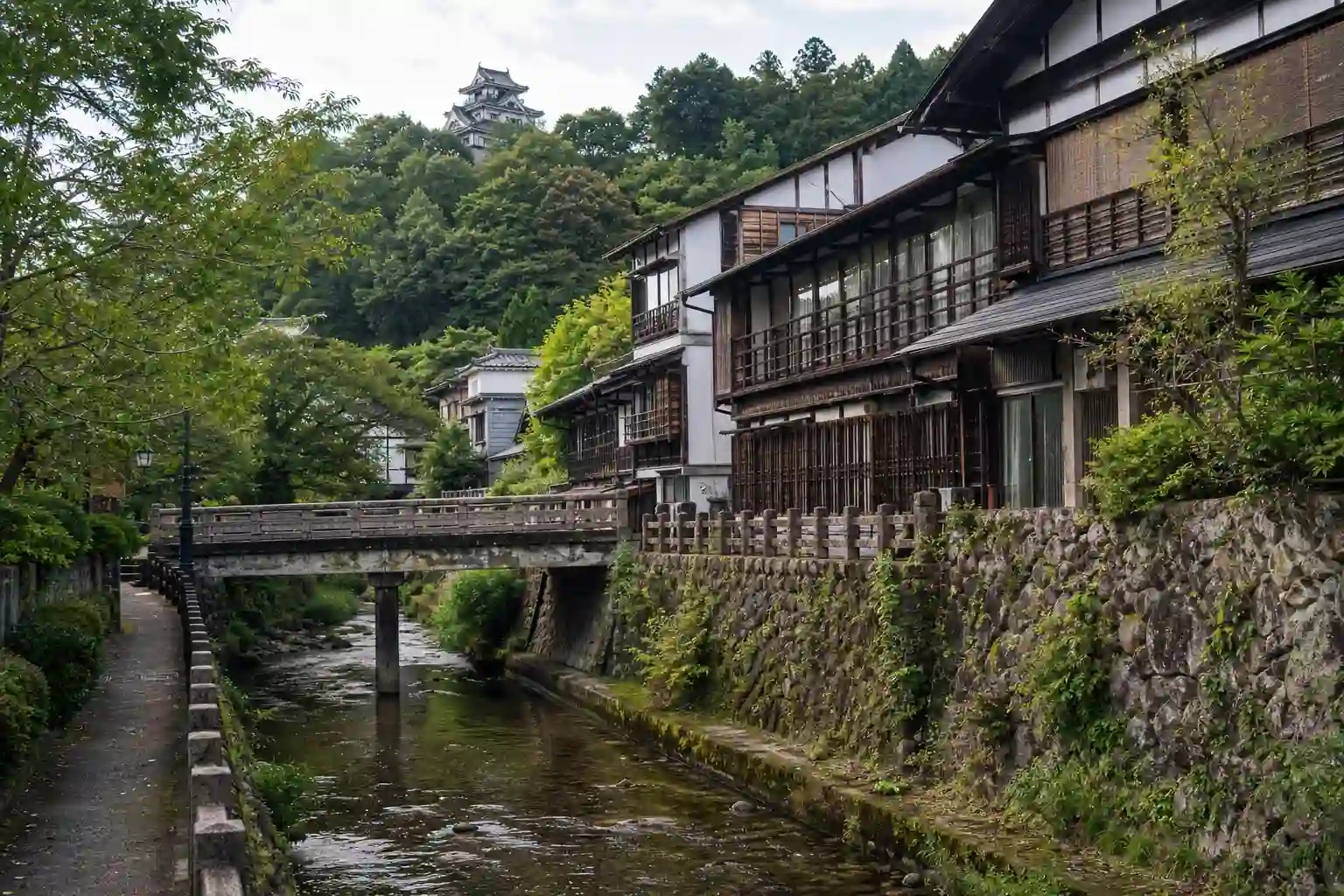
Gujo Hachiman is the sort of place that makes “off the beaten path” sound less like marketing and more like a change of pace. In Gifu’s green mountains, the old castle town is stitched together by clear rivers, small canals, wooden houses and a summer dance that runs through the night. It is not a quick Kyoto detour. It is a rewarding regional stop if you are moving through central Japan—or if you are willing to make the journey from Nagoya for something with a real local pulse.
Why Gujo Hachiman is worth the effort
The town’s personality comes from water and movement. Channels run beside streets and homes, and the valley setting keeps the scale human. The official tourism association’s English guide is refreshingly honest that English is limited in some places, but the town is set up for a slower kind of welcome. You are not arriving to collect one landmark and leave; you are walking a compact historic centre, following the rivers and noticing how the town still works.
Gujo Hachiman is also a place of useful oddities. It is a major centre for Japan’s plastic food replicas, the realistic dishes displayed outside restaurants nationwide. Workshops let visitors make their own samples, turning a familiar piece of Japanese visual culture into a hands-on activity. The town has a wooden reconstructed castle on the hill, too, but the most memorable part is often the relationship between the castle, the water and the streets below.
The August timing: Gujo Odori 2026
If you are considering Gujo Hachiman this month, the timing is unusually good. The official 2026 schedule lists dancing on many nights through July, August and early September. The four all-night Obon sessions are scheduled for August 13–16. On those nights, dancing begins at 8 p.m. and continues until 4 or 5 a.m., depending on the date.
Gujo Odori is not a stage show where visitors sit and watch. The circle moves through the town, and visitors can join once they understand the steps. The tourism association describes the festival as a tradition with more than 400 years of history; it was added to UNESCO’s Intangible Cultural Heritage list in 2022. That recognition may bring more attention, but the key detail for a visitor remains simple: come prepared to participate respectfully, not to treat the dancers as background scenery.
The all-night sessions are a serious commitment. Accommodation in and around the centre is limited, and local trains do not run simply because the dancing continues until dawn. If you want to attend August 13–16, reserve a room early and check your return transport before you start dancing. For a first visit, one of the regular evening sessions can be easier and still gives you the atmosphere without building your entire night around the last train.
A sensible day in the castle town
Start with the rivers and old streets
Begin in the lower town and follow the water before climbing anywhere. The Seseragi and Yoshida rivers give Gujo Hachiman its cooling, reflective centre, and the small waterways around the old houses are a better introduction than rushing straight to the castle. Take your time with bridges, shopfronts and the small details of a town shaped around clean water.
The official tourism association offers a self-guided riverwalk map, which is useful if you want structure without joining a tour. It also lists workshops and sights in the centre, including places where English-language help is available. The town is walkable, but the hill to the castle is a different proposition from a flat canal stroll.
Climb to Gujo Hachiman Castle
The original castle was built in the sixteenth century and later destroyed, like many Japanese castles in the early modern period. The present building was reconstructed in wood in 1933, which gives it a different feel from the concrete keeps found in many cities. From the hill, the valley view explains the town’s layout: the castle watches over the water routes and the compact streets below.
The walk from the town centre takes about 20 minutes according to JNTO’s destination guide, but it is uphill and summer heat changes the calculation. Go early, carry water and do not treat the climb as a quick photo errand before a full day of dancing. If mobility or heat is a concern, check current taxi and road access rather than assuming the hill is easy.
Make a food sample—or just eat well
Sample Village Iwasaki is the best-known place to try making plastic food replicas, and reservations are advised. The workshop is playful, but it also explains why fake food is so visible in Japan: it is a practical menu language, not merely a souvenir gimmick. If the workshop is full, you can still spot the craft throughout the town and enjoy local food in the real world.
How to reach Gujo Hachiman
From Nagoya, the most straightforward planning approach is usually a highway bus or a rail journey via Gifu and Mino-Ota. JNTO lists the train route as JR from Gifu to Mino-Ota, followed by the Nagaragawa Railway to Gujo Hachiman. Highway buses from Nagoya and Gifu also serve the area; some stop at Gujo Hachiman Inter, while a smaller number reach the more convenient Jokamachi Plaza.
That distinction matters. Gujo-Hachiman Station is not the same thing as the historic centre, and arriving at an interchange can leave you needing a local connection or taxi. Check the operator’s timetable for your actual date, especially around the all-night dance nights when ordinary services may not match your plans.
Who should go—and who should skip it?
Go if you like regional towns, local festivals, craft workshops, riverside walks and travel days that are not optimised around the most famous rail pass. Skip it if you have only one spare day in Kyoto and want a simple add-on. Gujo Hachiman is not “hidden Kyoto”; it is a Gifu destination with its own geography and calendar.
If your route already includes Nagoya, Gifu, Takayama or the wider Chubu region, Gujo Hachiman fits naturally. If you are staying in Kyoto, save the idea for a future trip rather than forcing a long transfer into an already full itinerary. Japanify’s Kyoto walking tours are the better choice when what you really need is a well-paced day in Kyoto itself.
Before you book
Check the official 2026 Gujo Odori schedule for the exact night and venue, and use the Gujo Hachiman Tourism Association for access updates, workshops and local maps. JNTO’s Gujo destination guide is useful for the rail and bus approach, while the association’s town sightseeing page lists central attractions and English-supported workshops. Festival hours, transport and accommodation availability can change, so verify them again before travelling.