
Kurayoshi makes more sense when you stop trying to turn it into an extra stop between Kyoto temples. It is in Tottori Prefecture, on the other side of the mountains from Kansai, and the journey deserves room in your itinerary. Come for a merchant quarter, small shops and an afternoon that doesn't need six major attractions to justify itself.
The white-walled storehouses are the obvious draw. But the useful question is not whether they look good in a photograph. It's whether you would enjoy spending time around them after the photograph is taken. If the answer is yes, Kurayoshi is worth a closer look.
Is Kurayoshi worth visiting?
Kurayoshi is a good fit for travelers who enjoy historic streets, small shops and a slower stop in western Japan. You can visit its old merchant quarter without a car, using a local bus from JR Kurayoshi Station. From Osaka, however, allow a substantial rail journey before that final connection. This is not a quick add-on to an already packed Kansai day.
The white walls belonged to a working town
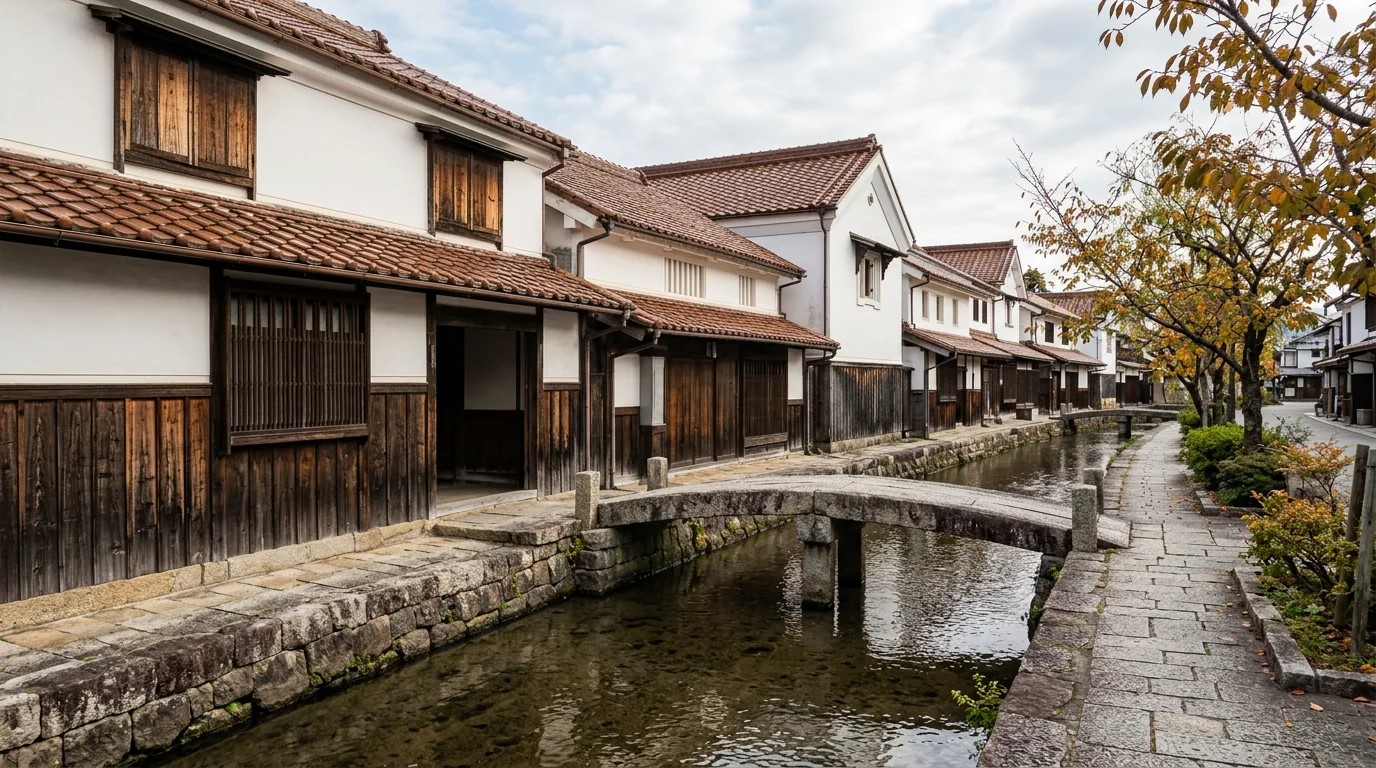
Shirakabe Dozo-gun is the name to put into your map. The Tottori prefectural tourism guide describes white-plaster storehouses beside the Tamagawa waterway, red-tiled roofs and small stone bridges. Buildings associated with brewing and soy-sauce production now accommodate shops, tea shops and galleries. The district preserves architecture with roots in the Edo and Meiji periods.
Those details make a better starting point than treating the area as a backdrop. Look at how the buildings meet the water, how dark timber sits below the plaster and how the bridges connect one side to the other. Give yourself permission to turn down a street because something caught your eye, not because it appears on a numbered list.
We would set aside a few unhurried hours for the quarter, including a stop to eat or browse. That is our planning suggestion, not an official minimum visit time. Someone interested only in the canal view can make a shorter stop; someone interested in buildings and shops may want longer.
Red roofs, small purchases and a manga connection
The city's English visitor brochure explains the regional red roof tiles, known as Sekishu-gawara, and the reuse of townhouses and storehouses for crafts, sweets and other shops. It also points out Kurayoshi's appearance in Jiro Taniguchi's manga Haruka na Machi e, a story that returns its adult protagonist to the town of his youth.
That gives the walk another possible focus: buildings as part of a lived story rather than a collection of attractive facades. You do not need to know the manga to enjoy the town, but a reader may find more to notice than the standard storehouse photograph.
The brochure also suggests food such as taiyaki and soy-sauce-flavored ice cream. Treat that as an idea for what to look for, not a guarantee that every item is available whenever you arrive. Check the shop's current menu and opening days if a particular stop matters to you. Old travel PDFs are useful for context; they aren't live stock lists.
Getting there: the station is not the storehouse district
JNTO's Kurayoshi guide identifies the Super Hakuto limited express as a connection from Osaka, with the journey taking just over three hours. Check your particular departure and arrival time rather than using that estimate as a complete door-to-door plan. The guide also identifies the JR San-in Line for travel from Tottori.
Then comes the local leg. Kurayoshi Station and the historic quarter are separate places. That is easy to miss when an itinerary simply says “train to Kurayoshi, walk around.”
The tourism association's station-to-storehouse bus instructions direct visitors to bus stand 2. For the local route, get off at Akagawara / Shirakabe Dozo-gun; the ride is listed at approximately 12 minutes. The Park Square route offers another approach via Shiyakusho / Utsubuki Kouen Iriguchi, taking approximately 17 minutes.
Before leaving the station, confirm which route your bus follows and photograph the return-stop information. Frequencies vary by time period. Leave a buffer before any onward train, especially if your rail ticket ties you to a particular departure. A transfer that looks small on the map still belongs in the schedule.
Add a museum, not another rushed town
If you want a second focus for the day, look at the Tottori Prefectural Museum of Art in Kurayoshi. Its official calendar is the place to check exhibitions and closures for your date. Normal hours are listed as 9:00–17:00, with Monday closures; when Monday is a public holiday, the following weekday is normally the closure day. The museum notes that closures can change.
Check the exhibition before committing your afternoon. “There's a museum” is not, by itself, a reason to race through one. If the program interests you, give it its own block of time and work out the transfer separately. If it doesn't, lunch and a longer walk are perfectly reasonable uses of the day.
This also avoids the familiar mistake of using a smaller destination as a base for three more destinations. Adding every nearby attraction can turn the slow part of your trip into the most complicated part.
Day trip or overnight?
From an existing Tottori-area base, a Kurayoshi visit can fit naturally into a regional itinerary. From Osaka, the return rail journey eats a much larger part of the day. An overnight in the area may make more sense if you want time for both the merchant quarter and another substantial visit.
That isn't a promise of an old-town evening packed with open shops. Check accommodation location, dinner arrangements and individual opening hours before booking. Sleeping “in Kurayoshi” doesn't automatically mean staying beside the canal, either. Put the actual address into your map.
Who should skip this detour?
If you have a short first trip and still want full days in Tokyo, Kyoto and Osaka, Kurayoshi may be the wrong addition. The journey is real, and squeezing it in doesn't become sensible just because the destination is less familiar.
If you enjoy architectural details, a shop you didn't plan to enter and a lunch break without a stopwatch, the trade-off is different. Choose Kurayoshi because that is the kind of day you want—not because anyone has promised an empty town or a more “authentic” Japan. It is a place to visit thoughtfully, not a badge for avoiding the obvious route.
Travel information checked October 7, 2026. Featured image: an original AI-generated interpretation of Kurayoshi's storehouse townscape, not a documentary photograph or a guarantee of current conditions.