
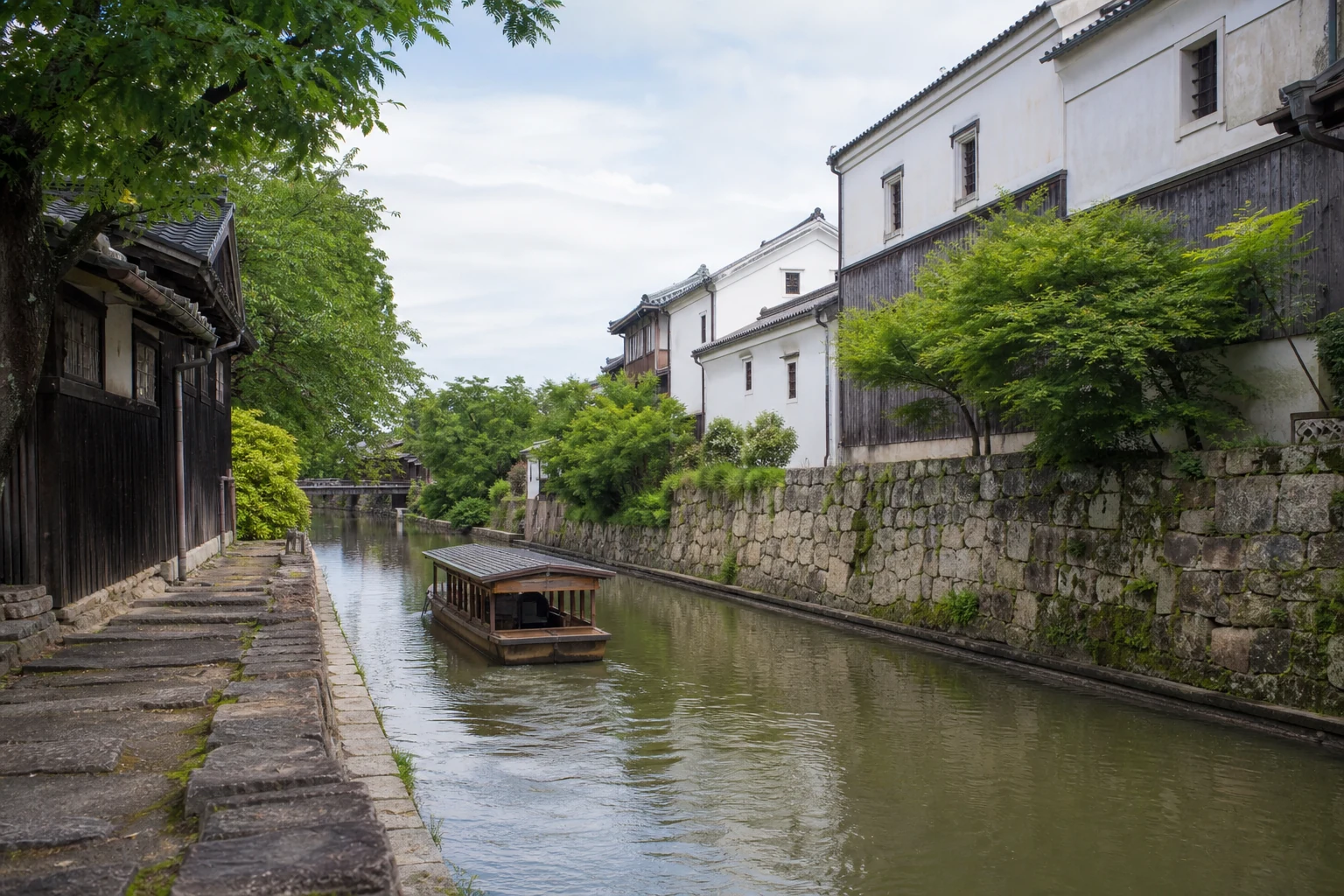
The useful thing about Omihachiman is not that it is a “hidden Kyoto.” It is not Kyoto at all. It is a small Shiga city built around commerce, water and a castle that disappeared more than four centuries ago. From Kyoto Station, the JR Biwako Line reaches Omi-Hachiman in roughly 40 minutes. Most visitors stay on the train. Getting off gives you a very different version of historic Japan.
There are no giant temple complexes to race between. Instead, there is a restored canal lined with white storehouses, streets of old merchant homes, a four-minute ropeway to a ruined castle hill, reed wetlands and a strange, appealing pocket of Western-style architecture. It works as a day trip because the old town is compact. It works even better if you do not try to “complete” it.
Why Omihachiman feels different
Omihachiman began as a castle town in 1585, when Toyotomi Hidetsugu built Hachimanyama Castle and ordered the digging of Hachimanbori. The waterway served as both a defensive moat and a commercial route connecting the town to Lake Biwa. The castle was abandoned in 1595, but the town kept prospering because the canal remained useful.
That history matters when you walk here. Omihachiman's old center is not arranged around a single religious landmark. It is arranged around movement: goods arriving by water, merchants leaving for markets around Japan, and wealth returning in the form of houses, storehouses, schools and public works. The city's official introduction explains how local merchants built nationwide trading networks from this compact base near Kyoto, Osaka and the old highways to Edo.
The result is quieter and more domestic than the famous preserved districts of Kyoto. But do not turn that into another internet fantasy. Omihachiman is a functioning regional city, not an empty film set. Weekends, festivals and autumn can bring plenty of domestic visitors. The station area is modern, and the historic district is not directly outside the ticket gate.
A day that makes sense
Start with the canal, not the ropeway
From Omi-Hachiman Station, the old town around Hachimanbori is about 10 minutes by bus or taxi, or roughly 30 minutes on foot. Walking is possible, but the route between the station and historic center is mostly ordinary city. Unless that everyday streetscape interests you, save your feet for the canal and merchant district.
Hachimanbori is about 4.7 kilometers long, although the photogenic central section is much more compact. Traditional wooden residences and white-walled storehouses line the water. The Omihachiman Tourism Association's history of the canal is worth reading before you arrive: residents stopped a plan to fill the polluted waterway in the 1970s, then restored and maintained it through local preservation work. What looks timeless today survived because people made a modern decision to save it.
Walk both banks slowly. Then turn into Shinmachi and Nagaharacho rather than staying beside the water for every photograph. These streets make the Omi merchant story visible: deep plots, restrained facades and houses built by families whose businesses reached far beyond Shiga.
Take one boat, not every boat
There are two distinct boating experiences, and confusing them is an easy planning mistake. Short cruises operate on Hachimanbori itself, among the old storehouses. Longer wetland boats travel through reedbeds, rice paddies and waterways connecting the town with Lake Biwa.
For a first day trip, the canal ride is the easier fit. The official boat information lists a small motorboat service that may accept walk-ins when space is available and a hand-rowed service requiring advance reservations. The rowboats normally close on Wednesdays, while schedules also change around Obon, New Year and winter. Check the operator details instead of building your day around a screenshot from an old blog.
The wetland ride is the more unusual choice if landscape matters more to you than architecture. It needs more time and generally more planning, but the reed channels show why this town developed here in the first place. Do not squeeze both experiences into a short visit simply because both contain boats.
Climb after lunch
Himure Hachimangu Shrine and the Hachimanyama Ropeway sit beside the canal district, so the mountain makes a natural afternoon stop. The cable car climbs the 272-meter hill in about four minutes. At the top are surviving stone ramparts, Zuiryuji Temple and views across the town, Lake Nishinoko, Lake Biwa and the surrounding mountains.
According to the official ropeway page, cars run every 15 minutes from 9 a.m. to 5 p.m., with the final uphill departure at 4:30 p.m. Do not leave it until the last possible minute. Haze can soften the lake view in summer, but the overhead view still makes the town's canal-and-wetland geography click into place.
The detail most day-trippers miss
Omihachiman's surprise is William Merrell Vories, an American-born architect, teacher, missionary and businessman who settled here in the early twentieth century. His Spanish-style Old Hachiman Post Office, wooden houses and institutional buildings sit among the older Japanese townscape without turning the city into an architectural theme park.
If the canal tells the story of early modern commerce, the Vories buildings show how Omihachiman kept changing. The Old Hachiman Post Office is the easiest place to notice the contrast. Some other buildings have limited opening dates or require appointments, so treat them as architecture to encounter along the walk rather than assuming every door is a museum entrance.
Who should actually go
Choose Omihachiman if you enjoy urban history, traditional streets, boats, photography or understanding how trade shaped a place. It is especially good after several temple-heavy days in Kyoto. The shift from religious monuments to merchant culture prevents historical Japan from collapsing into one visual stereotype.
Skip it if this is your first visit to Kansai and you have only two days total. Kyoto's major sights are famous for legitimate reasons, and replacing them with a lesser-known town does not automatically make a trip more meaningful. If you want a calmer, more contextual Kyoto day without leaving the city, a focused route such as our Nanzenji Zen walk is the more efficient choice.
For everyone else, Omihachiman is the rare detour that does not demand heroic logistics. Take the train, take the bus to the old town, choose either a canal boat or a wetland boat, and leave enough unscheduled time to follow the streets. The point is not to prove you found somewhere obscure. It is to notice a kind of Japanese history that the standard Kyoto checklist barely mentions.