
The Osaka day trip most people never consider
If your Osaka plan begins and ends with Dotonbori, you have not seen the city’s older argument with the sea. South of the neon, Sakai grew as a trading port, a city of merchants, workshops, tea rooms, and enormous burial mounds. It is close enough for a practical half-day or day trip, but different enough to reset your idea of what “historic Japan” is supposed to look like.
Sakai is not a secret village waiting to be discovered. It is a working city. Trains, bikes, apartment blocks, school runs, and delivery vans sit beside old wooden townhouses and craft businesses. That mix is exactly the point. You are not entering a theme park version of the past; you are visiting a place where old industries still shape the streets.
Why Sakai feels different from Kyoto
Kyoto’s famous historic districts are organised around temples, shrines, and carefully preserved lanes. Sakai’s story begins with commerce. The city was a prosperous port and an international trading centre in the medieval period, and that wealth helped support the tea culture associated with Sen no Rikyu, the influential tea master born here.
The result is a destination with several layers that do not always announce themselves. A knife shop can lead to a conversation about forging and food. A tea museum can open onto the history of merchant wealth. A giant keyhole-shaped kofun can make ancient Japan feel less like a textbook and more like a landscape decision: someone built this enormous monument here, and the city grew around it.
Start with the Mozu Kofun area
The Mozu Kofun Group is the strongest reason to make the detour. These burial mounds are part of the Mozu-Furuichi Kofungun UNESCO World Heritage site. The most famous mound in Sakai is Daisenryo Kofun, traditionally identified as the mausoleum of Emperor Nintoku. You cannot climb onto the mound or walk around it like a temple garden; the monument is surrounded by a wooded moat and viewed from the public paths around it.
That limitation is part of the experience. From ground level, the scale is difficult to read. A map, museum visit, or guided walk helps you understand the keyhole shape and the wider group of tombs rather than treating the site as a single scenic pond. The official access information lists JR Mozu Station as the nearest station, with the mound roughly a five-minute walk away. Only local trains stop there, so check the service before you leave.
The Sakai City Museum, across from the park, is the sensible companion stop. It provides historical and archaeological context, including material related to the kofun. Without that context, you may spend ten minutes looking at trees and wonder what you were meant to notice. With it, the quiet landscape starts to make sense.
Then follow the city’s craft story
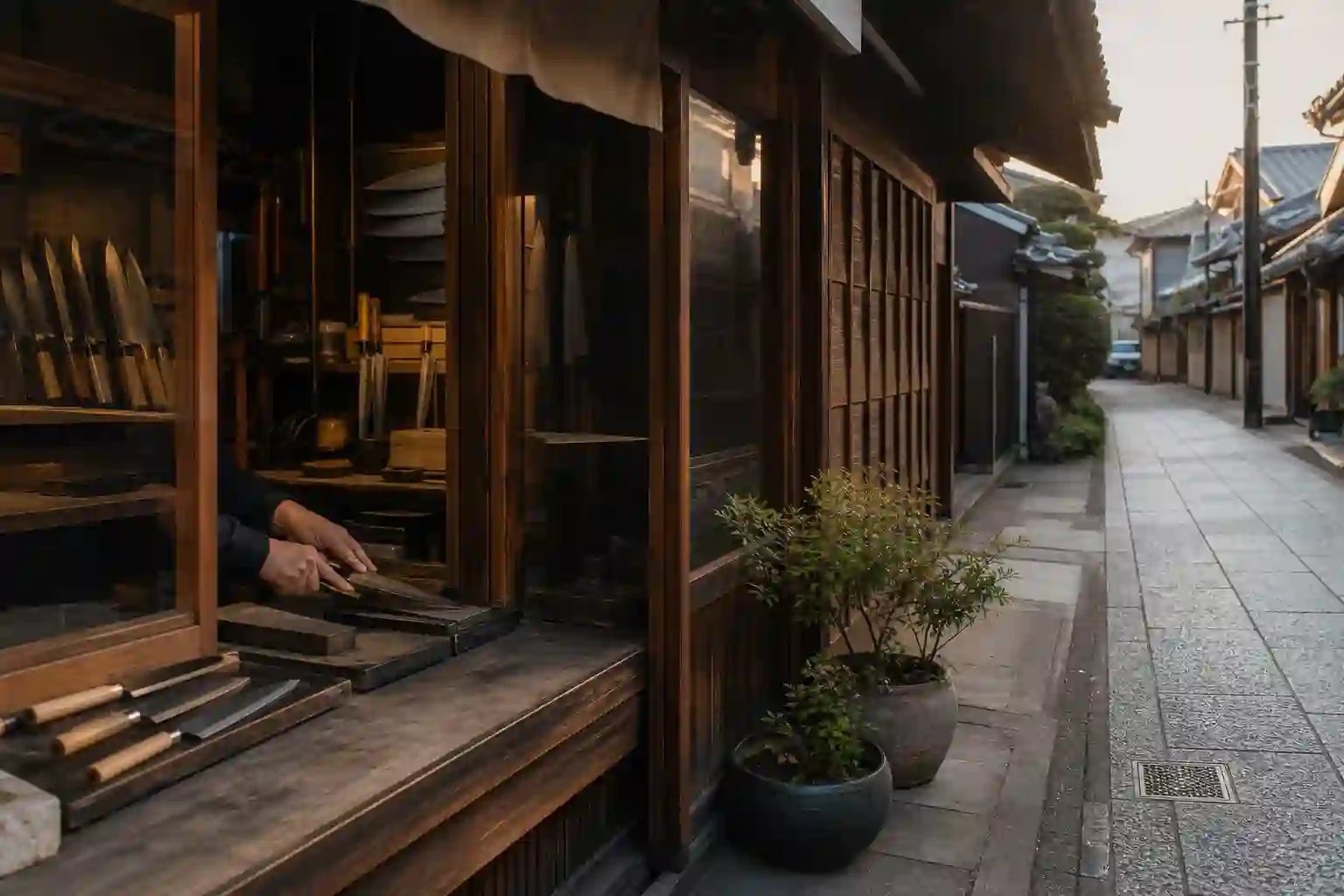
Sakai knives are famous for a reason, but the useful visit is not simply “buy a knife in Japan.” Sakai’s cutlery tradition developed through older metalworking skills and the demands of a major commercial city. The city’s official craft information connects the development of forging technology to the tools made for building the region’s ancient burial mounds, while later tobacco-knife production helped establish Sakai’s modern cutlery reputation.
At the Sakai Traditional Crafts Museum, you can see how the city presents that history and compare different kinds of local work. Some workshops and tourism programmes offer demonstrations or hands-on sharpening experiences, but availability, language support, and booking rules vary. Treat a workshop as a scheduled experience, not something you can assume will be open because a blog listed it once.
If you buy a knife, ask about the steel, sharpening, maintenance, and whether the shop can arrange shipping. A beautiful blade is not a souvenir if you cannot legally or practically take care of it at home. The best purchase is the one you understand.
Make time for Sen no Rikyu’s Sakai
Sakai Plaza of Rikyu and Akiko is a compact way to connect two of the city’s cultural figures: Sen no Rikyu and poet Yosano Akiko. The facility includes exhibitions, tourist information, and a tea ceremony experience. The city lists the plaza’s regular hours as 9:00 to 18:00, with tea experiences from 10:00 to 17:00; it also notes a regular closure on the third Tuesday of the month, excluding public holidays.
The tea experience is not a performance designed to make you feel ignorant. It is a chance to slow down and see how architecture, utensils, sweets, movement, and hospitality fit together. The city notes that the experience is conducted in Japanese, with translation apps and English and Chinese documents available. That is a useful detail: language support exists, but it is not the same as an English-language show.
A realistic route
- Morning: Take the JR Hanwa Line to Mozu Station, walk the Daisenryo Kofun area, and visit the Sakai City Museum.
- Lunch: Move toward Sakai’s central historic districts rather than rushing back to Osaka for a familiar chain meal.
- Afternoon: Choose one craft stop—Traditional Crafts Museum, a knife shop, or a pre-booked workshop—then visit Sakai Plaza of Rikyu and Akiko if the opening hours fit.
- Late afternoon: Walk the old merchant-town streets and finish at the waterfront or return by train before the day becomes a transport puzzle.
Do not try to tick every museum in one afternoon. Sakai is spread out, and the city’s charm is in the transitions between the headline stops. A bicycle can make sense, but only if you are comfortable navigating ordinary Japanese traffic and checking where bicycles may be parked. Otherwise, use trains, buses, and short walks with a little patience.
Who should go—and who should skip it
Choose Sakai if you like craft, archaeology, urban history, tea culture, or destinations that ask you to connect the dots. It works particularly well after several days of temple interiors and famous viewpoints. The change of scale—from an imperial tomb to a knife workshop to a tea room—shows how different kinds of Japanese history overlap.
Skip it if this is your first and only day in Kansai. A lesser-known destination is not automatically a better destination, and Sakai rewards curiosity more than checklist travel. If you have already seen Osaka’s headline sights and want a day with more texture, however, it is one of the region’s most convincing detours.
The honest takeaway
Sakai is not “the Kyoto nobody knows.” That comparison sells the wrong thing. It is a former trading port with its own rhythm, where kofun, tea, knives, and merchant streets belong to the same story. Go because you want to understand how a city is made—not because you need another hidden-gem photograph.
For a different kind of local context, Japanify’s small-group Kyoto and Osaka walks focus on the streets, stories, and details that disappear when an itinerary is reduced to famous names.