
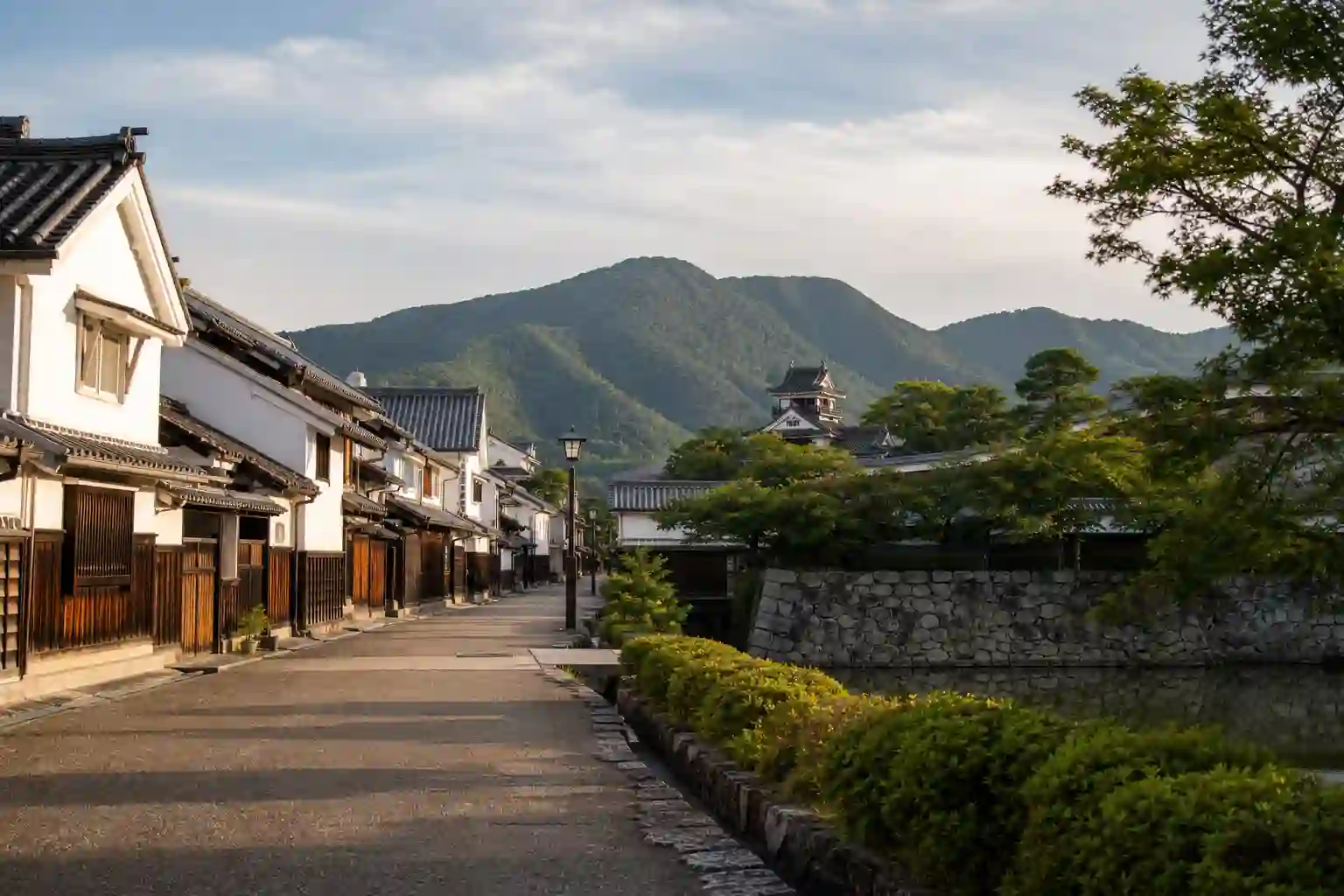
If Kyoto’s headline sights are already on your itinerary, Tamba-Sasayama is the kind of detour that changes the rhythm of a trip. The Hyogo town is close enough for a realistic day out, but its appeal is not another famous temple or a photo stop. You come for a compact castle town, old merchant houses, mountain air and pottery that is still made locally.
What makes Tamba-Sasayama different?
Tamba-Sasayama grew around Sasayama Castle and the roads that connected the region to wider Kansai. The castle itself is now a ruin and the reconstructed Oshoin palace, but the town plan and streets around it still make sense on foot. The official tourism route pairs the castle area with Kawaramachi Tsumairi Merchant Houses, where gabled entrances, latticed facades and fire walls preserve the look of an Edo-period commercial street.
That is the first honest reason to visit: the experience is coherent. You can walk from the moat to a samurai residence, stop for lunch, browse a shop in a former merchant house and still feel that you are in one town rather than ticking off unrelated attractions. It is quieter than Kyoto, but it is not a theme park pretending to be old Japan.
A practical one-day route
1. Start at Sasayama Castle
Begin at the castle ruins and the Oshoin. The present palace was reconstructed in 2000 after the earlier building was destroyed by fire. The surrounding grounds are open for strolling, with the moat giving you a useful sense of how the castle town was laid out. In summer, the south moat’s lotus display can be a bonus, but check the city tourism site for current notices before you go.
Nearby, the Okachimachi Samurai Residence District is a better history stop than a quick castle photograph. The Anma-family residence museum presents the practical side of a lower-ranking samurai household: rooms, furniture and everyday objects rather than only armor and heroic stories. Opening days and hours can change, so treat the official listings as your final check.
2. Walk Kawaramachi slowly
From the castle area, follow the streets toward Kawaramachi. “Tsumairi” describes houses whose main entrance is on the gabled end, a detail that gives the district a distinctive rhythm. Look for the evenly spaced wooden lattice, wing walls and udatsu fire barriers. They are easy to miss if you rush, and they explain why this district is protected as an Important Preservation District for Groups of Traditional Buildings.
Some old buildings now hold cafes, restaurants, small hotels and shops. That mix is useful: you can take a break without leaving the historic area, but you should still remember that these are working buildings and homes, not an open-air film set. Keep voices down, stay off private thresholds and ask before photographing interiors.
3. Add Tamba ware only if you have the time
The pottery route is the part many short itineraries skip, and it is the reason I would consider staying overnight if crafts interest you. Konda-Tachikui, in the southwest of the city, is the home of Tamba-yaki, one of Japan’s Six Ancient Kilns. The official route describes roughly 60 potteries spread through the area, with galleries, climbing kilns and places where visitors can try making ceramics.
This is not a convenient final-hour add-on from the castle. The tourism association places the pottery village about 20 minutes by car from the castle town, and the studios are spread along a road rather than gathered into one station-front museum. If you do not have a car, check buses and workshop reservations in advance, or choose the castle-town route and save Tamba-yaki for a separate visit.
How to get there from Kyoto
From Kyoto, take the JR Fukuchiyama Line toward Sasayamaguchi Station. The journey is not a single city-train hop, so check the day’s connection and allow for a transfer if your itinerary requires one. At Sasayamaguchi, the official tourism site says to transfer to a Wing-Shinki bus toward the castle town; the ride to the Nikaimachi area takes about 15 minutes, followed by a short walk.
That last bus matters. Sasayamaguchi Station is not the historic center, and assuming the station is “close enough” can turn a calm day into an awkward roadside walk. If you are planning the pottery studios, a rental car or taxi becomes more practical. In other words, Tamba-Sasayama is reachable without a car, but it rewards a little planning more than Kyoto’s central districts do.
What should you eat?
Look for seasonal produce rather than one signature dish you must hunt down. Tamba-Sasayama is known for black soybeans, chestnuts, Japanese yams, tea and other agricultural products. Menus and farm-shop stock change with the season, which is part of the point. A bowl or sweet made with local black soybeans is a more useful souvenir than a generic “regional” snack with no clear connection to the place.
If you stay overnight, the town has renovated traditional houses and small inns, including properties in or near the merchant district. They can make sense for travelers who want an early pottery start, a slower dinner or a second morning in the countryside. They are not automatically the cheapest option, so compare room policies and transport before booking.
Is Tamba-Sasayama worth the detour?
Yes, if you want a day with texture rather than a longer checklist. No, if you expect every attraction to be open late, every sign to be in English or every pottery studio to welcome walk-ins. Tamba-Sasayama’s charm is precisely that it is a living regional town: buses are limited, workshops have their own schedules and quiet streets are part of the experience.
For a first visit, I would choose the castle, samurai district and Kawaramachi on foot, then add one carefully researched food or craft stop. That is enough to understand the place without turning a rural detour into a race. If you want more ideas for building a calm Kyoto base before or after a day like this, Japanify’s Kyoto walking tours are designed around small groups and a comfortable pace.
Sources and final checks
Before departure, check the Tamba-Sasayama official suggested route for bus guidance and current route notes, the city’s official tourism homepage for closures and seasonal notices, and JNTO’s destination overview for the rail approach. The official Visit Hyogo feature is useful for background on the castle town, Tamba-yaki and local accommodation. Hours, bus times and workshop availability can change; verify them again on the day you travel.