
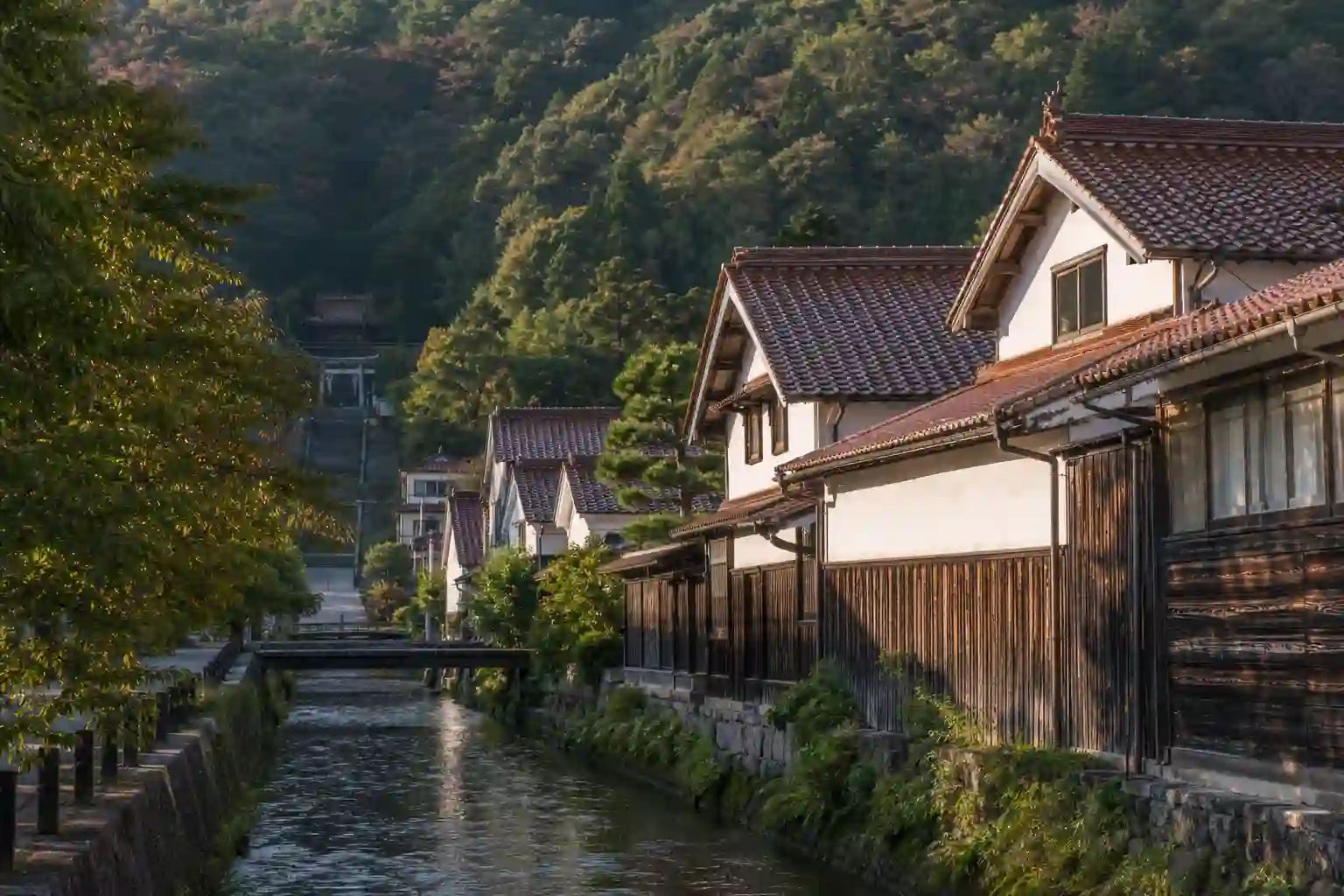
Tsuwano is often called “Little Kyoto,” which is both helpful and slightly unfair. The small castle town in western Shimane has white-walled streets, samurai-era houses, canals full of bright carp and a mountain shrine reached by a long red-torii path. It does share some visual vocabulary with Kyoto. It does not have Kyoto’s crowds, scale or pressure to move on to the next famous photograph.
That makes Tsuwano a strong choice for travellers who want history at walking pace. It is not a secret village with no visitors, and it is not an effortless day trip from Tokyo or Osaka. The reward comes from giving it a full day—or an overnight—and letting the town stay small.
What you actually come to see
The old town sits in a narrow mountain valley. Water channels run along streets lined with traditional buildings, and koi move through them beneath small bridges. The scene is attractive, but it is also practical: these canals are part of the town’s everyday landscape, not a decorative theme park built for visitors.
The former castle site rises above Tsuwano. The keep itself is gone, but the climb gives you a sense of the town’s compact geography and the surrounding mountains. In autumn, the lookout is known for cloud-filled valley views, but the walk is worth doing outside that season too if the weather is clear.
Tsuwano Taisha, also known as Taikodani Inari Shrine, is the most immediately recognisable stop. Its red torii climb through the wooded slope above town. You do not need to rush through every gate. Go early or late in the day, walk quietly and leave time to look back down over the rooftops.
The official Japan National Tourism Organization guide highlights the castle town, the shrine, yabusame horseback archery and the nearby SL Yamaguchi steam locomotive. It is a useful overview, but the best part of Tsuwano is how close those elements feel once you are on foot.
Why it feels different from a Kyoto detour
Kyoto’s historic districts are urban. Even the quiet lanes are surrounded by shops, buses, residences and a constant flow of people. Tsuwano’s history is embedded in a much smaller town, so the transitions are slower: a house becomes a museum, a canal becomes a footpath, and a hill becomes a viewpoint without a queue system.
That does not mean every street is empty or every building is open. It means the town rewards attention more than optimisation. You can spend an hour on a short lane because the rooflines, garden walls and water channels keep changing, not because an app told you to stop there for exactly seven minutes.
How to plan the visit
Arrive by rail, but check the day
Tsuwano and Masuda are the area’s rail and air gateways according to JNTO. The town is served by train, and the SL Yamaguchi steam locomotive is one of the region’s signature experiences when it is running. Timetables and operating days are not interchangeable, so check the current JR West information before building your itinerary around the steam train.
If you are connecting from another rural stop, Masuda can be a practical base. If you want the town after the day-trippers leave, staying in Tsuwano is the better choice. This is one of those destinations where the final train out can arrive before you feel finished.
Give yourself one full walking day
A sensible rhythm is: old streets and canals in the morning, the shrine or castle site before the heat builds, lunch in town, then a museum, café or slower second walk. The shrine climb includes steps and the castle site is elevated, so wear shoes that are comfortable on uneven surfaces.
Do not expect a late-night resort town
Tsuwano is a small regional town, not a nightlife destination. Restaurant hours can be limited, especially outside peak travel periods. Book accommodation ahead if you are staying overnight, ask about dinner arrangements and carry a little cash for small businesses.
What to do respectfully
People live among the scenery. Keep voices down near homes, do not lean over private fences to photograph gardens and avoid turning a narrow bridge into a photo studio. The canals and shrine paths are beautiful because they are cared for; leave them as you found them.
If you see a festival or yabusame event during your visit, treat it as a local observance first and a spectacle second. Check the organiser’s instructions about viewing areas and photography. A smaller town can feel welcoming without having the staff and barriers of a major attraction.
Who should go—and who should skip it
Go to Tsuwano if you enjoy historic streets, quiet walking, rural rail journeys and the chance to stay somewhere that is not trying to be a second Kyoto. It suits repeat visitors who want a different rhythm and first-time travellers who can spare a day beyond the Golden Route.
Skip it if your itinerary is already overloaded, if you need a dense choice of restaurants and late trains, or if you only want a quick photograph of red torii. The town’s appeal is cumulative. It becomes memorable when you stop trying to extract it in an hour.
For more Japan routes that trade checklist tourism for local texture, browse Japanify Tours’ experiences.
Bottom line: Tsuwano is a compact, atmospheric castle town in Shimane with canals, samurai-era streets, a mountain shrine and a famous steam-train connection. “Little Kyoto” is a useful introduction, but the better reason to visit is that Tsuwano has its own pace—and it is much easier to hear when you stay awhile.