
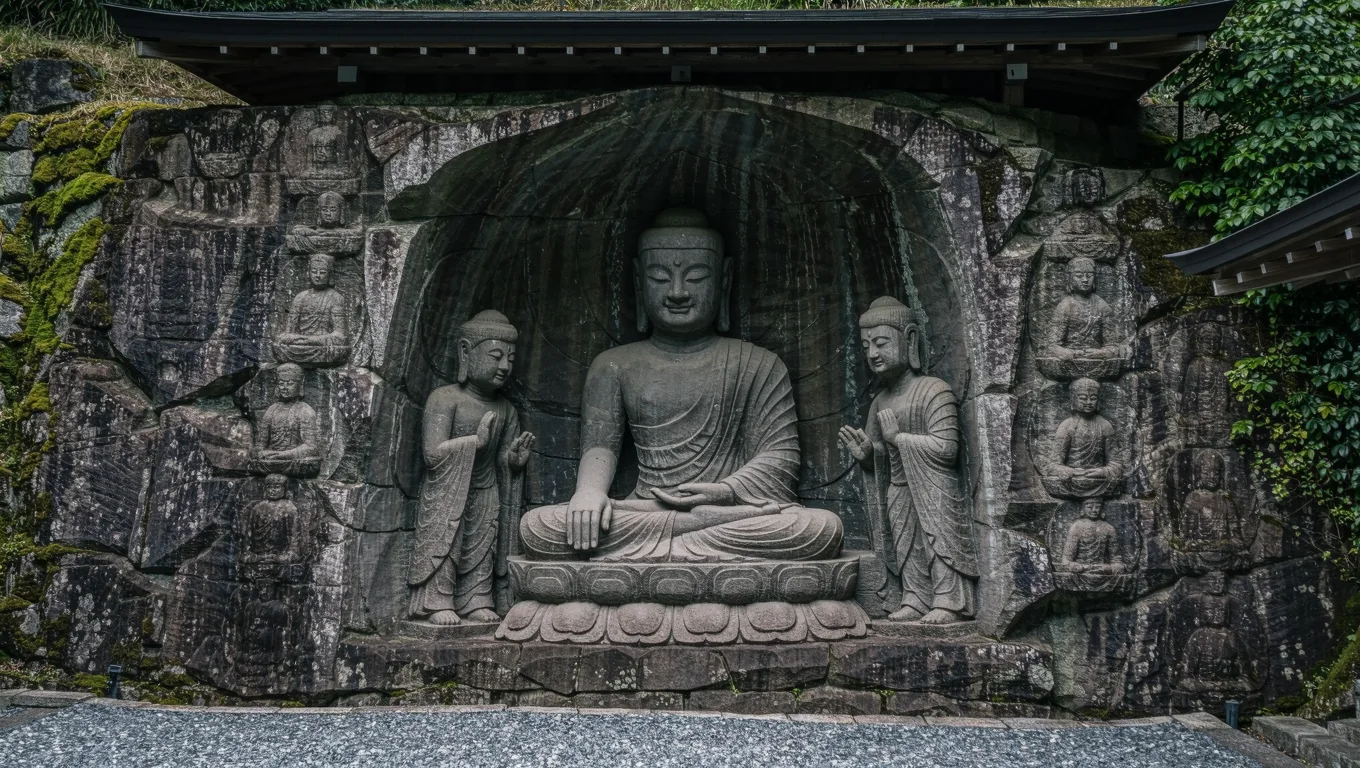
Oita does not have to mean another hot-spring stop. At Usuki, Buddhist figures have been cut directly into a rock face, and looking at them raises a better question than how quickly you can collect the next famous sight: how did people make something this detailed from the hillside itself?
The Usuki Stone Buddhas make sense as a focused outing for travellers already exploring eastern Kyushu. Give the carvings proper attention, work out your return transport before arriving, and leave room for Usuki's old streets if the day allows. There is no need to turn it into a race around the prefecture.
What you are actually looking at
The term magaibutsu means Buddhist figures carved directly into a rock face. These are part of the rock rather than statues transported into a temple hall. The site's official English introduction places their creation between the Heian and Kamakura periods and explains that the rock derives from volcanic material associated with Mount Aso.
The precise story behind their creation remains uncertain. The official account says that who carved them, and why, is unknown. That gap deserves to stay a gap. A confident origin story can make a tidy caption, but it would give visitors certainty the surviving evidence does not supply.
That uncertainty also changes how to visit. You can appreciate carving, scale and expression without pretending to decode every original intention. Start with what is visible, then use the interpretation to add context.
Four groups, not one quick photograph
The carvings are arranged in four groups: Hoki First, Hoki Second, Sannosan and Furuzono. The official Japanese description of the groups gives the detail behind the National Treasure label: 59 figures received the designation in 1995, and two guardian figures were added in 2017, bringing the total to 61.
Furuzono's central Dainichi Nyorai is the best-known face of the site. There is a conservation story behind that face, too: its head was returned to position in August 1993 during restoration. Older images can therefore show something different from the restored arrangement. Check the date before treating an old photograph as a guide to what you should expect now.
Our suggestion is to resist making the central figure your entire visit. Compare the groups: the arrangement of figures, the treatment of faces and robes, and the relationship between the carving and the surrounding stone. Those are useful things to look for even if Buddhist iconography is new to you.
Use the free audio guide
You do not need to arrive with a specialist vocabulary. The site's official guide information confirms that visitors can use a free smartphone audio guide in English, Japanese, French, Korean, and simplified and traditional Chinese. Access is through QR codes at the groups, and an internet connection is required.
Bring headphones and make sure your phone has charge and mobile data. This is an easy detail to miss when planning a day around train connections. We would set aside roughly an hour for looking and listening, then add breathing room rather than treating that estimate as an official circuit time. Visitors with mobility requirements should ask the site about the route before travelling; do not assume every viewpoint is step-free.
The transport detail that decides the day
Usuki Station and the stone Buddhas are separate stops in your plan. Reaching the railway station does not mean you have reached the carvings.
The official access page lists the local bus journey from Usuki Station at about 20 minutes and ¥200 one way. It identifies buses towards Oita Kencho-mae or Mie, with visitors getting off at Usuki Sekibutsu. Crucially, the page links to timetables and tells passengers to check the day of operation.
Use those links for your actual date, including the journey back. The quoted journey time tells you how long the ride takes; it does not tell you when the next bus comes. Avoid building your day around an assumed turn-up-and-go service. A taxi is another option, but confirm availability and the current fare locally rather than budgeting from an old online estimate.
For drivers, the site lists free parking and an approximately five-minute drive from Usuki Interchange. Driving can simplify this particular transfer, although it still leaves you with a walking visit once you arrive.
A workable plan, without an overstuffed itinerary
Current official opening hours are 9 a.m. to 5 p.m., with last admission at 4:30 p.m., year-round. Standard admission is ¥550 for adults of high-school age and older, and ¥270 for elementary- and middle-school children. These details were checked on 11 November 2026; check the official pages again near your visit.
Choose your outward and return connections first. Then give the stone Buddhas a generous slot between them. Arriving just before last admission leaves little room for the kind of looking this trip is supposed to encourage. If the available connections make everything tight, shorten the rest of the day rather than rushing the main reason you came.
Add the old town if you have time
Back in central Usuki, Nioza offers a different way to look at the same volcanic material. The Usuki Tourism Association's visitor guide describes roads cut through tuff in the historic district, with temples and former samurai-family houses around them. The cut-through near the former Shinko-ji Temple is one of its highlighted sights.
That makes a coherent second chapter: rock used for sculpture outside the centre, then rock shaping streets in town. Keep it optional. Lunch, a street walk and a comfortable train connection are a better finish than adding another attraction simply because it fits on a map.
Choose Usuki if you enjoy sculpture, material detail and a day with one clear focus. If your Kyushu route is already full and you would be squeezing in a long detour for a single photograph, leave it for another trip. The appeal here is having time to look.
Featured image: an AI-generated editorial illustration inspired by Japanese cliff-carved Buddhist figures, not a documentary photograph or an exact reconstruction of the Usuki sculptures.