
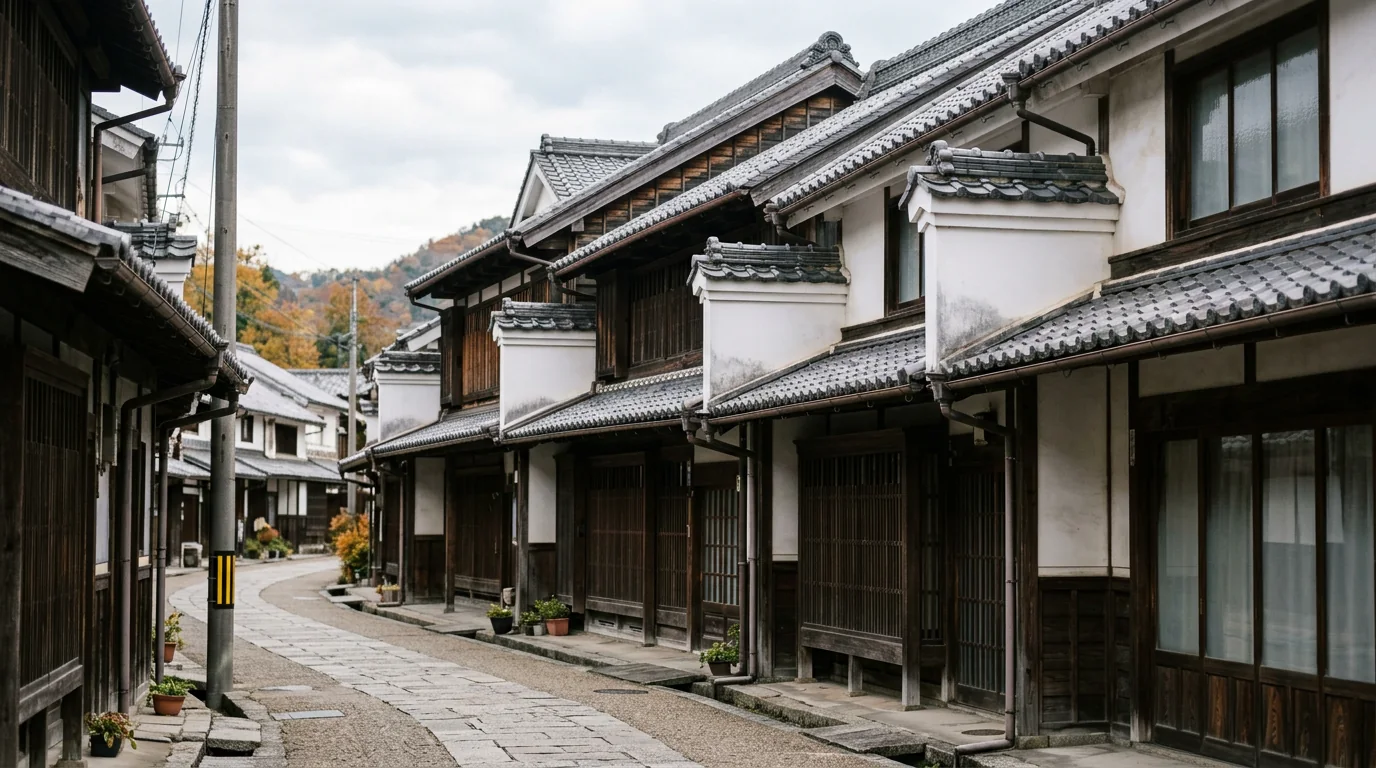
Wakimachi, in Mima City in western Tokushima, is a Shikoku detour for travellers who like a place more once they understand how it made its money. Its old merchant street is known for udatsu: raised, tiled walls at the edges of buildings. They helped limit the spread of fire, but they also became an expensive way to announce that a household was doing rather well.
That combination makes the town interesting. The roofline is not just decoration. It gives you something specific to look for, and the indigo trade explains why people here could afford it. This is a better reason to visit than another vague promise of “the real Japan.”
What are you looking at when you spot an udatsu?
Tokushima Prefecture's townscape account describes projecting upper-storey walls made with earth and topped with roof tiles. Their practical role was to separate buildings and impede fire spreading between them. The more elaborate versions also advertised family standing.
The same source connects Wakimachi's prosperity to indigo and silk-cocoon trading, supported by shipping on the Yoshino River. So, when you look up, you are seeing both a response to a physical danger and evidence of commercial ambition. Fire protection and showing off were not mutually exclusive.
Start by noticing the edge of one house, rather than trying to photograph the whole street immediately. Follow the plaster up to its tiled cap, then compare it with the next building. Look at the latticework below it, too. Giving yourself a small visual task makes a short street much more absorbing than simply walking to its far end.
Go inside the indigo merchant's house
The Yoshida Family Residence is the obvious place to turn that roofline into a fuller story. According to the city's visitor information, Yoshida Naobei established his indigo business in 1792. The property includes five buildings around a courtyard, including the main house and storehouses. It is open to visitors as a city-designated cultural property.
A merchant residence offers a useful change of perspective after the street. Outside, wealth is something displayed to passers-by. Inside, you can consider the space needed to live, store goods and run a business. Do not assume the date the business began is the construction date of every part of the property; the city's account describes buildings from different stages of the Edo period.
The city currently lists standard adult admission at ¥510, with opening hours of 9am–5pm and final admission at 4:30pm. Check for special-event arrangements before relying on the ordinary price.
A closure detail worth checking before you travel
The published information is not fully consistent. The city's facility regulation lists Wednesday closures, shifting after a Wednesday public holiday, plus December 27–January 1. The tourism page mentions the year-end closure but omits Wednesdays. It would be misleading to turn that omission into a promise of daily opening.
If the interior is central to your visit, confirm your intended date directly with the residence on 0883-53-0960, especially for a Wednesday. The street and the house are different parts of the plan; being able to walk along one does not establish that you can enter the other.
The theatre adds a different chapter
Wakimachi is not a single-period stage set. The wooden Odeonza theatre dates to 1934. Tokushima's official tourism listing explains that it later served as a cinema and that restoration was completed in 1999, including the revolving stage and the space underneath it.
It is a worthwhile possibility if you are curious about how a town entertained itself after the merchant district's earlier heyday. The contrast matters: a commercial household and a performance space tell different stories about the people using this area.
The published ordinary sightseeing admission is ¥200 for adults. That is not a ticket to whatever performance happens to be scheduled. The building is also used for events, so check whether sightseeing is possible on your date rather than assuming the theatre functions only as a museum. Keep this stop flexible if you have a tight return connection.
Can you reach Wakimachi without a car?
Yes, but allow for the last leg. The Japan National Tourism Organization's access guidance routes visitors through Anabuki Station on the JR Tokushima Line, followed by roughly ten minutes by car. For a rail-based visit, plan that transfer as a taxi journey and arrange how you will get back.
Do not let a convenient-looking railway map disguise the difference between reaching the station and reaching the townscape. Check your actual train departures, and ask about the return taxi before setting off to explore. We would not build a timed itinerary around a taxi appearing immediately when you want one.
JNTO describes the historic row as about 430 metres long. That makes the core compact, but it does not make the whole excursion a 430-metre stroll: your station transfer, interiors and any food stop sit outside that number.
Who will enjoy this detour?
Wakimachi suits someone who wants to read a town through its buildings: why one wall projects, where the goods went, and how prosperity changed the street. It is less convincing as a long journey made solely to reproduce one attractive photograph.
For a practical visit, make the residence your planned indoor stop after confirming its opening date, give the street time before or afterwards, and treat the theatre as a separate possibility. Leave room in the schedule for looking, not just moving. There is no need to claim the place is deserted or undiscovered for it to deserve your attention.
Visitor information checked October 28, 2026. Confirm opening dates and event arrangements before travelling. The featured image is an AI-generated illustration inspired by Wakimachi's merchant architecture, not a photograph of a specific house or street.