
The myth: you must remove your shoes everywhere
Japan has a famous shoes-off culture, so first-time visitors often arrive with one anxious question: Do I need to take my shoes off every time I enter a building? Online advice can make it sound as if you should be ready to untie your laces at the door of every café, shop, and train station.
That is not the reality. Shoes come off in places where the boundary between outdoor and indoor space matters—homes, many traditional inns, some restaurants, certain temples and museums, and facilities with tatami or carefully maintained floors. In a normal Western-style hotel lobby, department store, convenience store, or modern restaurant, you generally keep them on. The trick is not memorising a nationwide list. It is learning to read the entrance.
The real rule is the threshold, not the country
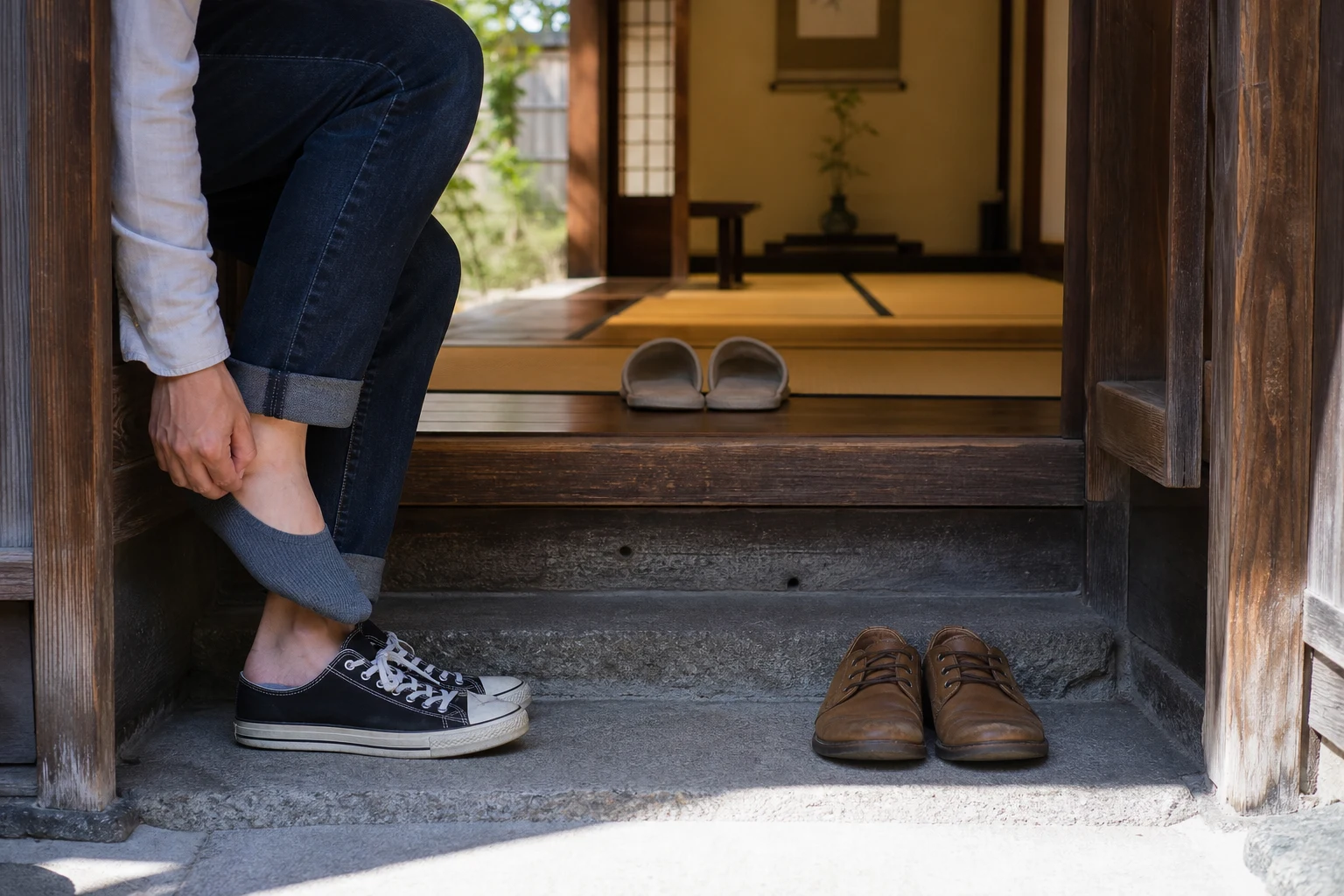
Japanese homes often have a genkan: a lower entrance area where outdoor shoes stop before you step up into the living space. Traditional buildings extend that idea to tatami rooms, ryokan corridors, tea rooms, hot-spring facilities, and some dining rooms. The purpose is practical as much as symbolic. Outdoor shoes carry grit and moisture; tatami is a woven surface used for sitting, relaxing, and sometimes sleeping.
The Japan National Tourism Organization describes the expectation clearly: at attractions, restaurants, and traditional hotels, visitors may be asked to remove shoes, and shoe racks or slippers are usually provided. The word “may” is doing important work. There is no single rule covering every restaurant or every temple. The building, room, floor, and operator’s instructions decide.
How to tell before you make an awkward mistake
Look for a raised floor
A step up from the entrance is a strong clue that outdoor footwear stops below it. Pause before the step and look for a shoe rack, lockers, a row of shoes, or a basket of slippers. If everyone ahead of you is removing footwear, follow their lead. You do not need to wait for a dramatic announcement in English.
Read the visual signals
Signs may say “please remove your shoes,” but the signal can be as simple as a line of slippers or a staff member pointing toward a shoe cabinet. At a temple or castle, the shoe-removal point may be inside the building rather than at the outer gate. Keep your shoes together and remember where you placed them; large entrances can become surprisingly busy at popular sites.
Copy the slipper logic
Indoor slippers are for indoor floors, not for every surface in the building. If you see a separate pair of toilet slippers, switch into them only inside the toilet and switch back when you leave. Do not wear slippers onto tatami unless the venue specifically provides tatami-safe slippers; the usual expectation is bare socks or feet. This sounds fussy until you realise that the floor itself is part of the room’s furniture.
Where you will probably remove shoes
- Private homes: Remove outdoor shoes in the genkan before stepping onto the raised interior floor.
- Ryokan and traditional lodgings: Shoes normally stop at the entrance. Staff will explain where hotel slippers, yukata, and tatami rules apply.
- Tatami rooms: Remove shoes and usually slippers before stepping onto the woven mats.
- Some temples, castles, gardens, and museums: Interior rooms may require footwear to be removed to protect historic floors and tatami.
- Some restaurants and cafés: Traditional or floor-seating venues may have a shoes-off entrance, while their modern neighbours do not.
- Onsen and bath facilities: Shoes or outdoor slippers are left at the entrance; follow the facility’s locker and changing-room instructions.
Where you normally keep your shoes on
Do not start removing your shoes in a department store, supermarket, station, ordinary shopping street, or Western-style hotel just because you are in Japan. Most modern restaurants with chairs and a standard tiled or wooden floor expect shoes to stay on. A café with a raised tatami corner may ask you to remove them only for that section. Again, the entrance and the floor tell you more than the country label.
The small details that make the habit easier
Wear socks you are happy to be seen in
Open sandals are not a disaster, but socks make shoes-off transitions easier and more comfortable. They also protect your feet on cool floors and make tatami etiquette straightforward. If you know you will visit a ryokan, temple interior, or tea room, choose footwear that comes off without a wrestling match.
Turn shoes neatly
Place outdoor shoes to the side, with the toes facing toward the entrance, or use the shoe locker provided. This keeps the threshold clear and makes leaving easier. Do not place street shoes on the raised indoor floor while you search for your slippers.
Ask instead of guessing
A friendly “kutsu o nugimasu ka?”—“Should I take off my shoes?”—is useful, but a simple gesture works too. Staff are used to visitors who are learning. The Japan National Tourism Organization’s advice is refreshingly practical: if you are unsure, ask. Japanese etiquette is not a test designed to catch tourists out.
Why the online version feels stricter than real life
Travel content often compresses a nuanced habit into a memorable command: “Japan is a no-shoes country.” That sentence is easy to share and hard to use. It makes visitors nervous in places where they should simply walk in, and it can obscure the reason shoes come off where they do—cleanliness, floor care, and the transition into a more intimate kind of space.
The better mental model is a map of zones. Outdoor shoes belong in the outdoor zone. Indoor slippers belong on ordinary indoor floors. Bare feet or socks belong on tatami. Toilet slippers belong in the toilet. Once you see those zones, the etiquette becomes ordinary rather than mysterious.
The Japanify takeaway
You do not need to remove your shoes everywhere in Japan. Remove them when the entrance, floor, sign, or staff member tells you that the space has changed. Keep them on when you are entering a normal modern public building. Watch what other people do, protect the floor, and ask when the signal is unclear.
That is the real culture tip: Japanese manners are often local and physical. They are built into steps, racks, slippers, mats, and the way a room is used—not enforced as one giant national checklist. Pack shoes that are easy to remove, bring clean socks, and you will be ready for the places where the rule actually matters.
For a slower walk through Kyoto’s historic streets and the living neighbourhoods behind the postcard views, see Japanify Tours’ small-group walks.