
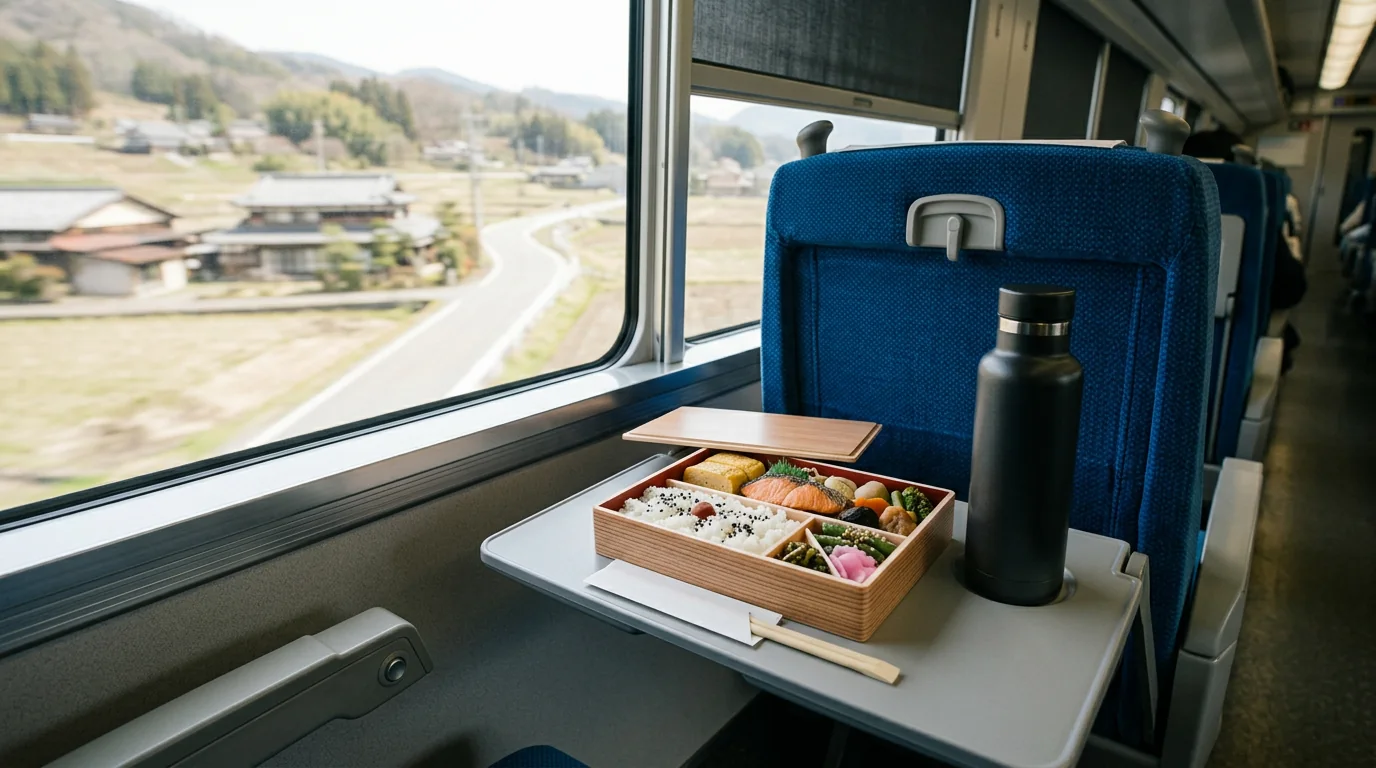
You bought lunch at the station. Now you're looking at the train and wondering whether opening it will make you the tourist everyone wishes had stayed home. The internet has an answer, of course: never eat on Japanese trains. Except it also tells you to buy a station bento for your bullet-train journey.
Both pieces of advice need a train attached to them. A meal on the Shinkansen and a meal on a crowded subway are not the same situation. Treating them as one national rule creates unnecessary anxiety and, sometimes, genuinely inconsiderate behavior.
Can you eat on trains in Japan?
Yes on the Shinkansen; on commuter trains, saving your meal for later is usually the considerate choice. The important distinction is between an operator's restrictions and travel etiquette. Check the particular service, the space around you and any posted instructions rather than assuming every train follows one rule.
Tokyo Metro's actual answer is more useful than a blanket ban
This is worth checking at the source. In its Japanese FAQ about eating and drinking onboard, Tokyo Metro says it does not restrict food and drink, while asking passengers not to inconvenience others. The answer was last updated on September 25, 2025 and was checked for this article on October 5, 2026.
That does not turn a subway carriage into a dining room. It does mean that “Tokyo Metro bans all eating” is the wrong explanation. The operator gives a consideration-based answer, not the universal prohibition that gets repeated online.
Also, Tokyo Metro speaks for Tokyo Metro. Its answer is not permission from every railway company in Japan. Local instructions still matter.
A Shinkansen bento is not an etiquette mistake
For the Tokaido Shinkansen between Tokyo, Kyoto and Shin-Osaka, JR Central's official guide explicitly welcomes eating and drinking at your seat. It suggests coffee or a station bento and asks passengers to consider their neighbors. No need to hide a rice ball as though it were contraband.
There is one practical catch: the same guide says food and drink sales are unavailable in Standard Class on that service. Buy what you need before boarding; don't build lunch around an old video showing a trolley coming down the aisle. Other routes and travel classes have their own arrangements.
The lunch itself needn't become a production. Settle into your seat, use the tray, keep your belongings within your space and pack up before your stop. A manageable box is a better travel companion than a complicated meal that needs balancing on three surfaces.
Why the commuter-train advice is different
The Japan National Tourism Organization's mindful-travel guide draws the distinction clearly: eating on the Shinkansen is acceptable, while eating on commuter trains is considered poor manners. It points to a seat with a tray table as a useful signal.
Think about the space rather than trying to memorize a list of forbidden foods. If someone is standing inches from your elbow, opening a meal gives them the smell, the packaging and the risk of a spill without any choice in the matter. That is a good reason to wait even where an operator has no blanket restriction.
Our practical recommendation for a packed subway or local commuter carriage is simple: keep lunch wrapped. Plan a food stop before boarding or after getting off. This is advice for sharing a small space, not a claim that every snack triggers punishment.
What about limited-express and quieter regional trains?
Don't decide from the word “express” alone. Look at your actual carriage. A forward-facing seat with a tray gives you somewhere to put a meal; a side-facing bench surrounded by standing passengers does not.
That is a rule of thumb, not a substitute for the operator's policy. For an unfamiliar service, check its passenger guidance or ask staff. A quieter carriage may make a snack less intrusive, but quiet is not an automatic waiver of posted restrictions. Likewise, a long journey doesn't create a dining area where there isn't one.
How to enjoy an ekiben without taking over the carriage
Ekiben means a station bento. JR-West's train-use guide describes these boxed meals as food sold for enjoyment on trains, often featuring regional ingredients. That helps explain why train-eating advice that ignores the type of train falls apart so quickly.
If a meal fits your service, keep it easy:
- Choose something contained. Avoid food that needs assembling across the tray and neighboring seat.
- Think about smell and spills. A tightly packed carriage is a poor place to test how far a hot meal's aroma travels.
- Keep drinks secure. A lid or cap is useful, especially when someone needs to pass.
- Keep your packaging together. Put wrappers and containers into a bag instead of scattering them around the seat.
JR-West's etiquette guidance asks passengers to put food and drink waste into the provided train or station receptacles. If you cannot find a suitable bin, keep the waste with you. The tray and seat pocket are not places to abandon lunch.
Plan the meal around your transfer, not your hunger panic
A useful approach to a Tokyo-to-Kyoto travel day is to eat during the Shinkansen leg, then keep any leftovers packed during a local transfer. You don't need to apply the bullet-train routine to the next carriage simply because both journeys happen on rails.
If you're arriving ahead of a city walk, such as our Kyoto Ghost Tour, leave a proper gap for food and getting to the meeting point. Trying to squeeze dinner into the last local train is a planning problem you can avoid, not a cultural test you need to pass.
Quick answers before you board
Is eating on Japanese trains universally prohibited?
No. Check the operator rather than accepting a national blanket claim. Tokyo Metro's published answer has no general food-and-drink restriction, but still asks for consideration toward other passengers.
Can I eat an ekiben on the Shinkansen?
Yes: JR Central explicitly permits meals on the Tokaido Shinkansen. Buy food before boarding if you're relying on Standard Class on that route, and keep your meal within your own space.
Is a quiet local train automatically a good place for lunch?
No. Crowding is only one factor. Seating, posted instructions and the particular service matter too. When unsure, wait for a suitable food stop or ask staff.
The useful question isn't “What do Japanese people always do?” It's “What works on this train, without making the journey worse for someone else?” Start there. Your bento will survive the wait.
Featured image: an original AI-generated illustration of a Shinkansen lunch setting, not a photograph documenting a particular service.