
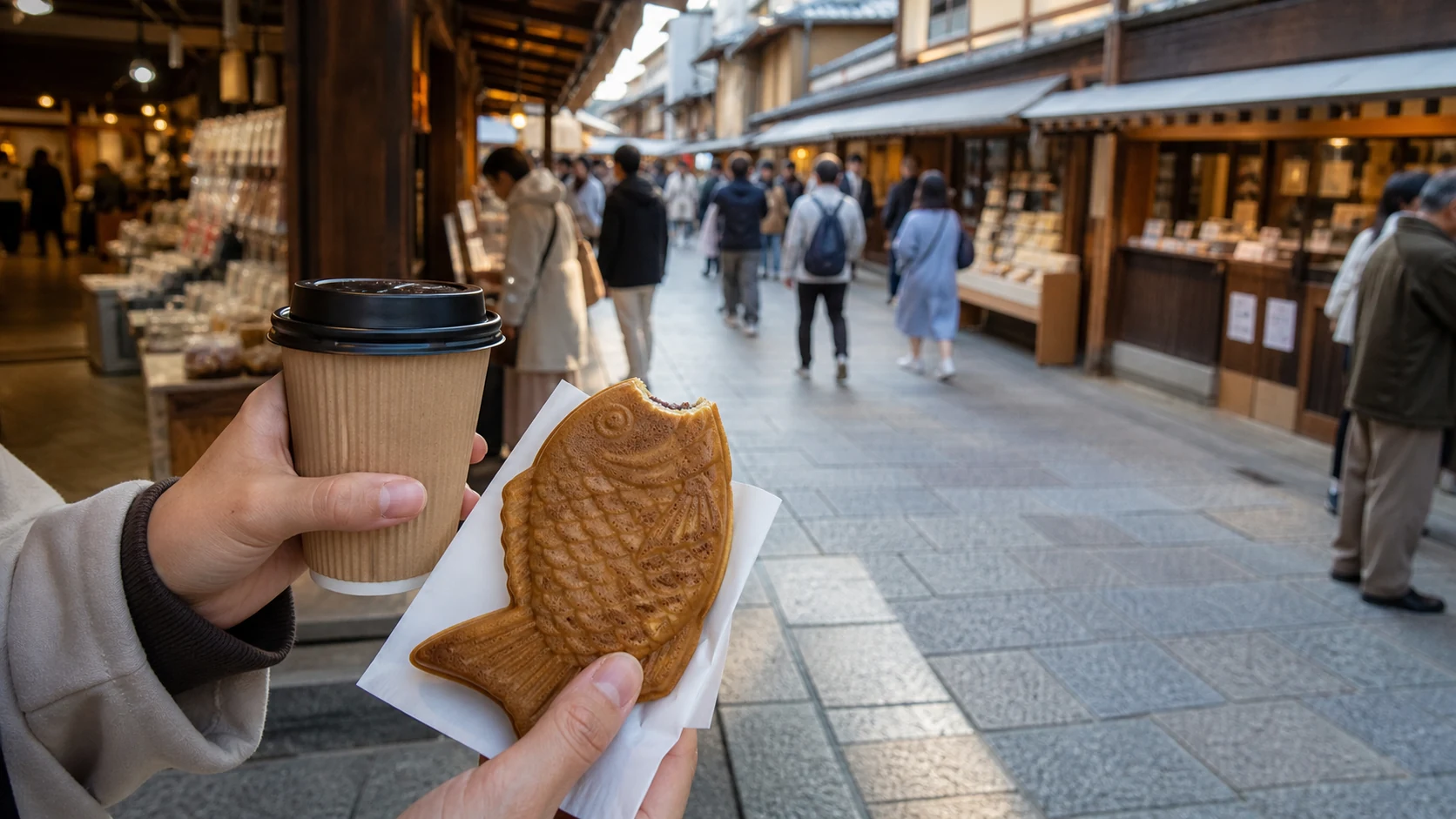
No, Japan does not have a blanket “no eating while walking” rule
One of the Internet’s favorite Japan warnings goes something like this: never eat or drink while walking. Say it often enough and it starts to sound like a law. It is not. Japan has convenience stores full of portable food, festivals built around handheld snacks, shopping streets that actively promote food-hopping, and neighborhoods where someone carrying coffee attracts precisely zero attention.
The more accurate answer is less dramatic and much more useful: eating on the move is situational. What matters is the location, the crowd, the food, and whether you are creating a problem for the people around you.
Even the Japan National Tourism Organization’s etiquette guidance describes the issue as contextual. Messy food and lidless drinks are a poor choice in dense crowds, while outdoor eating at festivals and beneath cherry blossoms is normal. The practical advice is often to step aside rather than keep moving through foot traffic.
Why the myth sounds believable
There is a real cultural preference underneath the exaggerated rule. Japanese public etiquette often revolves around avoiding meiwaku: causing trouble or inconvenience for somebody else. Eating while moving can mean crumbs, spills, greasy skewers, sudden stops, and packaging with nowhere obvious to go. On a narrow pavement or packed station platform, that is irritating in any country.
There is also a difference between “people do not commonly do this here” and “you are forbidden to do this.” Tour advice regularly collapses those two ideas into one. A behavior can be uncommon in a quiet business district without being offensive everywhere in Japan.
Japan’s official tourism FAQ uses deliberately limited language: eating while walking is discouraged in some areas. “Some areas” is doing important work in that sentence.
Places where eating as you explore is completely normal
Street-food culture is not an accidental loophole. It is a visible part of markets, festivals, temple approaches, and shopping arcades across the country. Takoyaki, taiyaki, yakitori, croquettes, dango, grilled seafood, and dozens of regional snacks are designed to be eaten without sitting through a restaurant meal.
The official JNTO guide to local street food and markets explicitly describes visitors enjoying snacks while browsing or pausing at seats near vendors. It adds one sensible qualification: individual markets may ask people not to eat and drink while walking, so follow the local rule.
Shopping streets can be even more direct. A JNTO feature on Japanese shotengai describes tabearuki—literally eating while walking—as something that is encouraged in certain arcades. Summer festivals are another obvious example. Portable food is central to the experience, although stepping away from the busiest flow is still the considerate move.
So yes, you can walk with a coffee. You can eat festival food outdoors. You can move between stalls with a snack. Nobody is dispatching an etiquette police unit because you took three steps while holding taiyaki.
Places where you should stop and pay attention
A specific market can set its own expectations. Kyoto’s Nishiki Market is the classic example. Its visitor guidance asks people not to eat while walking and instead consume purchases in front of the shop or in a designated space. That is not “the rule in Japan.” It is a rule for Nishiki Market, created for a narrow, busy commercial street where food, shoppers, and working businesses compete for very little space.
Commuter trains are different from long-distance trains. Eating a full snack on a crowded city train is generally poor form, particularly when it smells strongly or can spill. On a shinkansen or another long-distance service with forward-facing seats and tray tables, eating an ekiben is part of the journey. The train layout tells you a lot.
Crowds change the calculation. A lidded drink on a broad pavement is not the same as a dripping sauce-covered skewer in a shoulder-to-shoulder queue. If people must dodge you, if your food could touch somebody’s clothes, or if stopping would block the route, move aside.
Shop boundaries matter. Do not carry outside food into another shop or leave your rubbish with a vendor who did not sell it to you. Bins are limited, so you may need to keep the packaging until you find the correct place to dispose of it.
The rule that actually works
Forget “never eat while walking.” Use this instead:
- Look for posted instructions and follow the rule of the specific market, shrine approach, venue, or shopping street.
- Do not eat messy or strongly scented food in dense pedestrian traffic.
- Step to the side when stopping, and avoid blocking entrances or queues.
- Keep your rubbish until you find an appropriate bin.
- On transport, treat tray tables and long-distance seating as a strong signal that eating is expected; avoid meals on crowded commuter services.
- Watch what the space is designed for. A festival food lane and a rush-hour platform are not the same environment.
This is not about performing perfect Japanese behavior or anxiously copying every person nearby. It is ordinary spatial awareness. The cultural detail is that Japan often communicates expectations through the design and mood of a place rather than through one universal command.
Context beats commandments
Japan travel advice becomes ridiculous when a preference is stripped of context and presented as sacred law. “Never eat while walking” is memorable, shareable, and mostly useless. It fails the moment you enter a festival, a food-focused shopping street, or any place selling snacks specifically for immediate consumption.
The better habit is to read the room. If the place welcomes street food, enjoy it. If a sign asks you to eat beside the stall, do that. If the pavement is packed, stop somewhere safe. If you are holding something capable of redecorating a stranger’s jacket, give everyone a little space.
That kind of context is what good local guidance should provide. Japanify’s small-group walks in Kyoto and Osaka are built around explaining why a place works the way it does—not handing travelers a list of fake universal rules.