
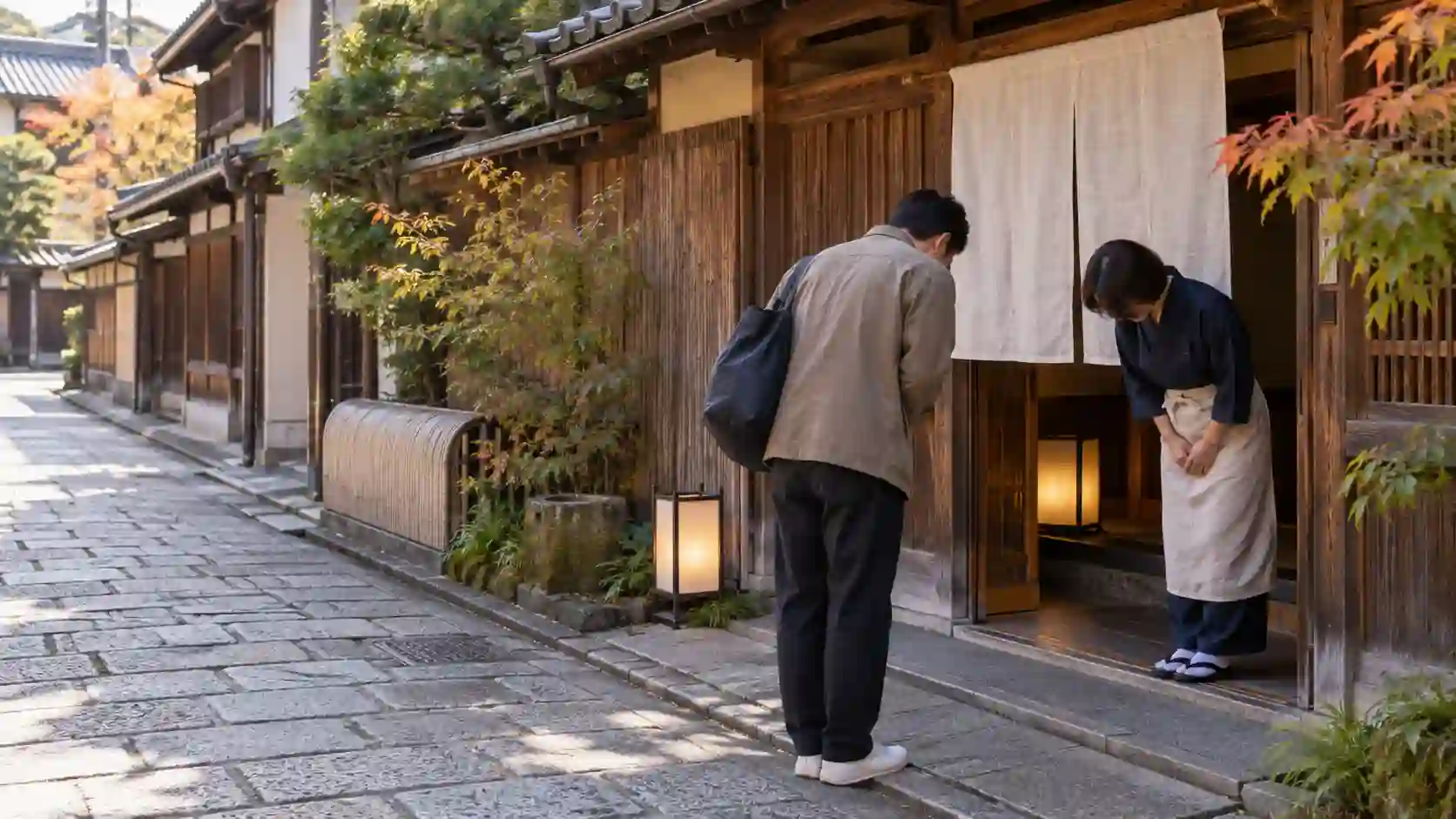
One of the quickest ways to make a first trip to Japan feel harder than it needs to be is to turn bowing into a performance exam. You have probably seen the advice: bow every time you greet someone, bow at exactly the right angle, and never use a handshake. That is not how ordinary travel interactions work.
Bowing is common in Japan, but visitors do not need to master a formal routine. A small, natural bow can be a considerate response to a greeting, thanks, or apology. A nod, a smile, and a clear “arigatou gozaimasu” can also be perfectly appropriate. The useful question is not “How deep should I bow?” but “What is happening in this interaction, and how can I avoid making it awkward for the other person?”
So, do you have to bow?
For normal sightseeing, there is no single bowing rule that applies to every shop, train, restaurant, hotel, and street encounter. The Japan National Tourism Organization’s etiquette guide says that local people do not necessarily expect foreign tourists to know every nuance. Its practical advice is to pay attention to common practices, and, if you are unsure about a greeting, a simple bow is usually the safest option.
That is very different from saying you must bow constantly. Japanese people use different greetings depending on their relationship, the setting, and the level of formality. A hotel employee may bow as part of professional service. A friend meeting you on the street may give a light nod. A customer thanking a shop worker may dip their head briefly and leave. Copying the exact movement of a formal business ceremony in each of these moments would look more theatrical than respectful.
The Japan Foundation’s Irodori learning material makes the same everyday distinction: bowing is used for greetings and thanks, but when friends meet in the street, a light nod can be enough. That is a much better model for a traveller than the idea that everyone in Japan is waiting to grade the angle of your back.
What a useful travel bow looks like
If someone bows to you, return a small bow while making eye contact before or after the movement. Keep your shoulders relaxed, let your head and upper body dip naturally, and come back up without holding the pose. You do not need to count seconds or measure degrees.
For most visitor situations, think of a brief acknowledgement rather than a formal ceremony. You might use it when:
- you arrive at a small inn, guided activity, or appointment;
- someone helps you with directions, luggage, or a reservation;
- you are apologising for a small inconvenience, such as blocking a path;
- you are leaving a shop, restaurant, or home after being welcomed.
Pairing the gesture with a few words is often clearer than bowing in silence. “Arigatou gozaimasu” works for thanks. “Sumimasen” can get someone’s attention or acknowledge a minor inconvenience. “Onegaishimasu” is useful when making a polite request. You do not need perfect pronunciation; an obvious attempt to communicate is usually more useful than a dramatic bow with no context.
Why the Internet gets bowing wrong
Online etiquette lists often flatten several different worlds into one. A business meeting, a ryokan check-in, a shrine visit, a school ceremony, and a quick convenience-store purchase do not have the same social choreography. Formal Japanese etiquette does include distinctions of posture and depth, but that does not mean a tourist should reproduce every formal distinction in a casual exchange.
Even JNTO’s own etiquette pages acknowledge variation. Its general guide describes bowing as a common way to greet, thank, apologise, and say goodbye, while its broader etiquette article tells visitors to observe what others do or ask for guidance. That combination is the important part: bowing is a useful tool, not a universal script.
There is also a difference between returning a gesture and forcing one. If a cashier says a cheerful “arigatou gozaimasu” while already serving the next customer, a smile and “thank you” may be more natural than stopping the queue to bow. If a guide welcomes your group with a formal greeting, a small bow and a greeting back are a good match. Context beats anxiety.
Shrines and temples are a separate context
Religious sites deserve more attention than an ordinary shop entrance. The Japan Tourism Agency’s multilingual shrine guidance recommends a slight bow before passing through a torii gate and explains the hand-and-mouth purification at the water basin. JNTO’s 2026 smart-travel guide gives a similar short sequence: bow at the entrance, purify your hands, and pray respectfully.
Think of that as guidance for entering a sacred space, not a requirement to bow at every architectural gate you see. Not every gate is a torii, and not every visitor follows the same level of observance. Look for signs, watch the people who are actually worshipping, and keep out of the way of anyone who is. At a temple or shrine, quiet attention matters more than trying to look like you have rehearsed a ritual.
When you leave, a brief turn toward the main area and a small bow can be a thoughtful way to acknowledge the place. If a site gives different instructions, follow those instructions. A local practice takes priority over a generic travel checklist.
Do handshakes cause a problem?
No. JNTO notes that handshakes are less common than bowing in Japan, but it does not present a handshake as an offence. In international hotels, business settings, and tours with travellers from several countries, a handshake may happen naturally. If someone offers a hand, take it; if they bow, return the bow. A brief combination of handshake and small bow can look a little clumsy, but it is not a disaster.
Physical familiarity is a more personal question. JNTO’s etiquette guide says hugs, kisses, and high-fives are less common as greetings and advises visitors to read the other person’s body language. When you are meeting someone for the first time, a smile, a verbal greeting, and a modest bow give the other person room to choose the level of contact.
The best rule: notice the situation
Japan’s tourism agencies repeatedly frame manners around consideration rather than a catalogue of punishments. JNTO describes omoiyari—consideration for others—as lowering your voice, not blocking people, and noticing how your behaviour affects the space around you. The Japan Tourism Agency’s responsible-traveller guide makes the same point: respect local people and other visitors, ask before taking photographs, and keep cultural places intact.
That is the real answer to the bowing question. Make a small bow when it helps you meet the tone of the moment. Use words as well as gestures. Do not turn a staff member’s routine service bow into an invitation to perform. At a shrine or temple, follow the site’s guidance. If you make a mistake, smile, apologise, and move on.
For more myth-versus-reality advice about everyday travel, browse the Japanify Tours Japan Reality Check archive. For the source guidance behind this article, see JNTO’s Japanese Etiquette 101, its Japanese Customs and Etiquette guide, the Traveling Mindfully guide, the Japan Foundation’s Irodori greeting lesson, and the Japan Tourism Agency’s multilingual shrine and temple guidance.