
The internet’s version is too simple
“Never tip in Japan.” It is one of those travel rules that is useful as a first warning and misleading as a final answer. Japan does not have the everyday tipping culture that visitors from the United States or Canada may be used to, and leaving extra cash at a normal restaurant, café, taxi, or hotel can create confusion. But there are also situations where a discreet gratuity is possible, especially when you have arranged a private guide or interpreter who is accustomed to international guests.
The practical answer is simple: do not add a tip automatically, check the bill, and treat exceptional gratuity as a specific gesture rather than a percentage. You are not expected to calculate 15 or 20 percent after every meal.
What normally happens at restaurants
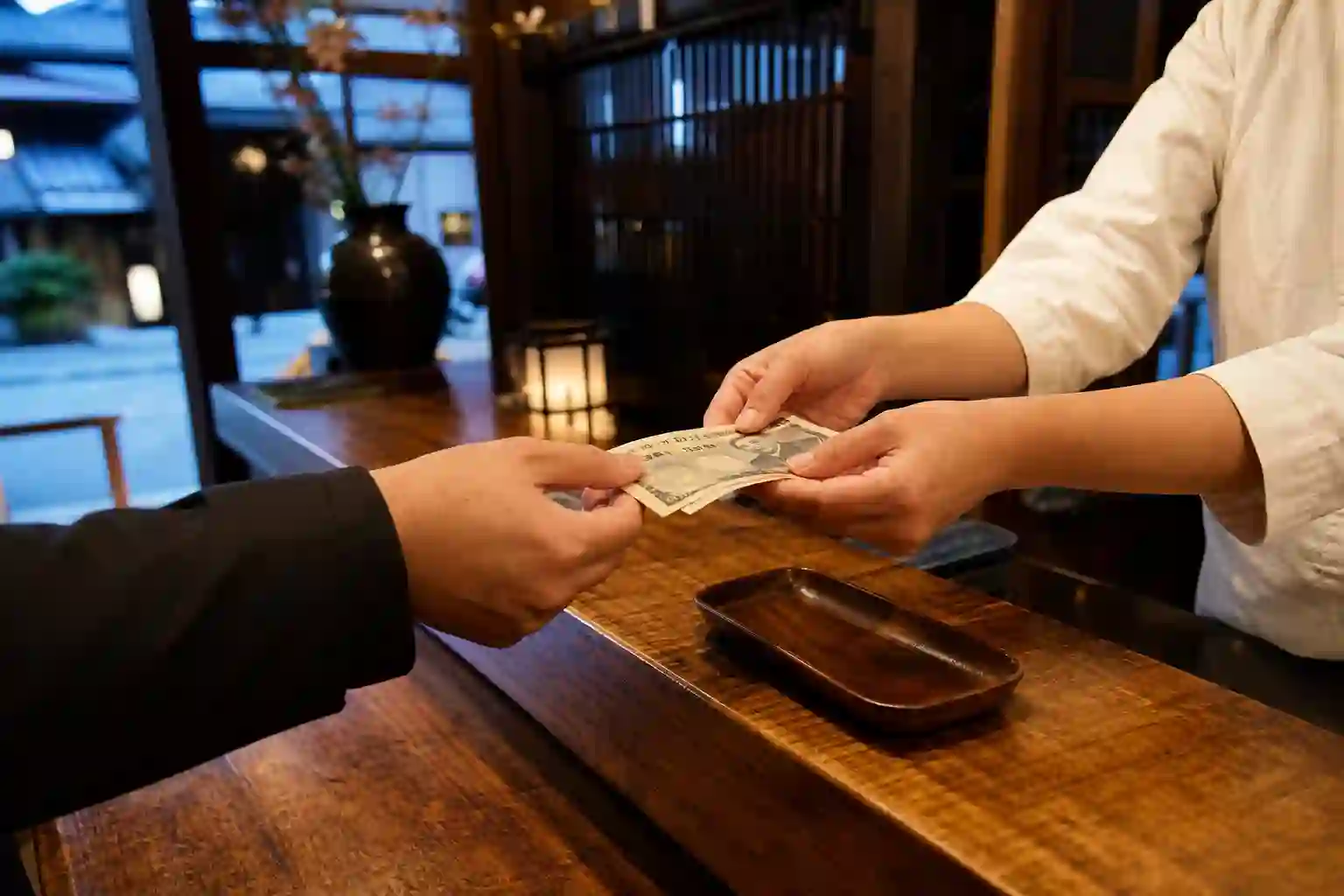
At an ordinary Japanese restaurant, you pay the amount on the bill. That might include a consumption tax, a cover charge, a seat charge, or an otoshi small dish at an izakaya, depending on the establishment. It is not a tip. If the menu or receipt includes a service charge, that is also already part of the transaction. Read the line items before assuming you have forgotten something.
The Japan National Tourism Organization says tipping is not common for services in bars, cafés, restaurants, taxis, and hotels. Its responsible-travel guidance also notes that a tip may be met with confusion. That confusion is usually practical rather than dramatic: a server may chase you down to return money because they think you left cash behind.
Good service is not waiting for a bonus at the end. It is built into the price and the relationship between the customer and the business. A small family restaurant, a ramen counter, and a formal kaiseki meal may feel very different, but none requires you to import a foreign tipping system.
What about taxis?
Do not round up a taxi fare because you feel you should. Pay the meter or agreed fare, collect your change, and close the door when the driver has finished the ride. Many Japanese taxis have automatic rear doors, so wait for the driver to operate the door rather than pulling it open yourself. That is a separate etiquette point, but it illustrates the larger rule: notice how the local system works instead of adding a familiar ritual from home.
If a driver goes far beyond what you expected because of a route problem, address the fare with the driver or company. A tip is not the fix for a disputed charge. Keep the receipt when one is provided and use the normal customer-service route.
Hotels and ryokan are not the same
At a standard Western-style hotel, you generally do not tip the front desk, housekeeping staff, or porter. A warm thank-you is enough. A traditional ryokan has a more complicated history of hospitality and personal service, but that does not mean every guest should leave cash in the room. Follow the inn’s instructions and ask staff if you are unsure.
Japan has a custom called kokorozuke, a small gratuity given from the heart in certain situations. It is not an everyday service charge and it is not a licence to hand money to anyone who was polite. In settings where a gratuity is genuinely appropriate, the money is usually placed in a small envelope and offered discreetly. Do not pull out a fistful of loose notes at the counter.
Private guides and interpreters
This is where many online explanations become contradictory. JNTO specifically notes that a private guide or interpreter accustomed to overseas practices may accept a tip as a gesture of thanks. “May accept” is the important phrase. It is not an obligation, and it is not a reason to assume that every guide wants a percentage.
If you want to thank a private guide, ask the company or guide what is customary, especially when the booking is through an international operator. A personal note, a small gift from home, or a sincere message can also be appropriate. If you do offer money, use an envelope and do it privately at the end, not as a public performance. A guide should never have to negotiate your gratitude while the rest of the group watches.
Can tipping ever be insulting?
“Insulting” is a stronger word than the situation usually deserves, but it explains why a casual tip can land badly. In a culture where the listed price is meant to cover professional service, extra money can suggest that the service worker needs to be rewarded separately or that the customer is trying to create a different relationship. More often, though, the worker simply wants to return the cash and close the transaction correctly.
Do not turn this into another exotic Japan story about mysterious rules. The point is not that Japanese people are offended by money. People give gifts, support performers, make donations, and offer gratuities in particular contexts. The point is that each context has its own form. A donation box at a shrine is not a restaurant tip. A gift to a private guide is not a compulsory service percentage.
What to do instead of tipping
- Pay promptly and correctly. Use the bill, the tray, or the payment terminal as the venue directs.
- Say thank you. “Arigatō gozaimasu” is enough. At a restaurant, “gochisōsama deshita” is a natural way to thank the staff after the meal.
- Leave a good review. Mention the staff member or guide by name if the platform allows it and you genuinely want to help.
- Return to the business. Repeat customers matter more than a one-off bill loaded with foreign expectations.
- Ask when the situation is unusual. A private guide, interpreter, ryokan host, or special cultural experience may have different conventions.
The Japanify takeaway
You do not need to budget a hidden 20 percent for Japan. At restaurants, cafés, taxis, and ordinary hotels, pay the stated price and thank the people who helped you. If a private guide or interpreter has gone out of their way and the context supports a gratuity, ask first and offer it discreetly in an envelope.
That is the human version of the rule: Japan is not anti-gratitude. It simply has other ways to show it. A clear thank-you, respectful behaviour, and a thoughtful review will usually communicate more than an unexpected banknote left on a table.
For more practical context before a Kyoto or Osaka visit, explore Japanify Tours’ small-group walks and ask your guide what is customary for the specific experience you book.