
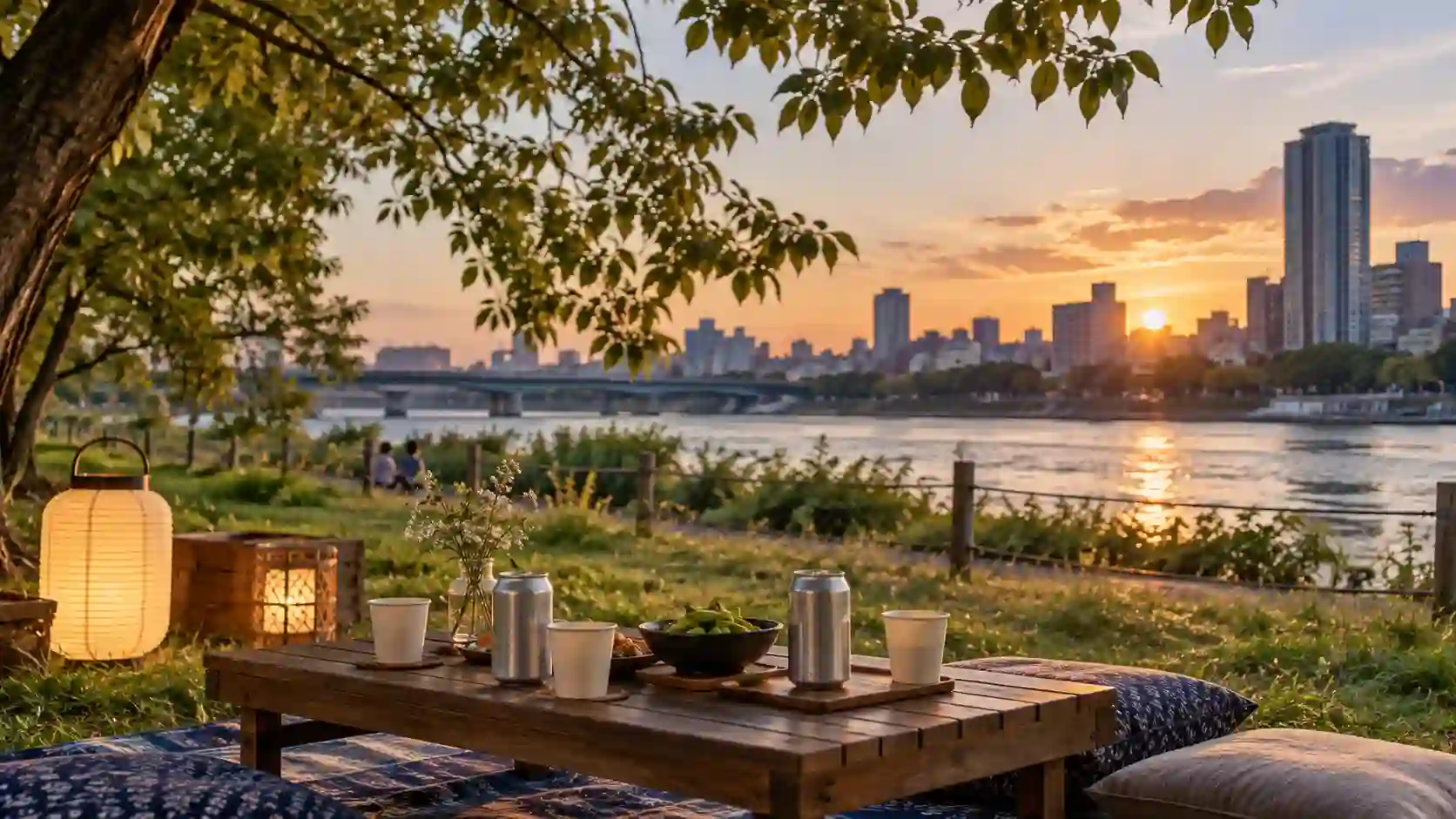
Short answer: drinking outside is not automatically illegal in Japan. The part that gets lost online is the second half: where you drink, how you behave and what a particular park, event or neighbourhood allows all matter.
That is why visitors hear two apparently opposite claims. One person says Japan has a strict ban on drinking in public. Another posts a photo of a beer under the cherry blossoms and says you can drink anywhere. Neither is a useful travel rule. Japan has a legal baseline, local restrictions and a strong expectation that you will not make your drink someone else’s problem.
So, is drinking in public illegal in Japan?
Not as a blanket national rule. The Japan National Tourism Organization (JNTO) says that drinking outside does not, by itself, violate Japanese law, and points to hanami picnics as a familiar example. Its advice comes with an important qualifier: loud, boisterous behaviour is not part of the culture, and visitors should take their litter with them. Read the guidance on Japan’s local laws for the distinction.
That does not give every street, station entrance or temple approach the same status as a picnic area. A park can post its own conditions, an event organiser can prohibit alcohol, and a town or private property owner can ask people to stop. If a sign or staff member says “no drinking,” that local rule is the one that applies.
Why the myth keeps circulating
Japan’s public spaces often feel orderly, so visitors sometimes mistake quiet social expectations for criminal law. People also see very different scenes: a relaxed group sharing canned drinks at a spring picnic, then a warning against drinking outside a convenience store. Both observations can be accurate because context is doing the work.
JNTO’s responsible-travel guidance puts it plainly: most public etiquette is about avoiding inconvenience rather than memorising a universal list of taboos. For alcohol, it recommends bars, izakaya and restaurants, and tells travellers to avoid drinking on the street or outside convenience stores. JNTO also notes that public drinking is frowned upon and may bring police attention or fines in some circumstances. That is a practical warning about behaviour and location, not a claim that one sip outdoors is always a crime. See JNTO’s Traveling Mindfully guide for the full context.
Where a drink usually fits comfortably
Designated picnics and seasonal gatherings
Hanami is the obvious example. Friends and families may bring food and alcohol to a permitted picnic area, sit down, keep their voices reasonable and clean up before leaving. Local festivals and riverside gatherings can work the same way, but do not assume every festival has identical rules. Some ban glass, set a closing time or limit where people may sit. Follow the organiser’s signs and announcements.
Bars, izakaya and restaurants
These are the easy answer when you want a drink without guessing. Order from the venue, stay within its rules and let the staff handle waste. In an izakaya, a small cover charge or an otoshi appetiser may appear on the bill; that is a normal part of many establishments rather than a surprise penalty for drinking. JNTO’s nightlife guide explains the basic rhythm, from saying kanpai to settling the bill.
Where visitors should slow down
- Convenience-store frontage: A can bought at a konbini is not an invitation to turn the entrance, smoking area or pavement into a bar. Move to a place where sitting and eating are clearly intended, or take it back to your accommodation.
- Station approaches and commuter transport: A busy platform is a poor place for an open drink. On commuter trains, eating and drinking are generally considered bad manners; the shinkansen is a different, more food-friendly setting, but you still need to keep things tidy and quiet.
- Historic lanes and residential streets: Narrow streets in Kyoto and other tourist areas carry residents, deliveries and other visitors. Standing around with cans can block a doorway, spill into traffic or make photography and work harder for everyone.
- Temples, shrines, gardens and museums: Treat the site’s own rules as decisive. Sacred grounds and cultural venues may prohibit alcohol even when the city outside does not.
- Anywhere you are becoming disruptive: Shouting, spilling drinks, leaving cans behind or bothering strangers can turn a legal drink into a police or safety issue. Intoxication is not a cultural loophole.
Five simple rules that prevent most problems
- Read the sign before opening the can. Look for park, venue and event notices, including small Japanese signs near entrances.
- Sit down in a place meant for it. A picnic mat, festival seating area or licensed venue is very different from walking through a crowd with an open beer.
- Keep your volume and footprint small. Leave room for pedestrians, do not block shop doors and keep voices down near homes, stations and shrines.
- Carry your rubbish. Japan does not guarantee a bin at the end of every path. Take cans and cups back to your hotel, a venue’s collection point or the correct recycling station.
- Know the hard line. You must be at least 20 to drink in Japan; the National Tax Agency’s English guidance confirms that the age restriction stayed at 20 even after the adult age changed to 18. Never drive, cycle or operate a rental scooter after drinking.
For a broader look at how context changes everyday etiquette, our guide to eating while walking in Japan makes the same point: an internet rule that sounds absolute usually needs a location attached to it.
The real answer
Japan is not a country where every outdoor drink is forbidden, and it is not a country where “legal” means “welcome everywhere.” A permitted picnic, a festival bench and an izakaya are all straightforward. A crowded pavement, a convenience-store entrance or a temple gate calls for more judgement.
If you are unsure, ask the venue, look for a sign or choose a bar or restaurant. That small pause is the most reliable rule of all: enjoy your drink in a way that leaves the place, and the people sharing it, just as comfortable as you found them.