
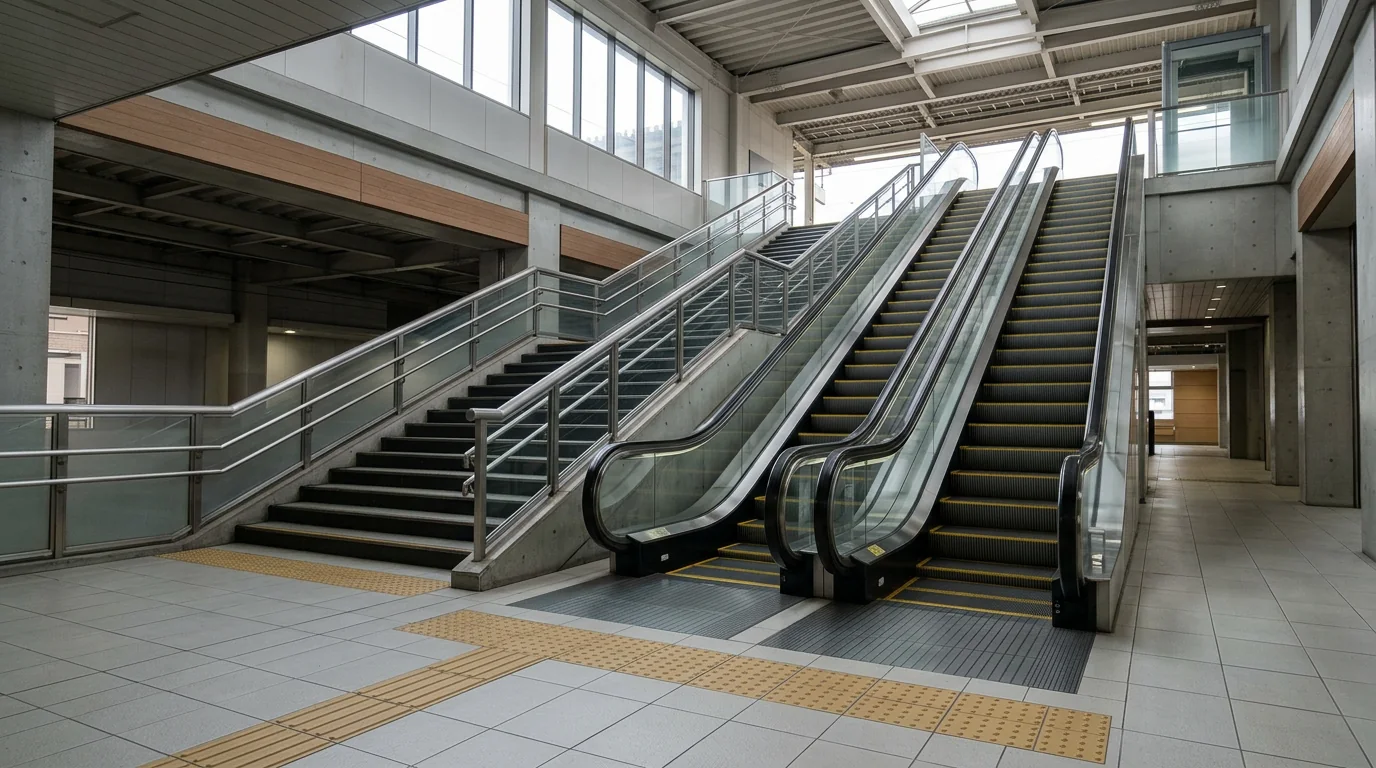
Which side should you stand on an escalator in Japan? The useful answer is: stand still, hold the handrail and follow the guidance at that station. The familiar Tokyo-left, Osaka-right habit is not an instruction to leave the other side open for walking.
That is less catchy than a two-city rule. It is also much more useful when you arrive with a suitcase, a connection to make and someone behind you who seems determined to get upstairs yesterday.
Japan travel advice often turns something people commonly do into something everyone must do. Escalators are a good example. You can observe a neat queue on one side and still be looking at behaviour the railway operator is trying to change.
The myth: Tokyo stands left, Osaka stands right, so copy the queue
There is a reason this advice keeps appearing. The regional contrast is familiar enough that Hankyu used it in a Kyoto escalator campaign: Osaka on the right, Tokyo on the left, with a different direction for the future—using both sides while standing still.
The official announcement for that 2024 campaign described a collaboration with Kyoto transport organisations. Its posters ran from February through June that year. This is not a newly announced October event; it is a particularly clear example of operators acknowledging the habit without endorsing the walking lane.
So, yes, those left-right patterns are recognisable. No, they are not a complete guide to safe or considerate escalator use. Nor should you turn them into a personality test for every person standing in front of you.
The reality: operators ask you not to walk
In July 2026, Tokyo Metro announced a joint escalator safety campaign involving railway operators and other organisations across Japan. Its request was straightforward: remain stationary and hold a handrail.
The explanation was not simply that walking looks impolite. Moving on escalators can lead to falls or collisions. The announcement also pointed out that some passengers can hold only a particular side's handrail. A custom that leaves everyone on one side can make the equipment harder for those passengers to use safely.
JR West's announcement of the same campaign gives its dates as July 21 to August 31, 2026. That summer campaign has finished. The important distinction for your trip is between the operators' stated safety advice and an informal queueing habit—not whether a particular poster is still on the wall.
This is guidance from transport operators, not a claim that one identical escalator law applies everywhere in Japan.
What should you actually do at the station?
You do not need to reorganise the crowd. You need to get on, ride and get off without making the situation worse.
- Look before boarding. Check the direction of travel, the landing ahead and any instructions displayed nearby. Finish checking your map before stepping onto moving equipment.
- Stand still and hold the handrail. Choose a position where you can ride securely. Do not assume that an empty space beside someone is an invitation to squeeze past.
- Keep your belongings under control. A bag should not be swinging into another passenger or left to move on its own. If managing your luggage and holding on feels awkward, look for an elevator.
- Keep the landing clear. After stepping off, move away from the exit before stopping to find your platform or wait for friends.
- If you need to walk, consider the stairs. Use them at a safe pace if they suit your mobility and luggage. Do not build a tight connection around overtaking people on an escalator.
These are planning habits, not a new set of supposedly mysterious Japanese rules. They work especially well when you are tired and carrying more than you intended.
Why the handrail side matters more than it looks
You cannot tell from someone's appearance which hand they can use comfortably. A passenger standing on the side you think is “wrong” may need precisely that handrail.
Hitachi Building Systems' escalator safety guidance explains both the risks of walking and the problem with insisting on a single standing side. It recommends standing within the step's markings and holding either handrail. Escalator steps are not ordinary stairs with a convenient motor underneath them.
The practical takeaway is simple: do not ask a stranger to change sides just because a travel video taught you a regional shortcut. Equally, do not make a point of obstructing someone to teach them a lesson. Ride steadily, leave other passengers space and let station staff handle problems.
With a suitcase, check the elevator route first
The easiest station route on a map is not necessarily the easiest one with bags. Before setting off, check whether the exit you want has an elevator and whether the route involves changing levels.
Tokyo Metro's accessibility information includes station equipment information and notices about elevator or escalator work. It is a better starting point than assuming every entrance has the same facilities. Use the equivalent operator information for the railway you are actually taking.
Build a little breathing room into an evening out, too. If you are heading to something like our Kyoto Ghost Tour, check the meeting point before leaving and allow time to get from the platform to the correct street. Arriving at the station is not the same as arriving at your meeting place.
Quick answers for travellers
Is standing on the right in Tokyo automatically rude?
No. Treating the left-right habit as the whole etiquette rule misses the operator guidance and the needs of passengers who require a particular handrail. Follow the instructions where you are and ride securely.
Should I walk because everyone else is walking?
Not on that basis. A common behaviour is not proof that the operator recommends it. Leave enough time for your journey that standing still does not feel like a crisis.
Does Kyoto have one universal standing side?
Do not rely on a city-wide shortcut. The Kyoto campaign above explicitly promoted stationary use on both sides. Check the station's guidance rather than trying to memorise one more exception.
The real Japan tip: watch what people do, but also read what the operator asks. Sometimes they are two different things.