
You can leave luggage overnight in some Japanese station lockers, provided the posted rules allow it and you stay within the storage limit. The mistake is treating every locker as a 24-hour rental with round-the-clock access.
There are three separate things to check: when another charge is added, how long the bag may remain, and when you can physically reach the locker. Those clocks can run differently. A suitcase can be within its permitted storage period while sitting behind a station entrance that has closed for the night.
Myth: one day's payment buys 24 hours
A daily charge can follow a fixed cutoff rather than count 24 hours from the moment you shut the door. Fukuoka Subway's official station-services guide, for example, says the date changes at midnight and continued use adds another charge equal to the starting fee. It lists a three-day usage period and access from the first train to the last.
Under that stated midnight rule, putting a bag in shortly before midnight and collecting it the following morning crosses a charging boundary despite being much less than 24 hours. That is a worked example of the published rule, not a claim about every locker in Japan.
Before paying, look for the charging cutoff as well as the headline price. The difference matters most when you arrive late, take an overnight side trip, or intend to collect your luggage early the next morning.
Myth: every operator uses the same deadline
Tokyu's standard coin-locker terms give a different daily charging reference: 2 a.m. They permit use for up to three consecutive days including the day storage begins. The inclusion of the starting day is a detail worth reading before interpreting “three days” as a full 72-hour allowance.
Those terms also explain what happens when luggage is left beyond the permitted period: the operator can move it to a designated storage location, and storage fees continue. That procedure is a consequence of overstaying, not an invitation to use a locker as a longer-term luggage service.
Fukuoka's midnight and Tokyu's 2 a.m. examples are enough to show why a rule copied from a travel forum may fail at the locker in front of you. Read the instructions for that installation, including any separate terms for a different locker product.
Myth: overnight storage means midnight access
Kyoto's official subway locker guide lists approximate availability from 5:30 a.m. to 11:30 p.m. It explicitly warns that items cannot be deposited or removed outside the available hours, that times can vary by station, and that users should confirm details on site.
That is guidance for Kyoto Subway lockers, not a promise covering every locker in the wider Kyoto Station complex. Different railway, retail and baggage-service areas need their own checks.
If you have an early departure, work backwards from the time you need the bag. A locker that becomes accessible after your intended departure is no help, even if leaving the bag there overnight is allowed. For a late evening, build the collection into your route before dinner or other plans make it awkward to return.
Myth: a price list tells you everything
Size and location affect the price, and an old screenshot may miss later changes. Tokyu's current locker information says that some lockers it operates introduced seasonal variable pricing from 1 August 2026. The applicable price is the amount shown on the touch panel at marked installations.
That does not mean all Japanese lockers use variable pricing. It means the amount displayed before payment deserves more trust than a remembered figure from someone else's trip.
Check fit before committing, too. Measure your case including wheels and handles, and compare it with the actual compartment rather than assuming a label such as “large” is standard everywhere. Have an alternative in mind if the suitable compartments are occupied; a locker-location map shows where storage exists, not necessarily an empty space waiting for you.
A staffed counter can solve a different problem
If a locker does not suit the bag or the plan, investigate a staffed service rather than hoping a storage deadline will stretch. At Kyoto Station, ASTY Kyoto's official information lists temporary luggage storage from 9 a.m. to 8 p.m. at ¥700 per piece. Its Hachijo-guchi locker information also says some lockers accept transport IC cards and links to an availability checker.
The counter's stated hours illustrate another trade-off: handing a bag to a person does not automatically provide later collection. Ask which service covers your intended return date and time. For several nights away, confirm a specifically suitable arrangement with a storage provider or your accommodation before leaving the bag; do not assume either will accept it.
The two-minute check before you close the door
Our practical recommendation is to settle these points while the bag is still beside you:
- When does the next daily charge begin, and how is the maximum storage period counted?
- What are the access hours on both your drop-off and collection dates?
- Is the locker inside or outside the ticket gates, and how will you return to it?
- Which key, IC card, receipt, code or other credential will you need to reopen it?
- Who operates it, and where is that operator's help number displayed?
Keep the required credential secure and separate from the stored luggage. Photograph the locker bank, its location and the operator details, but do not share any retrieval code publicly. If something goes wrong, follow the contact instructions on that locker rather than assume a nearby shop or station employee manages it.
The examples above were checked on 16 November 2026. They are operator-specific illustrations, not one national locker policy. For a few hours between hotel checkout and a train, a locker can be straightforward. For an overnight or multi-day plan, check all three clocks before walking away.
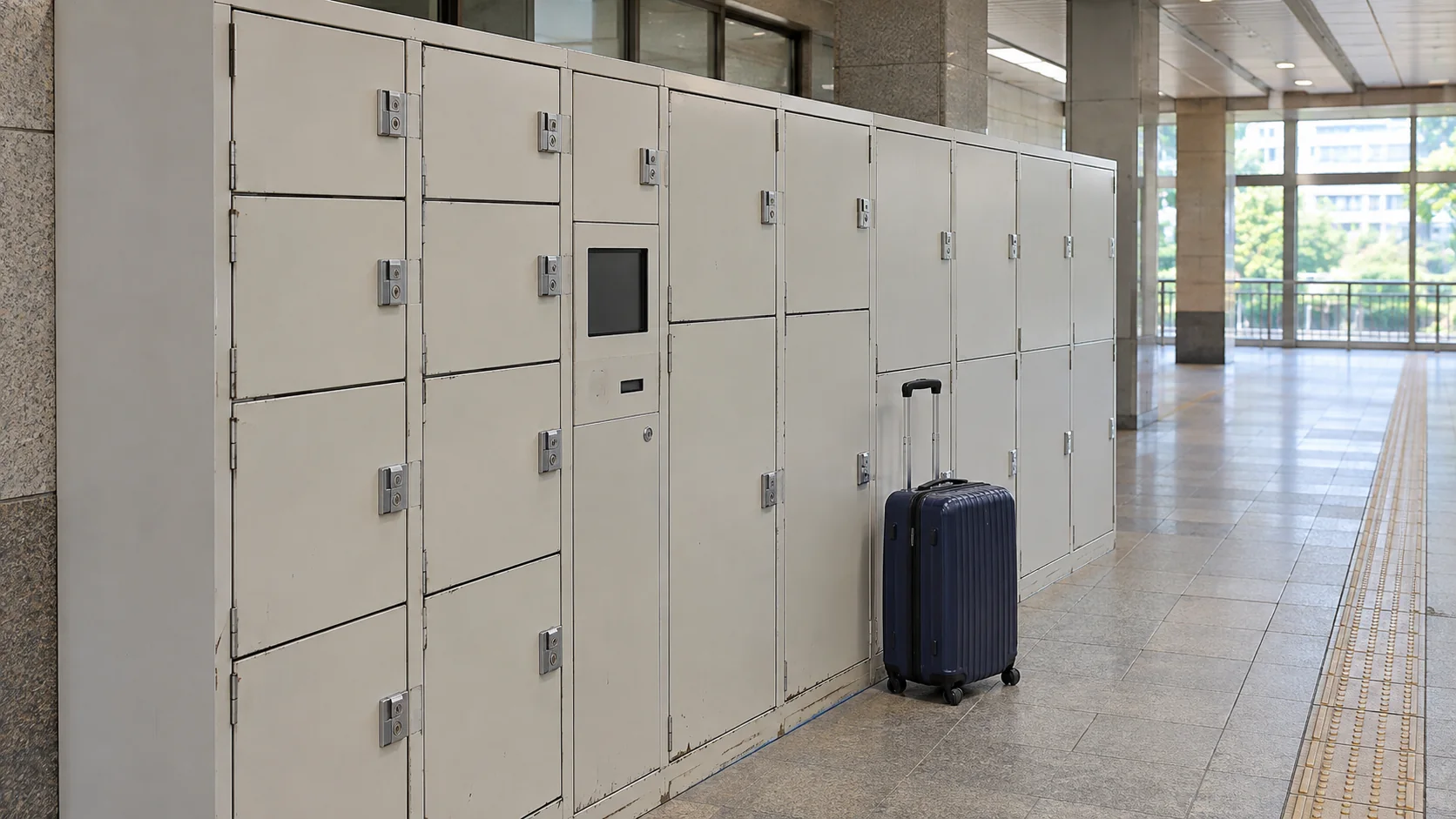
Featured image: an AI-generated illustration of a generic Japanese station locker area, not a photograph of a named station or a guide to a particular locker interface.