
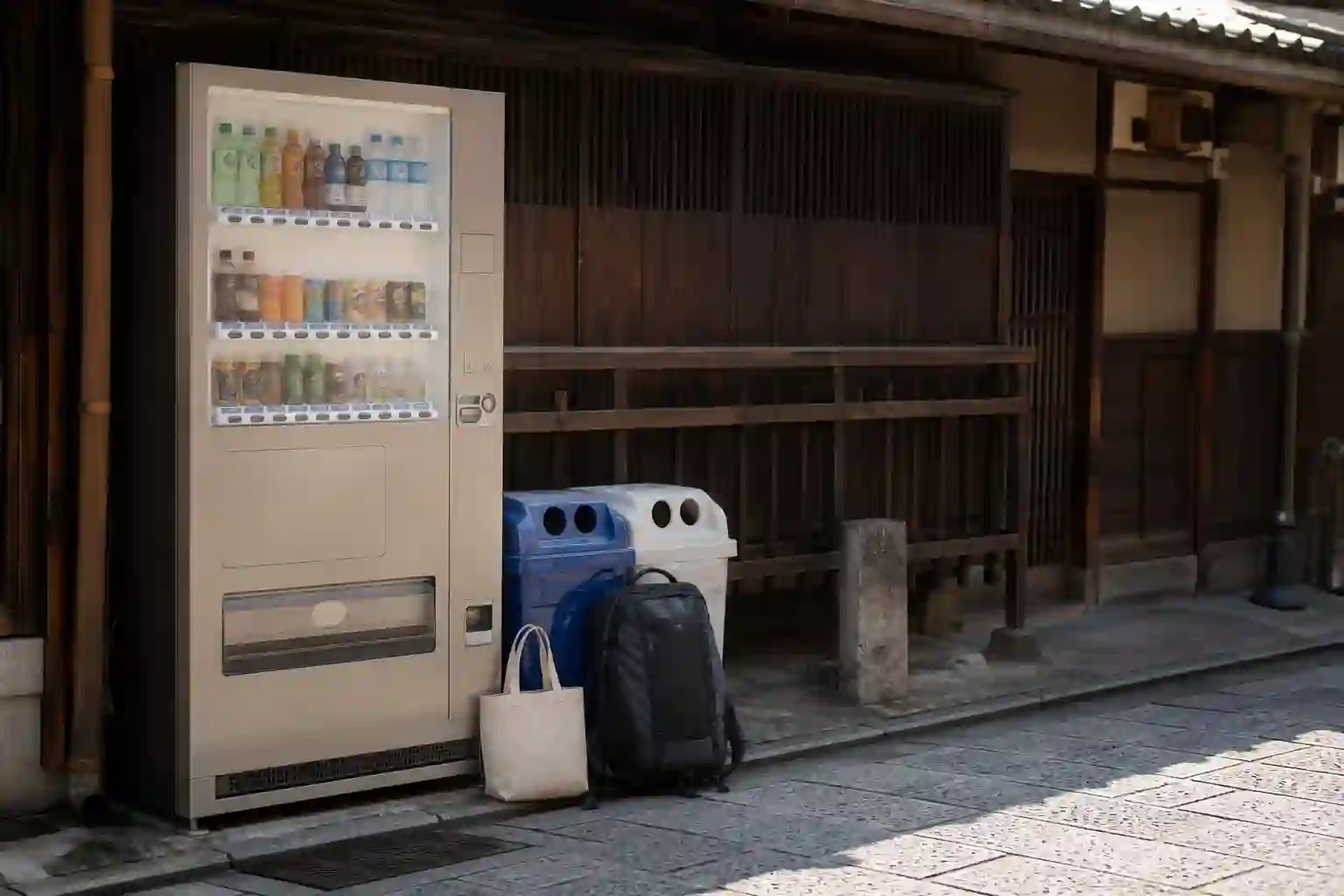
“Japan has no trash cans.” You will see this sentence everywhere before a first trip, usually followed by a warning to carry every wrapper across the country. It is an exaggeration built from a real inconvenience. Japan has public bins, but they are not placed on every corner, and the bins you do find are often connected to the place that created the waste: a station, vending machine, convenience store or shop.
The myth: Japan has no public bins
There is no national rule saying visitors must carry rubbish for an entire holiday. The Japan National Tourism Organization says travellers can usually find bins at train stations and convenience stores, while noting that carrying waste until an appropriate place is normal. The Japan Tourism Agency’s visitor guidance says the same thing in more practical language: use bins when available, separate recyclables correctly and take rubbish with you when one is not nearby.
That sounds less dramatic than “there are no bins,” but it is much more useful. You may finish a drink near a vending machine and find a bottle-and-can recycling slot right there. You may buy a snack at a convenience store and see a bin inside. You may also walk for twenty minutes with an empty package because the nearest public disposal point is at the station. All three situations are ordinary.
Why bins are less visible than visitors expect
Japan’s streets are clean without relying on a giant network of street bins. Shops, stations, offices and local governments each manage waste in different ways, and the result is a landscape where disposal points are concentrated rather than evenly distributed. Bins have also disappeared from some public places after safety incidents or because they became overloaded with waste from people who did not buy anything there.
This creates a strange first impression: spotless streets, very little street furniture and nowhere obvious to put a plastic lid. The clean street is not proof that nobody creates rubbish. It is a sign that disposal is handled through habits, business boundaries and scheduled collection rather than through a bin on every block.
Where you can usually dispose of waste
Stations and vending machines
Train stations commonly have recycling points, particularly near ticket gates, platforms or shops. Vending machines may have a dedicated return slot for empty PET bottles and cans. These are designed for the items sold nearby, not necessarily for a bag of unrelated lunch packaging. If the opening is small and clearly labelled, use it for the matching material only.
Convenience stores
Convenience stores often provide bins, but treat them as part of the store’s service rather than a free public dumping station. If you bought a drink, rice ball or snack there, disposing of its packaging is usually reasonable. Do not arrive with a full day’s rubbish from another neighbourhood and assume a tiny bin beside the counter can absorb it. If in doubt, ask staff or keep the bag.
Hotels and accommodation
Your hotel or ryokan is the safest place to finish the day’s waste. Empty bottles, wrappers and receipts can go into the room’s waste system, where they can be sorted and collected properly. Do not leave rubbish beside the room bin or in a corridor without asking; a small bag kept neatly in your daypack is enough until you return.
Sorting matters more than the myth
Japan’s bins are often divided into burnable waste, non-burnable items, cans and PET bottles. Some facilities add a separate plastic category or ask you to remove a bottle’s cap and label. The exact system varies, so read the icons rather than guessing from colour alone. A bottle with liquid still inside may be rejected, and a greasy food container may not belong in the same opening as a clean drink bottle.
The Consumer Hotline for Tourists explains that disposable containers can need separation by material, including paper cups, plastic lids and straws. You do not need to become a municipal waste expert before your holiday, but you do need to avoid treating every opening as “general rubbish.” If the labels are unclear, hold onto the item and ask at your accommodation.
What not to do with your rubbish
- Do not leave a bag beside a full bin, on a shrine wall or outside a shop.
- Do not use a toilet bin for bottles, takeaway boxes or large packaging.
- Do not hand your rubbish to a stallholder who did not sell you the food.
- Do not pour leftover drinks into a planter, drain or flower bed.
- Do not assume a convenience-store bin accepts anything simply because it is visible.
These are not mysterious Japan-only commandments. They are boundaries that stop a small waste problem becoming someone else’s work. The Japanese detail is that the boundaries are often handled quietly, without a staff member announcing them in English.
The easiest system for a day of sightseeing
Carry a small reusable bag inside your daypack. Put wrappers, receipts and empty packaging in it until you reach a station, the shop that sold you the item or your hotel. Keep wet and dry rubbish separate if you can. When you buy something from a convenience store, look for the disposal point before leaving. When you use a vending machine, check for the bottle-and-can slot nearby.
That tiny system is more reliable than searching “Japan trash can” every hour. It also keeps your bag from becoming a sticky mess. A zip pouch or washable tote is enough; you do not need special travel equipment.
The Japanify reality check
Japan does have rubbish bins. It simply does not promise that one will be waiting beside every bench, temple gate or street-food stall. The practical expectation is to manage your waste until you reach an appropriate disposal point, then sort it according to the facility’s instructions.
If you want a simple rule, use this one: take responsibility for the rubbish you create, but do not panic when the nearest bin is not immediate. Carry it neatly, follow the local signs and finish the job at a station, shop or hotel. For more everyday context while exploring Kyoto, Japanify’s small-group walking tours focus on how the city actually works beyond the postcard rules.
Sources and further reading
Read JNTO’s Japanese etiquette guide, the Japan Tourism Agency’s responsible-traveller guidance, JNTO’s rubbish and recycling tips and the Consumer Hotline for Tourists’ waste-separation explanation. Local facilities can have their own rules, so follow the signs where you are.