
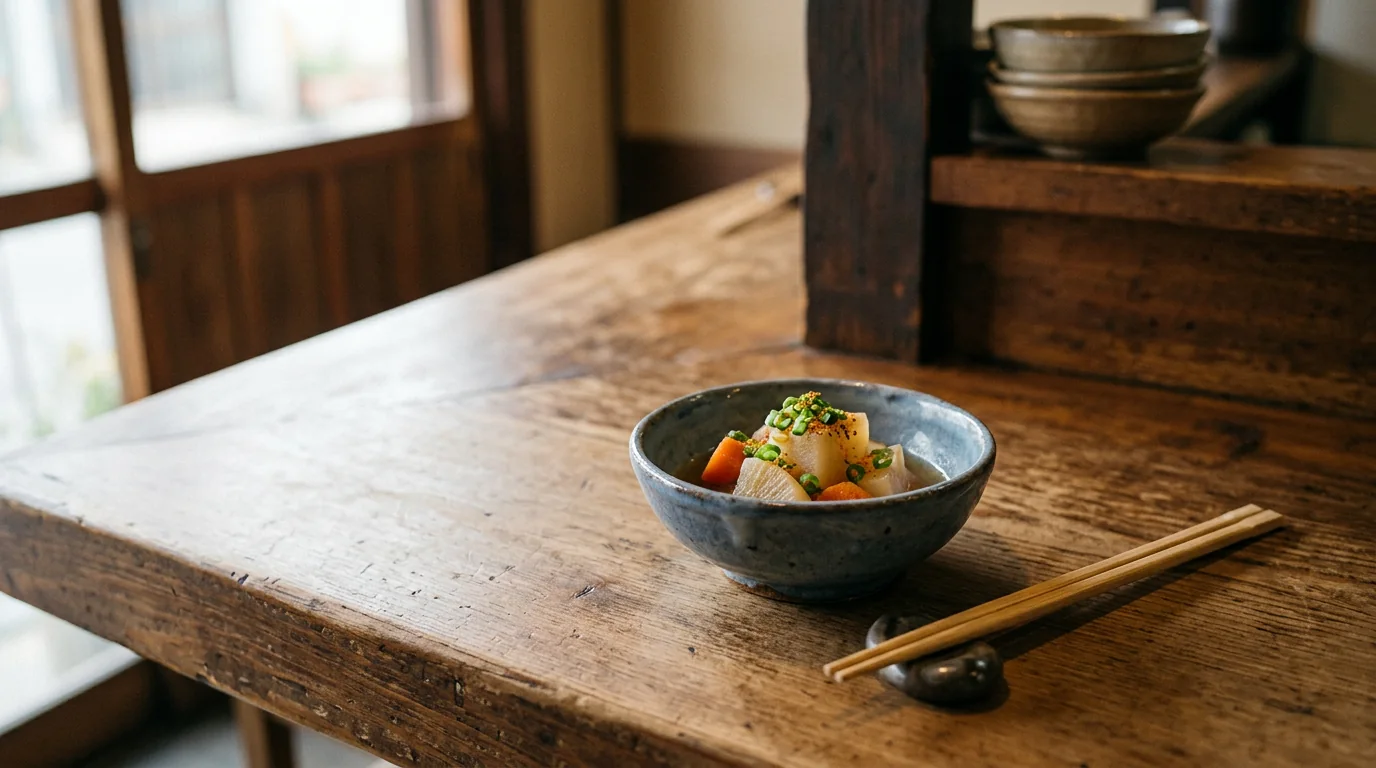
Otoshi is a small dish served automatically at some Japanese izakaya, often as part of a per-person seating charge. It is not necessarily free, and its arrival does not automatically mean you have been scammed. But the custom is not an excuse to accept any unexplained amount on a bill.
You sit down, start looking at the drinks menu and a little bowl appears. You did not choose it. Nobody asked whether you wanted it. Later, there is an extra line on the receipt.
That can feel strange if you come from somewhere that treats food brought before an order as a complimentary welcome. The useful Japan tip is not “never question the bill.” It is to find out what the establishment charges before the bill becomes a surprise.
What is the dish you did not order?
The National Consumer Affairs Center's tourist FAQ explains otoshi as an izakaya custom best understood as a table charge, with a small dish provided to each person. It also tells visitors to ask serving staff about food they did not order when it arrives.
That distinction matters. A customary starter and an accidentally delivered main course are not the same thing. If you are unsure which you have received, ask then, rather than constructing a theory about it after dinner.
GO TOKYO's izakaya guide describes the dish as part of a seating charge and notes that its contents can vary, from vegetables to fish. There is no single nationally prescribed otoshi dish that you can recognise at a glance.
A small portion is not evidence that the restaurant forgot the rest. Equally, the bowl's size does not tell you the price. Think of it as part of understanding the venue's pricing, not a miniature meal whose value you have to reverse-engineer.
Does every izakaya charge it?
No. “This is common” and “every place does this” are different statements.
For a concrete counterexample, Torikizoku states on its own website that it does not collect otoshi, seating or late-night charges. That is the operator's policy, checked for this article—not a rule for all chains or every other restaurant serving grilled chicken.
The lesson is not that a restaurant with a cover charge is bad and one without it is good. They are different pricing arrangements. Compare the total evening you are buying, and choose the one that suits you.
Nor should a good experience at one small bar become a prediction about the next place. Check again when you change venues, even if the street, neighbourhood and style of cooking look similar.
The question to ask before sitting down
You do not need a speech about Japanese culture. A clear question is enough: “Is there a cover or seating charge, and how much is it per person?” Ask to see the amount on the menu or other written information if that helps.
Then clarify anything that affects your group:
- Does the charge apply to each diner, or to the table?
- Is the small dish included in that charge?
- Are there any other charges to consider?
- What total will apply to the people actually sitting down?
Here is a purely hypothetical example, not a typical-price claim: if the stated charge is ¥500 per person and three people are seated, that is ¥1,500 before your chosen food and drinks. The arithmetic is simple; overlooking “per person” is what makes the receipt feel surprising.
If the answer does not fit your budget, thank the staff and choose somewhere else before ordering. An early, ordinary conversation is much easier than a late argument about what everybody assumed.
Can you decline the dish?
Ask the establishment. Do not rely on a universal internet answer that you can always refuse it—or that asking is somehow offensive.
There are two separate questions: whether you can skip the food, and whether the seating charge still applies. If the fee is tied to the seat rather than your appetite, taking the bowl away may not change the bill. Get the answer from staff rather than treating an untouched plate as an automatic cancellation.
The same distinction is useful if the starter contains something you do not eat. Explain your dietary requirements before the dish arrives, ask about ingredients and any available alternative, and clarify the charge separately. Do not assume that a different bowl means a different pricing policy.
What if the final bill still looks wrong?
Ask for a breakdown and point to the line you do not understand. Check the number of people charged, the amount you were told and the food and drinks recorded. Keep any receipt and relevant written pricing information.
The fact that otoshi exists does not settle every billing question. A familiar cultural label is not an explanation for a different amount, an extra item or a calculation you cannot follow. You can be respectful and still ask what you are paying for.
If the issue remains unresolved, the Consumer Hotline for Tourists offers advice about consumer problems involving restaurants and bars. Its website lists current contact hours and supported languages. It is an advice service, not an enforcement agency or a guarantee that a particular dispute will be resolved in your favour.
A little planning makes the evening easier
If you are fitting dinner around our Osaka Ghost Tour, check both the restaurant's charges and the time you need to leave. Do not assume settling the bill will take no time simply because you have finished eating.
You do not have to become an expert in every fee label before enjoying an izakaya. Understand the amount, understand who it applies to, then get on with your evening.
The reality check: an unordered starter can be normal. An unexplained bill still deserves a question. Knowing the custom should make you more comfortable asking—not less entitled to understand the answer.
Sources checked October 19, 2026. Charges and policies depend on the establishment. The featured image is an AI-generated illustration of an imagined izakaya starter, not a photograph of a named restaurant.