
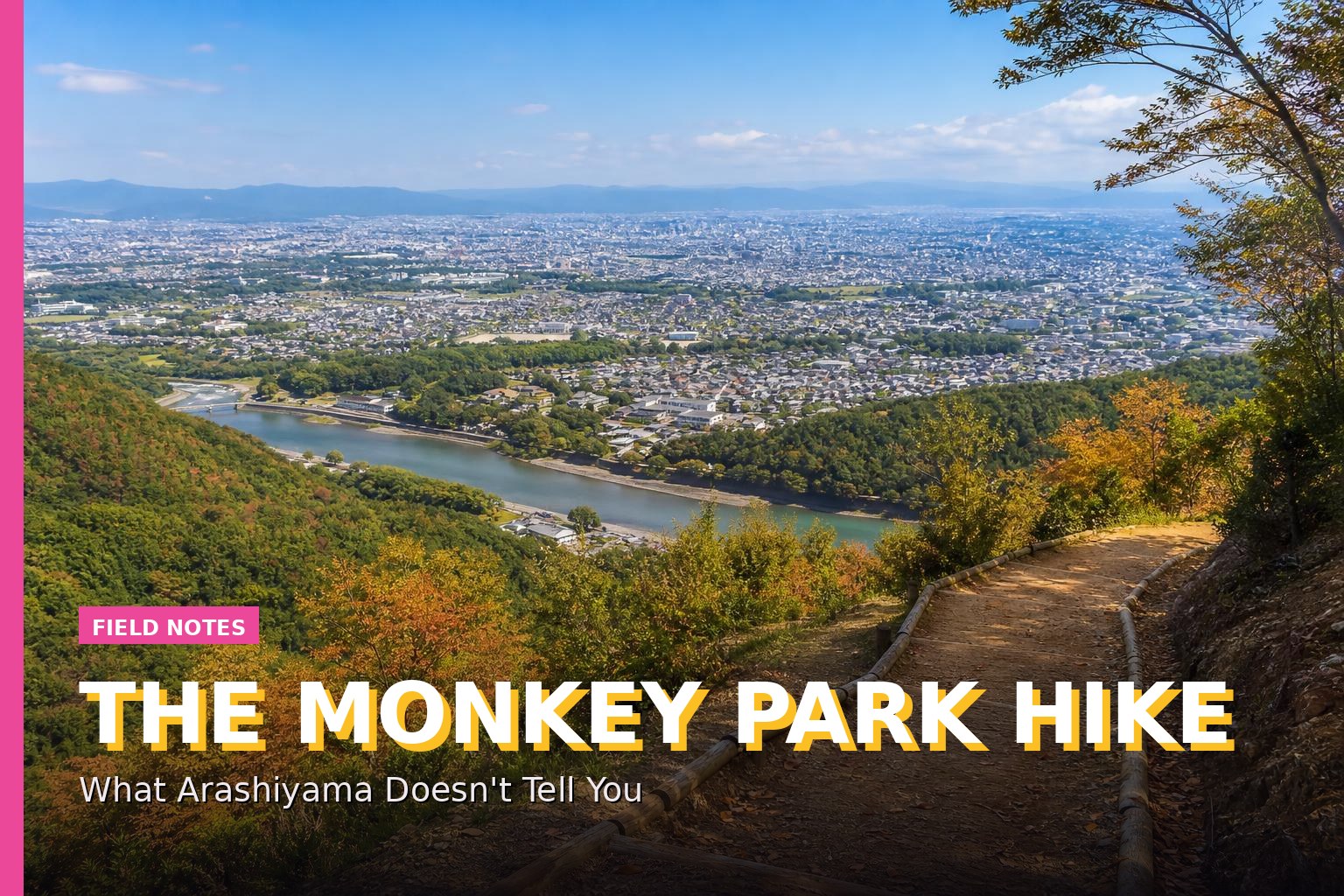
A woman stopped us near the base of Iwatayama last week — late forties, canvas slip-ons, holding her phone out with a map pin on it. She asked, in the slightly uncertain voice people use when they already suspect the answer, whether the monkey park was "up there, like, up up." We nodded. She looked at her shoes. She looked at the path. She looked back at her partner, who was already halfway through a bottle of water they had bought for the whole afternoon. They had come straight from the bamboo grove and assumed the monkeys were a short detour on the way to lunch.
They were not. They are almost never what people think they are.
What the brochures leave out
Here is the thing nobody writing about Arashiyama online seems to want to say plainly: the monkey park is a hike. Not a stroll, not a short climb, not "a few steps up." It is a sustained uphill walk on an uneven path, and it takes most people somewhere between twenty and forty minutes of real effort to reach the top. The reward is extraordinary — a working wild-monkey observation site with one of the best panoramas of Kyoto you will find anywhere — but you earn it with your legs.
In October this matters more than people expect. Visitors have usually read that autumn in Kyoto is cool and comfortable, and in the shaded lanes of the lower town that is broadly true. The monkey park path is different. It climbs through exposed hillside, often in direct sun, and the first half of October in particular can still be warm enough that an unprepared climb turns into something closer to a slog. By the time you reach the top you are sweating through the shirt you planned to wear to dinner.
The shoe problem
This is the single most common practical mistake we see on any Kyoto day, and the monkey park concentrates it. Visitors underestimate total walking distance across a full day in Kyoto and arrive under-shod — fashionable flats, thin-soled sneakers, canvas loafers, sandals with no grip. On flat Gion streets you can get away with it. On the Iwatayama path you cannot. The surface is packed dirt and worn stone, sometimes slick with fallen leaves this time of year, and the gradient is steady rather than steep in bursts. Thin soles telegraph every root and pebble up through your foot. By halfway, people are stopping not because they are tired but because their feet hurt.
If you are coming in October, and you plan to see the monkeys, bring the shoes you would wear for a long urban walk at minimum. Trail shoes are better. This is not a dramatic recommendation; it's just what the path actually requires.
Why we do it anyway
Because it is worth it. The bamboo grove is lovely and five minutes of your day. The monkey park is a different category of experience: real wild macaques, not fed through bars, moving through a working research site, with a view across the Hozu River and the entire western edge of Kyoto spread out below. On a clear October afternoon with the first colour starting to come in on the far hills, it is one of the honest highlights of the city. People who skip it because they didn't realise what it was tend to find out later, from someone else's photos, and regret it.
We build it into our full-day Arashiyama route deliberately, and we tell guests before they book that there is a real climb involved. We also pace the day around it — the bamboo grove and the quieter gardens come first, the monkey hike lands when legs are warm but not spent, and we build in proper breaks on either side. In warmer stretches of October we slow the ascent and stop in shade more often. The point is not to power through it. The point is to arrive at the top with enough left in you to actually look.
Why the misread happens
Most online write-ups of Arashiyama treat the monkey park as a bullet point on a half-day itinerary — bamboo, monkeys, Togetsukyo bridge, done by lunch. That framing is wrong in a specific way: it collapses a two-hour commitment into a line item, and it does so because the writers mostly haven't done it, or did it once in cool weather with good shoes and didn't notice what was hard about it. The result is a steady trickle of visitors who turn up at the ticket booth, look at the path, and either grind up it unhappily or quietly leave. Neither version is the experience the place can actually give you.
Add October's specific wrinkle — visitors arriving expecting full autumn colour and finding the hills still mostly green, which they often are in Kyoto until well into November — and you get a particular kind of disappointment. The climb was harder than advertised, the colour wasn't there yet, and nobody told them either part in advance.
The honest cost of getting it wrong
The failure mode here isn't that you can't do the monkey park alone. Of course you can. The failure mode is that you arrive at the base in the wrong shoes, in the warmest hour of an October afternoon, already tired from the bamboo crowd, and you make a decision in thirty seconds about whether to climb. Half the people in that position turn around. The other half go up resentful and come down more so. Either way the day quietly loses its best hour, and because you never saw the view, you don't know what you traded away. That's the part that's hard to explain in advance, and it's why we spend as much time on the climb in our pre-trip notes as we do on the sites themselves.
Knowing what a day actually asks of your legs is most of what separates a good Kyoto itinerary from a frustrating one. That read is the thing we're really selling — the monkeys are just the clearest example of it.