
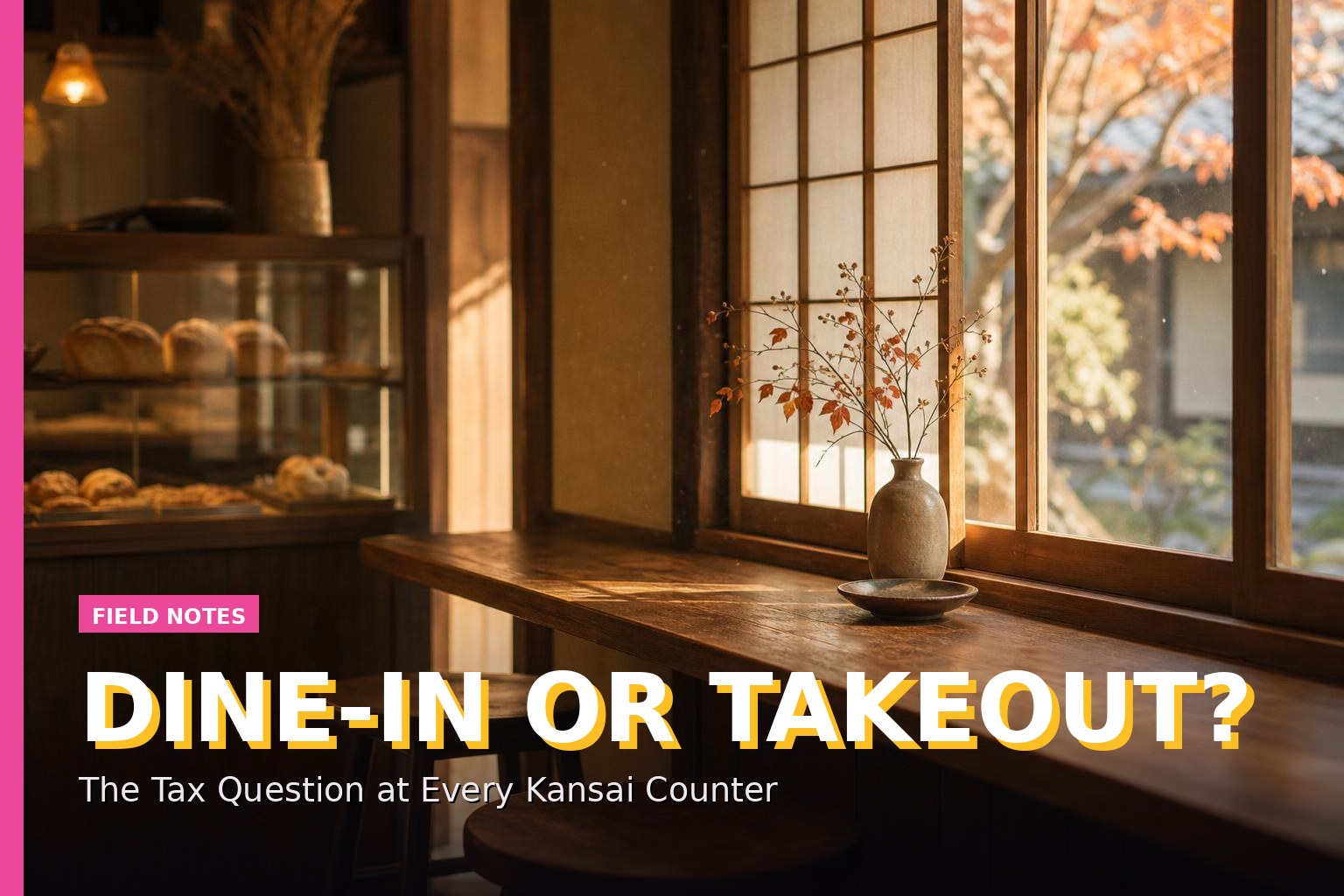
You're at a bakery on Sanjo. You've picked out a curry pan and an iced coffee. The woman at the register rings you up, then pauses and asks something you don't quite catch. She gestures vaguely at the two-seat counter by the window, then at the door. You say yes to whatever seems friendliest. She nods, prints the receipt, and hands you a paper bag.
Congratulations — you've just answered Japan's quietest tax question. And depending on which way you nodded, the total on that receipt shifted by a percentage point or two.
This is one of those small mechanics of daily life in Japan that no one explains to visitors, because to residents it is simply the shape of buying food. But once you understand what's being asked, a lot of small confusions at counters in Kyoto and Osaka suddenly make sense.
The two phrases you're actually hearing
The question comes in two flavors, and staff will use one or the other depending on the shop:
- Ten-nai de meshiagarimasu ka? — Will you eat it inside (the shop)?
- Omochi-kaeri desu ka? — Is it to take away?
Same question, opposite framings. A yes to one is a no to the other, which is where visitors sometimes trip themselves up nodding along to be polite.
The shortcut answers, both of which any staff member will understand instantly:
- Ten-nai de — eating in.
- Mochi-kaeri — taking it out.
You do not need to conjugate anything. You do not need to bow. Two words, delivered flat, and you're through.
Why they're asking
Japan runs a split consumption tax on food. Groceries and takeout food sit in a reduced bracket. Food eaten on the premises sits in the standard bracket. The gap is small — a percentage point or two — but it's real, and every register in the country is set up to apply the correct one.
This matters more than it sounds. It means the same onigiri, the same slice of cake, the same konbini bento, can cost slightly different amounts depending on where you eat it. The price tag on the shelf and the price you actually pay are not always the same number, and the difference is settled by your answer to that one question.
Chains handle this constantly. Starbucks asks. Doutor asks. The bakery chains ask. Even the convenience stores, if there's a counter or a seating area, will sometimes ask — though at most konbini the default assumption is takeout unless you've made it obvious you're planning to sit.
Where the tax question actually shows up
Not everywhere. A ramen shop with only counter seats doesn't ask — you're obviously eating in. A stall with no seats at all doesn't ask — you're obviously not. The question lives in the middle ground:
- Bakeries with a small eat-in corner
- Coffee chains and specialty coffee shops with seating
- Depachika basements at big department stores
- Convenience stores attached to eat-in counters
- Ice cream and dessert counters at malls
- Some standing-sushi and standing-soba places where takeout is also offered
Kyoto is thick with the first two. Half of the reason you're being asked at a Shijo bakery is that the shop technically has three chairs behind a pillar you didn't notice.
The trap: saying yes to eat-in and then walking out
Here's the wrinkle that trips people up. If you tell the cashier you're eating in, they'll ring it at the higher rate — and often plate the food differently, on a real dish instead of packaging it. If you then change your mind, grab the pastry, and walk out the door, you've technically paid the wrong tax and taken shop property with you.
Nobody is going to chase you down. But staff do notice, and in a small shop it creates an awkward moment where someone has to reprint your receipt or quietly write it off. The polite move, if you're genuinely unsure, is to default to takeout. You can always sit on a bench outside, or in one of Kyoto's small pocket parks, and eat there. The city is full of them if you start looking.
The reverse trap: takeout that's obviously eat-in
Some visitors, hearing there's a small saving, try to game it — order takeout, then sit down at the counter anyway. Two things happen. First, the shop notices, because staff are trained to. Second, you've made someone's day slightly worse for the price of a discount that wouldn't cover a vending-machine tea.
Japan's service culture runs on a lot of small unspoken agreements. This is one of them. Answer the question honestly, and you're a normal customer. Answer it strategically, and you've become the story staff tell at shift change.
Why the system works this way
Japan reworked its consumption tax rules in the late 2010s, adding the reduced rate specifically to soften the impact on daily groceries and essential food. Restaurant meals — a discretionary spend — stayed at the standard rate. Takeout food, being closer to groceries than to dining out, got the reduced rate too.
The result is a system that treats a sandwich eaten at a table as a different economic act from the same sandwich eaten on a park bench. Philosophically, that's a small thing. Operationally, it means every register in the country needs a way to tell the two apart, which means every cashier needs to ask. So they do, thousands of times a day, and after a while the question becomes as automatic as "receipt or no receipt" is elsewhere.
For travelers, the deeper thing this reveals is how much of Japanese retail is built around a very short, very precise exchange at the register. The country runs on staff being able to ask exactly the right question, and customers being able to give exactly the right answer, in about two seconds. Learning the two-word replies isn't just about the tax — it's about slotting into a rhythm that keeps a queue of twelve people moving without anyone feeling rushed.
What it means for your trip
Learn the two phrases. Pick whichever one feels easier to remember — ten-nai de for eat-in, mochi-kaeri for takeout — and use it as your default answer at any counter where food might go either way. If you don't know which one you want, takeout is the safer guess: you can always find somewhere to sit, and nobody will be inconvenienced if you change your plans.
The savings are trivial. The point isn't the money. The point is that once you can answer the question cleanly, a whole layer of small friction at Kyoto and Osaka food counters disappears, and you start noticing how well the whole system actually runs.
Half of what a small tour is: someone already burned the days figuring out these tiny rhythms, so you can just eat the pastry.