
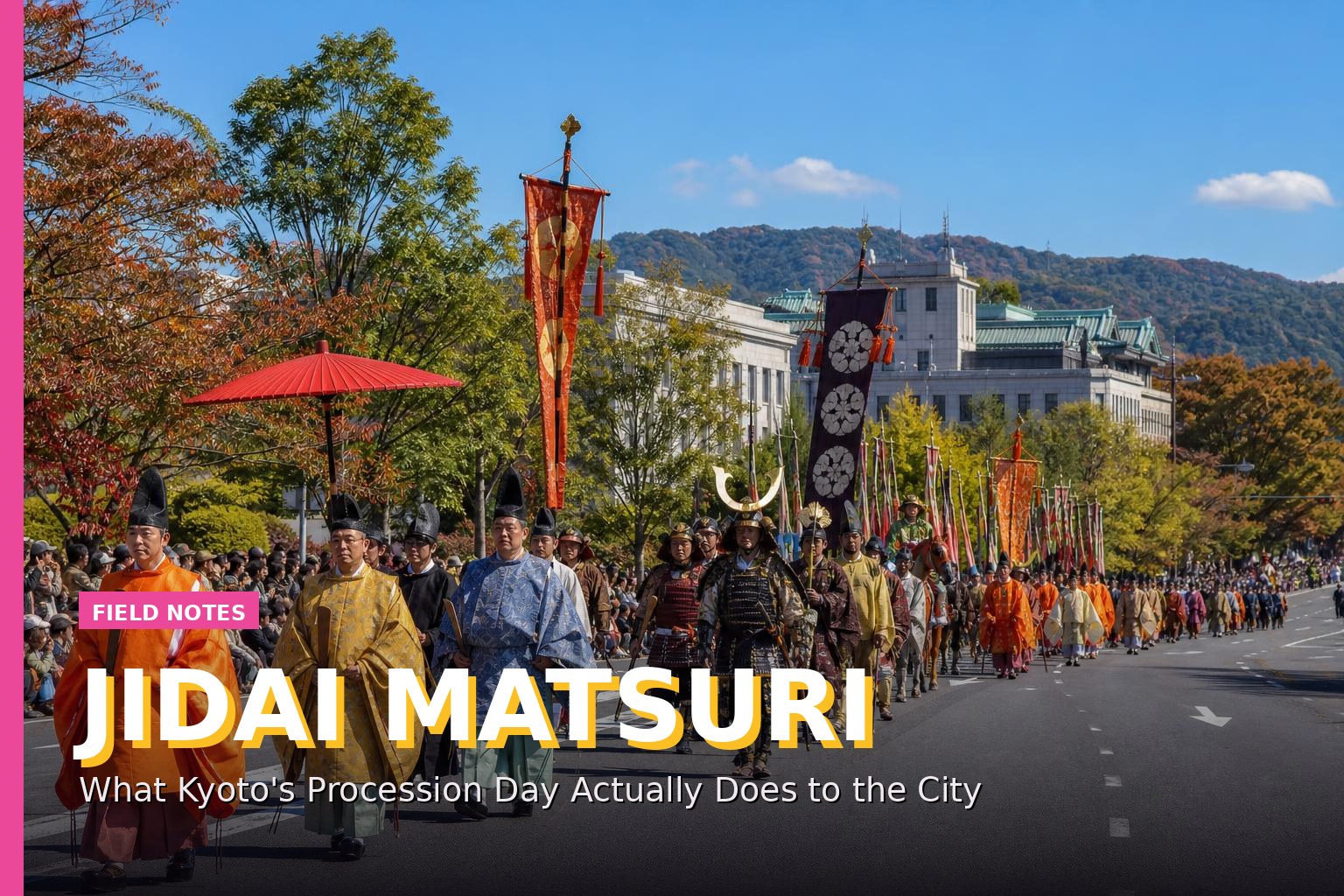
A guest asked me last October, somewhere on the slope above the bamboo, whether we were going to "see the parade later." She meant Jidai Matsuri. She had read about it on the flight over and assumed, reasonably, that a festival marked on every October list of things to do in Kyoto would be the kind of thing you drop into for twenty minutes between temples. Her hotel was near Karasuma Oike. The procession route ran, more or less, past her front door. She was wearing the shoes she had already worn for six hours.
I told her the honest answer, which is that Jidai Matsuri is not a thing you drop into. It is a thing that happens to your day whether you planned for it or not, and the question is only whether you noticed in advance.
What the Festival of the Ages actually is
Jidai Matsuri — the Festival of the Ages — is one of Kyoto's three big festivals, alongside Aoi in May and Gion in July. The headline event is a costumed procession that walks from the Imperial Palace down through central Kyoto to Heian Shrine. The costumes are organised in historical periods, running backwards from the late Edo era toward the Heian court. Roughly two thousand people take part. It usually falls on October 22, though weather can push it a day.
That is the guidebook paragraph. It is not wrong. It is just missing the part that matters, which is what the day feels like on the ground if you are a visitor who had other plans.
What it does to the city for a day
Central Kyoto on procession day is not shut, exactly. It is rearranged. The route cuts a long diagonal through the parts of town most visitors are staying in and moving through — the palace grounds, Karasuma, Oike, the approach to Heian Shrine near Okazaki. Buses are rerouted. Taxis cannot cross the line of the procession while it is passing. Pedestrians can, at marked crossings, but the crossings are managed and the timing is not yours.
So the real texture of the day is this: your morning plan on the east side of town is fine. Your afternoon plan on the west side of town is fine. Moving between them in the middle of the day, by any surface transport, is not fine. The subway still runs underneath all of it, which is the single most useful thing to know about Jidai Matsuri as a traveller. If your route can be done on the Karasuma or Tozai lines, you barely notice. If it depends on a bus crossing Oike-dori at the wrong hour, you lose an hour.
Watching it, if you decide to
If you do want to watch, the honest judgment is that where you stand matters more than when you arrive. The procession is long — it takes hours to pass any given point, moving at a walking pace — so you are not racing a start time, you are picking a spot and settling in. The stretches near the Imperial Palace at the start, and near Heian Shrine at the end, are the most crowded because they are the most photographed. The middle stretches along the route are quieter and the costumes are the same costumes.
There is also the night before. Kurama's fire festival — Kurama no Hi Matsuri — runs on the same date up in the mountains north of the city, and it is a genuinely different kind of event: torches, shouting, a small mountain village absolutely packed with people who came up on the one small train line that serves it. People try to do both in one twenty-four-hour window. It is possible. It is also the single most reliable way to end a Kyoto trip exhausted.
The October expectation gap
Here is the thing worth saying plainly, because it comes up every October in our groups. Guests arrive in the third week of October expecting two things: full autumn colour, and crowds everywhere. In most years they get neither. The maples around Kyoto city, as a rule, don't properly turn until well into November, and sometimes later than that. And the big crowds people brace for — the ones they have read about — are a late-November phenomenon tied to the foliage, not an October one.
What October actually gives you is comfortable walking weather, early-stage colour at higher elevations if you go looking for it, and a procession day that reshapes the centre of the city for about eight hours. It is a good month. It is not the month on the postcard, and travellers who booked it expecting the postcard spend their first two days quietly disappointed before they adjust.
Why the day is laid out the way it is
Jidai Matsuri was built in the 1890s, when Kyoto had just lost the emperor to Tokyo and needed, badly, to assert that it was still the cultural centre of the country. The procession is a civic argument in costume form: here are all the eras we have been the capital for, walking past you in order. That is why it ends at Heian Shrine, which was built as part of the same effort, and why the route traces the old centres of government rather than the tourist map.
Knowing that doesn't change what you do on the day. It does change what you are looking at if you decide to watch. A procession where every costume is period-accurate down to the dye lots reads differently when you understand it was designed as a statement rather than a pageant.
The honest cost of getting it wrong
The failure mode on a day like Jidai Matsuri isn't that something closes or that you miss the parade. It is subtler. You planned a day that crosses the route three times by bus. You end up walking two of those crossings instead, in shoes you chose for a different kind of day, and you arrive at your late-afternoon temple with forty minutes left before it closes instead of two hours. You see it. You tick it off. You don't know what the unhurried version would have felt like, because you never had it. That is the quiet way an October day in Kyoto goes wrong — not with a disaster, but with a steadily worse version of what you came for.
Reading an October week in Kyoto — procession day, foliage that isn't ready yet, weather that genuinely rewards walking — takes a season or two of getting it wrong in person. That reading is most of what you are paying someone else to have already done.