
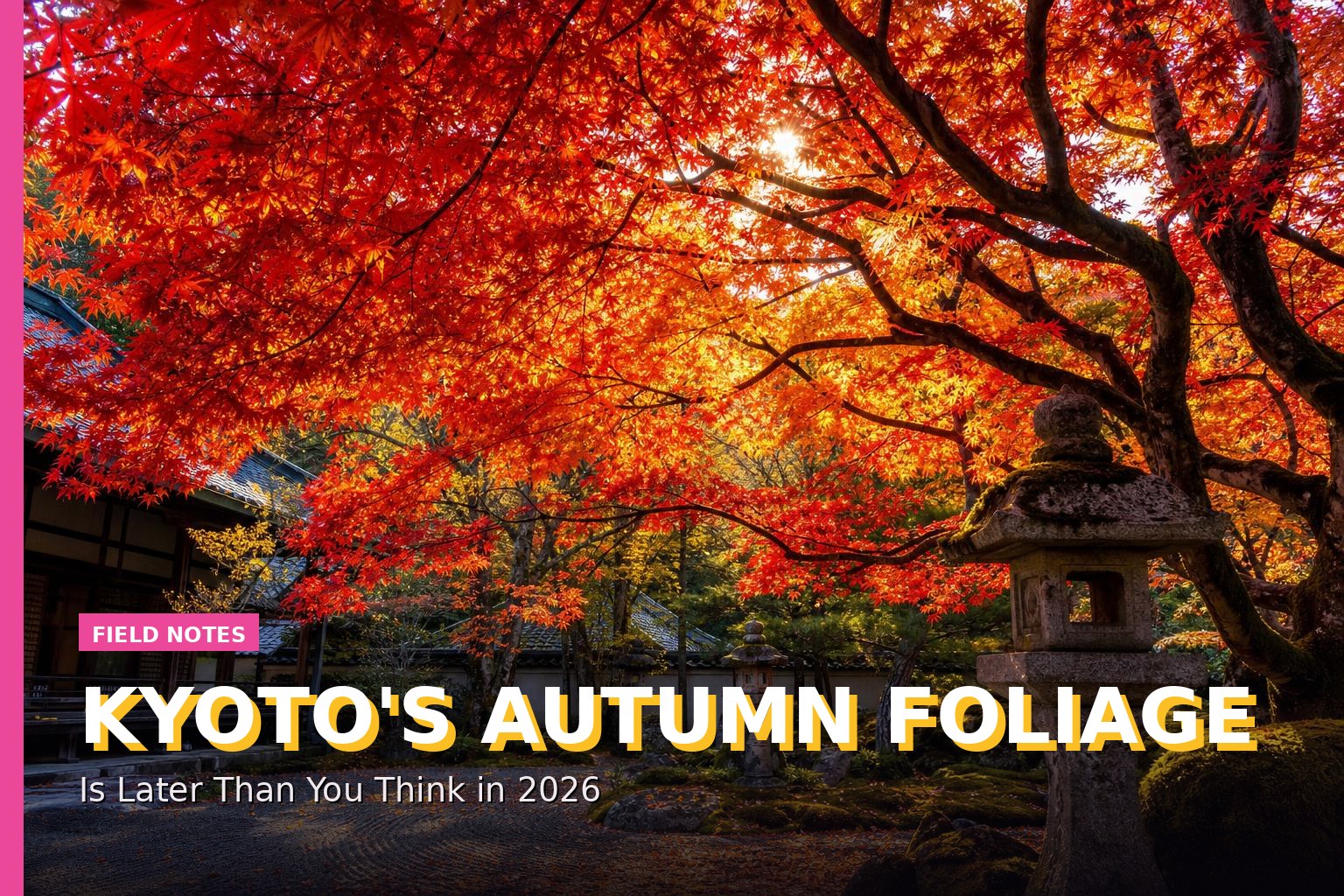
A guest wrote to us last week from Chicago. She'd already booked flights for the second week of November, moved a work deadline to make it happen, and wanted to confirm we'd be running the Arashiyama route "during peak colour." She'd read somewhere that Kyoto's maples turn in mid-November. She wanted to know which day would be the best.
We wrote back carefully. The honest answer is that the second week of November in Kyoto is not peak colour. It is often barely the beginning. And 2026 looks later than usual.
This is the conversation we have more than any other in autumn, and it is the one where a small planning error costs the most, because plane tickets don't refund because the leaves are behind schedule.
What the 2026 forecast actually says
The current forecast for this year puts Kyoto's peak red maples in mid-December. Not late November. Not "end of November into early December." Mid-December.
Even in a normal year, Kyoto runs later than most travellers expect. The city sits in a basin, the nights don't get properly cold until well into November, and the maples respond to cold nights, not the calendar. Tokyo tends to peak before Kyoto. Sapporo peaks a full month before Kyoto. Somehow the marketing photos, mostly shot at a handful of famous temples on the two or three good days a season, have convinced the internet that Kyoto peaks in mid-November. It does not.
2026 is running later than average on top of that. The summer was long, September has stayed warm, and the forecasting bodies have adjusted accordingly. If you are coming for red maples specifically, plan for the first half of December and expect the second week to be your safest bet.
The trap this creates
The trap isn't that people arrive to bare branches. It's more subtle than that. They arrive in mid-November, walk through Arashiyama, see some yellow ginkgo, a few maples starting to turn at the tips, and think: this must be it. This must be what everyone was photographing. It looks fine. It looks pretty. They post the pictures. They don't know what they're missing because they've never seen the same trees two weeks later.
The gap between "technically autumn" and "the reason people fly across the world for this" is enormous, and it is invisible unless you've stood in both. A maple at 40% turn and the same maple at 90% turn are effectively different trees. The 90% version is the one in the photographs.
How we're reading the season this year
Our approach doesn't change dramatically with the calendar — the Arashiyama route works in shoulder green as well as it does in peak red, because the bamboo is the bamboo and the monkey park view is the monkey park view. But what we tell guests to expect shifts a lot.
For anyone still in the planning phase: if red maples are the reason you're coming, and you have flexibility, aim later than you think. Early December is currently a better bet than late November for Kyoto specifically. The added benefit — and this is real — is that the crowds thin considerably once the Japanese domestic autumn-leaves tourism window closes, which happens on the calendar rather than on the actual foliage timing. You get better colour and fewer people in the same week.
If your dates are locked and they fall in mid-November, don't despair. The city is still beautiful. Ginkgo turn earlier than maple and are often at their best when the maples are barely starting. Higher-elevation spots outside the city turn earlier than the basin. And green Kyoto in cool weather is genuinely one of the best walking experiences in Japan, which most autumn-focused visitors never appreciate because they were too busy being disappointed about leaves.
Why Kyoto runs late
The reason is geography, and it's worth understanding because it explains a lot of Kyoto's weather quirks. The city is a basin ringed by mountains on three sides. In summer this traps heat and makes Kyoto genuinely brutal. In autumn it does something similar in reverse — the basin holds warmth into the evening, delaying the temperature drops that trigger the colour change in maples. The surrounding mountains turn first. The city turns last. If you drive thirty minutes up into the hills in late November you'll often find peak colour while the basin floor is still mostly green.
This is also why Kyoto's illumination events, the ones the temples run at night, are timed the way they are. They cluster into late November and early December because that's when the trees are actually ready, not because of some poetic tradition. The temples know their own trees.
The honest cost of getting it wrong
The failure mode here isn't dramatic. You arrive in Kyoto in mid-November, you have a lovely time, you see some early colour, you go home. You do not know that the same streets ten days later were on fire in a way that would have made you cry. You didn't miss anything you can name, so you don't mind. That's the version of this mistake that's hardest to warn people about in advance, because the person making it feels perfectly satisfied.
Reading a Kyoto autumn is genuinely difficult from a spreadsheet six months out — the forecast moves, the basin runs late, and the famous photos are all from the same three days. That reading is most of what you're paying for when someone else builds the day around what's actually turning.