
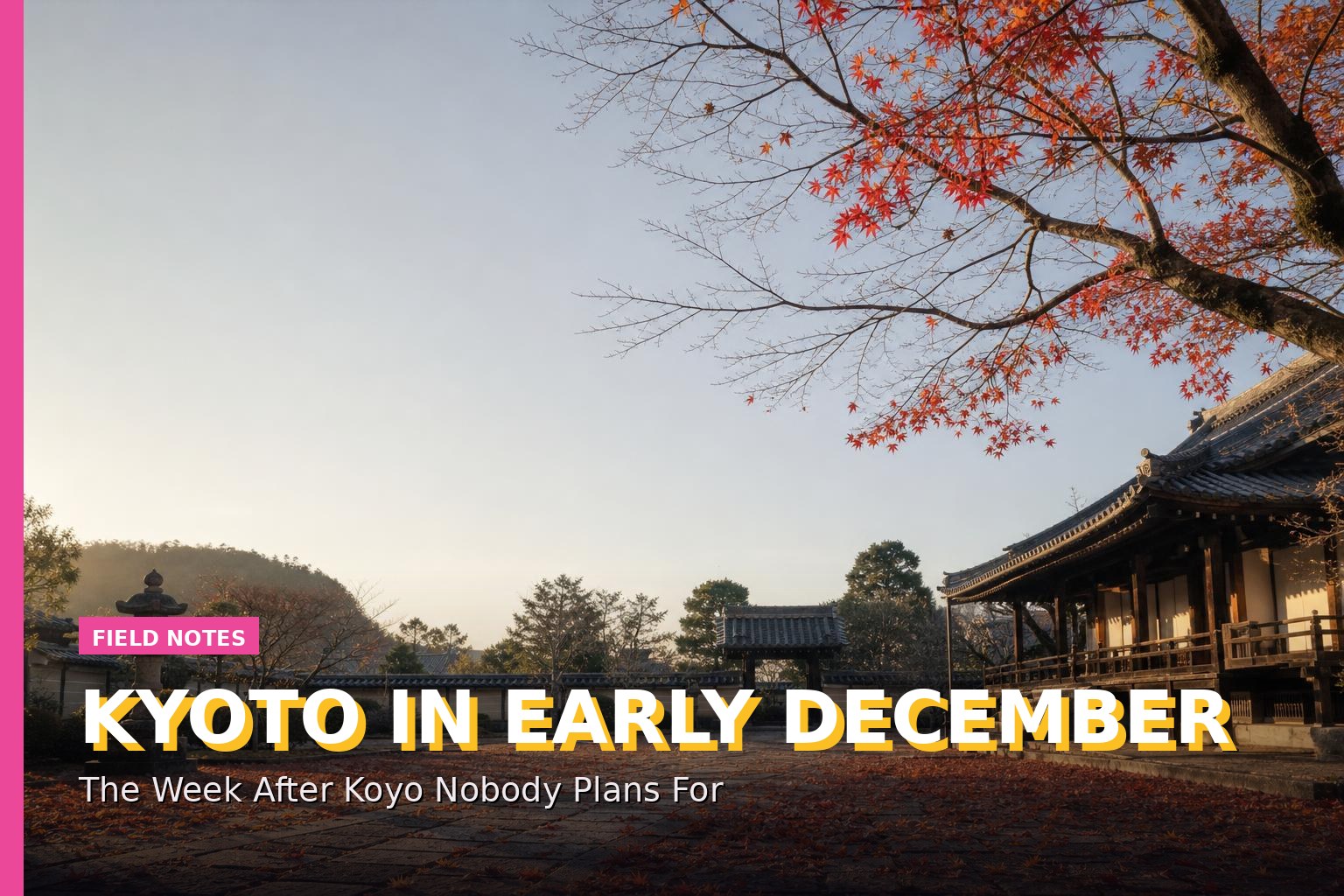
A guest last week, standing on the stone bridge below Eikando, said the thing visitors always say when they realise what they've walked into: "I thought we were too late." She'd booked for the last week of November expecting the peak and arrived to find the maples already deepening past red into that rust-brown stage where the leaves start to let go. Her husband was taking photos anyway. There were maybe a dozen other people on the path. A week earlier, at the same spot, there would have been two hundred.
She wasn't too late. She was early — for a different Kyoto that most visitors never see, because they've already left.
The week the city exhales
Every year, somewhere in the first ten days of December, Kyoto undergoes a handover that nobody publishes a schedule for. The peak koyo crowds thin out fast. The tour buses that have been circling Arashiyama and Higashiyama for three weeks reassign themselves to other work. The queues at the famous temples shorten, then collapse. The illuminations at the big-name gardens wind down. Hotel rates, which had been punishing through late November, start to behave like hotel rates again.
What's left is a version of the city that is still visibly autumn — leaves on the ground, late colour on north-facing slopes and in sheltered temple grounds, the low raking light that makes everything photograph well — but without the structural problem of thirty thousand other people trying to see it at the same time.
The catch is that most travellers don't know this window exists. The guidebooks talk about November. The Instagram geotags are all November. By the time early December arrives, the search traffic has moved on to winter illuminations in Tokyo and ski fields in Hokkaido. Kyoto in that first week of December sits in a gap that nobody markets.
What's actually still happening with the leaves
This is the part people get wrong in both directions. Visitors in late November assume peak has already passed; visitors in early December assume everything is bare. Neither is quite true.
Kyoto's autumn colour moves through the city unevenly. The exposed, south-facing, warm-microclimate spots peak first and finish first — these are usually the famous ones, because they're the ones that photograph dramatically in mid-November. The shaded, north-facing, higher-elevation, and more sheltered spots run a week or two behind. In a normal year, there is still real colour to be found in early December if you know where the late-peaking pockets are. In a warm year — and recent years have trended warm — there is significantly more.
The leaves on the ground are part of this, not a failure state. A temple courtyard carpeted in red maple leaves, with the last of the colour still in the upper branches, is one of the genuinely distinctive things Kyoto does. It doesn't look like a travel brochure. It looks better.
The operational judgment: adapt to conditions, not to the calendar
We make a decision about our Arashiyama route every single day of the autumn season, and it is the same decision we make in May and in February: we adapt to conditions, not to the calendar. The route stays largely the same between shoulder and peak season. What changes is pacing, where we linger, and what we skip on a given day because the light or the crowd or the weather has made somewhere else the better call.
In early December this matters more than usual, because the calendar is actively lying to you. The calendar says autumn is over. The trees — some of them, in the right spots — disagree. If you plan your week on the calendar, you'll skip Kyoto. If you plan it on conditions, you'll find one of the better weeks of the year to be there.
Why this window exists at all
The gap isn't really about botany. It's about how collective travel decisions get made. Peak koyo is a narrative — a story people tell each other about when to come — and narratives have sharp edges. They start on a date and end on a date. The leaves don't know this. They do what they do based on temperature, rainfall, and aspect, and in a given year the actual peak may be a week later than the narrative peak, or the colour may hold a week longer than the narrative says it should.
The same effect works for you in the other direction at other times of year. The first week after Golden Week. The gap between cherry blossom and the start of the summer humidity. The week after Obon. These are all windows where the story has moved on but the place is still doing what you came to see.
The honest cost of getting it wrong
The failure mode in early December isn't that you have a bad trip. It's that you don't come at all. You look at the calendar, you read that peak koyo is late November, you decide you've missed it, and you move Kyoto to next year's list. You never find out that the week you skipped was quieter, cheaper, visually still autumn, and in some ways easier to photograph than the peak you were aiming for. You don't know what you missed, because you weren't there to miss it.
The other failure mode is subtler. You do come, but you plan the trip as if it's winter — you skip the maple-famous temples because "the leaves are done," and you spend the day somewhere that would have been better in January. You arrive at the right city in the right week and spend it looking at the wrong things.
Reading a window like this one takes a season or two of getting it wrong first. That's most of what you're paying for when someone else plans the day.