
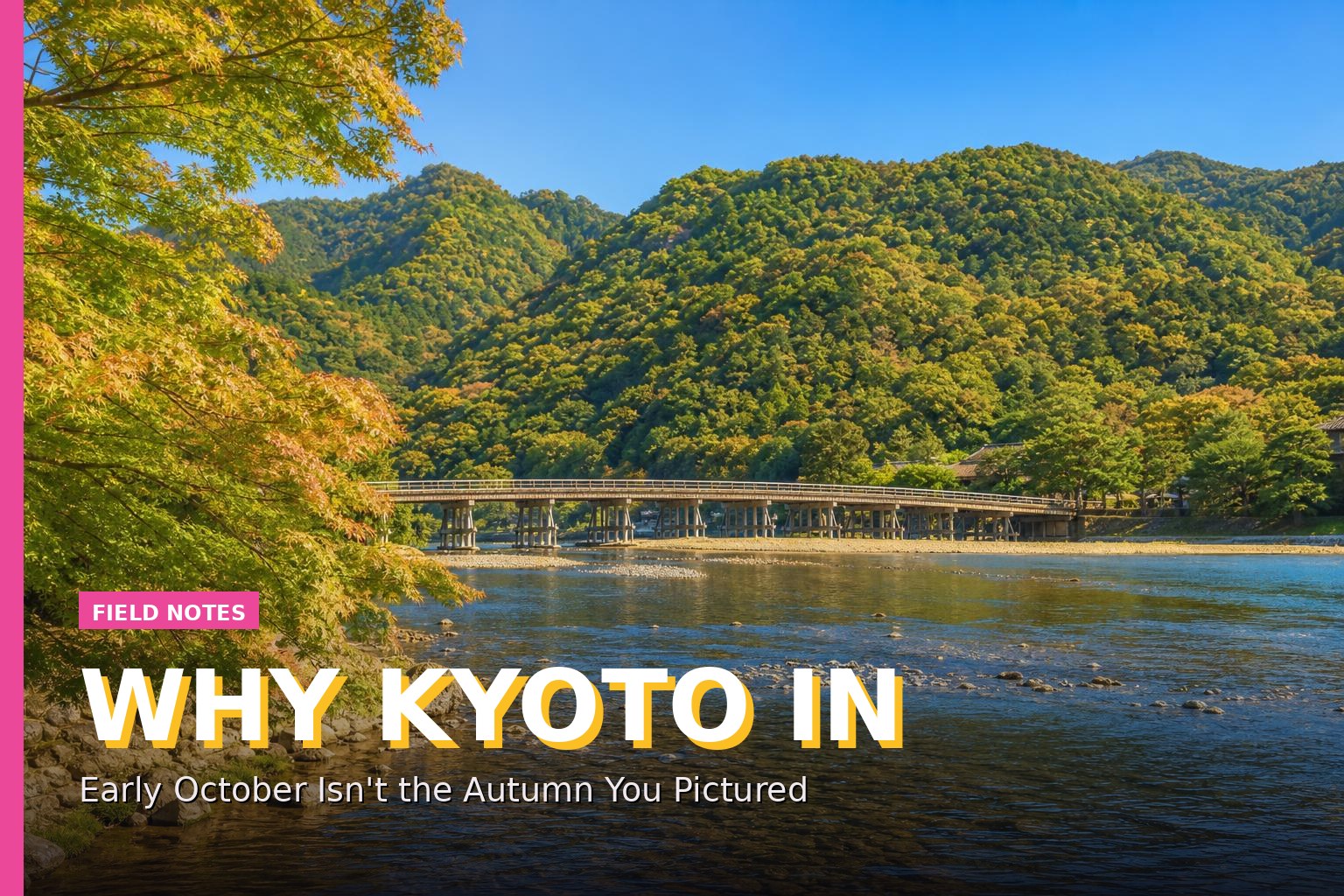
A woman on our tour last week — she'd flown in from Vancouver — kept looking up at the maples along the Katsura River and finally asked, almost apologetically, whether we thought the colour was late this year. It wasn't late. It was on time. She'd booked the trip nine months ago around the phrase "autumn in Kyoto," and what she was seeing was green leaves with the faintest hint of tired yellow at the edges. She wasn't disappointed exactly. She was recalibrating. You could watch it happen in real time.
This conversation happens more often than any other in early October. It is the single most consistent mismatch between what travellers picture and what the month delivers, and it is worth writing plainly about, because the picture in your head is costing you money and enjoyment in ways you probably haven't noticed.
What early October actually looks like in Kyoto
Kyoto in the first half of October is still, functionally, late summer wearing a cardigan. The cicadas have quieted. Mornings have an edge to them. But the maples on the eastern hills are green. The ginkgos have not turned. The famous photographs you have seen — the ones with fire-coloured leaves reflected in temple ponds — were taken in mid-to-late November, and in some years the first week of December.
Peak koyo in the Kyoto basin runs late. The mountains north of the city turn earlier, and the higher elevations around Kurama and Ohara start to show real colour before the temple gardens in the city do. But the postcards you are chasing — Tofuku-ji's valley of maples, Eikan-do lit up at night, the approach to Jingo-ji — those are November events, and often the back half of November at that.
If you booked October expecting that, you have two choices. You can grieve the trip you thought you were taking, or you can look at the trip you are actually on.
The trip you're actually on is better than you think
Here is what October in Kyoto does deliver, in exchange for the foliage you didn't quite get:
- Walking weather that is genuinely pleasant. Not the survival exercise August turns into, not the layered discomfort of late November mornings. Long days on foot become plausible again.
- Routes that are markedly less crowded than they will be four weeks later. The koyo peak brings a wall of domestic and international visitors that shoulder-season travellers do not see. We often walk into Arashiyama in early October and guests are surprised at how much space there is. They arrived braced for the crowds they'd read about, and those crowds don't show up until mid-November.
- Festivals. Early October is genuinely active — Kyoto's shrine calendar runs thick this month, and you can stumble into a small neighbourhood matsuri without planning for it.
The catch is that this only works if you know it is what you are getting. Travellers who arrive expecting fire-red maples spend three days looking for something that isn't there yet, and miss what is.
An operational judgment: don't chase the colour, chase the light
Our morning routes start at 9:00, 9:30 or 10:00 depending on the season, and the driver is opening hours — not light, not crowd timing. Shrines, temples and gardens along our routes open when they open. Starting earlier means standing outside closed gates.
This matters more in October than most people realise. If you are trying to build your own day and you have read a hundred blog posts telling you to "start at dawn to beat the crowds," you will arrive at your first stop and find the gate shut for another two hours. You will then be tired and slightly cross before the actual day begins. In November this trade might be worth it because the crowds are real. In early October it is not, because the crowds you were trying to beat mostly aren't there.
Our own route through the Bamboo Forest uses back streets and a lesser-known entrance, then a loop that takes everything in a sensible order. That structure works in every season, but October is the month where guests most clearly feel the benefit — because the crowds elsewhere are light enough that the "quiet approach" and the "normal approach" produce a similar experience, and yet the sequence itself still makes the day flow better.
Why the mismatch exists in the first place
Two forces are behind it. The first is that "autumn in Kyoto" as a marketing phrase compresses a season that in reality has three distinct acts: early October (green, quiet, warm), late October to mid-November (transitional, colour building, crowds building), and mid-to-late November (peak, crowded, cold mornings). Instagram flattens all three into one image, and that image is act three.
The second is booking lead time. Most trips to Japan are planned six to twelve months out. That's long enough for the traveller to lock in dates based on flight prices and work calendars, and short enough that the seasonal specifics get filled in later — usually by search results that show the peak, not the norm. By the time you find out early October isn't peak foliage, your flights are non-refundable.
None of this is anyone's fault. It's just how the information reaches you.
The honest cost of getting it wrong
The failure mode here isn't a ruined trip. It's a quieter thing. You spend a week in one of the most walkable cities on earth, in the best weather it has all year, comparing it against a photograph in your head. You take pictures that you find slightly disappointing when you get home. You tell friends Kyoto was "nice, but we probably went at the wrong time," when in fact you went at one of the better times and simply expected the wrong month.
The travellers who enjoy October most are the ones who arrive knowing what October is. That's mostly a matter of reading, and it is genuinely something you can do on your own. The harder part is designing a day around what the month actually offers rather than what you thought it would.
Reading a season correctly takes a few years of getting it wrong in public. That's most of what you're paying for when you hand the day to someone else.