
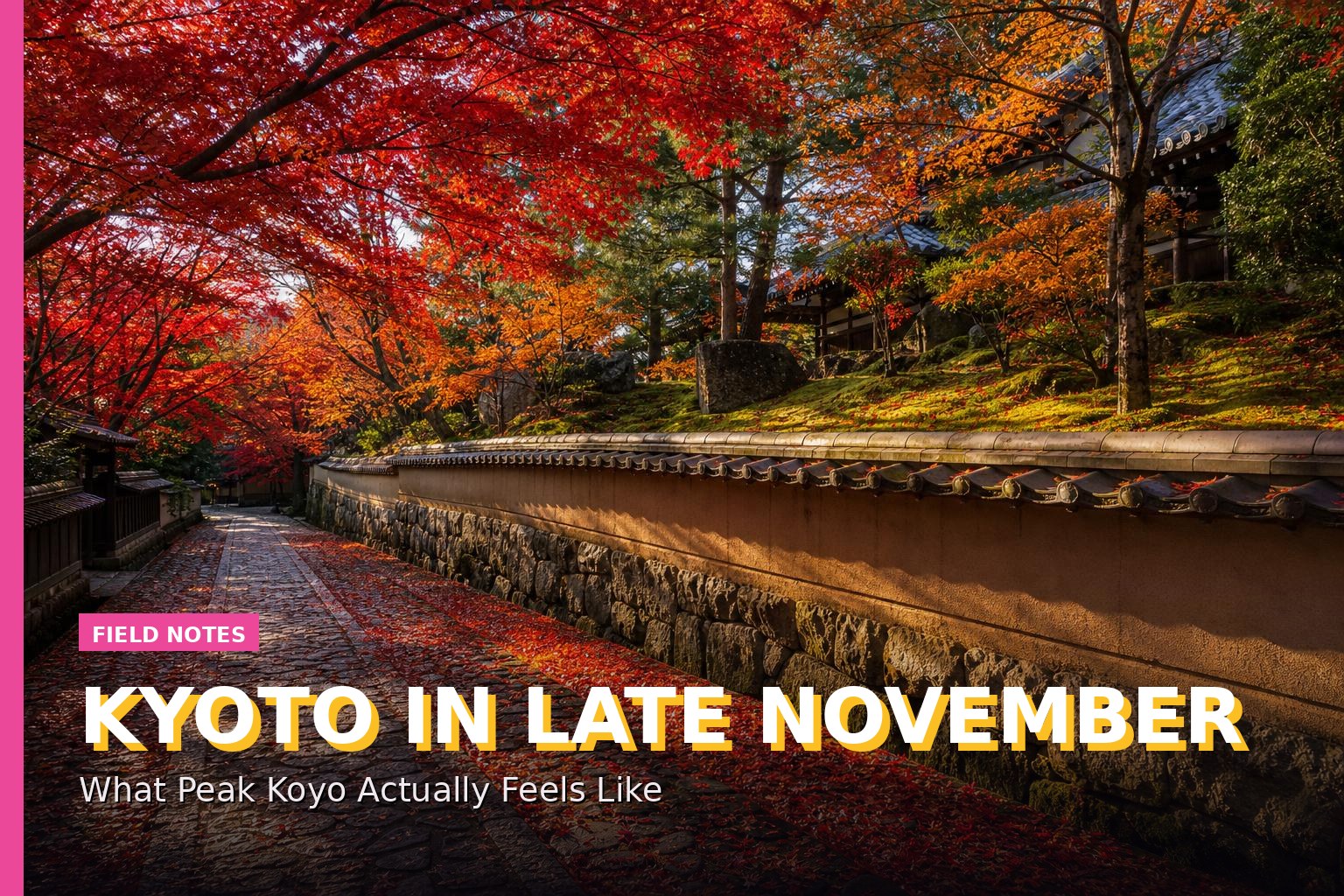
A guest last Saturday asked us, mid-morning on a side street above Nanzen-ji, why it was so quiet. She had read everything. She had steeled herself for the worst week of the year. She had packed patience like it was sunscreen. And here we were, walking under a maple ceiling that was doing exactly what the posters promised, with maybe eight other people in sight. She kept looking over her shoulder like the crowd was going to catch up.
It didn't. Not on that street, not that morning. Two hours later, at a temple whose name you would recognize, we stood shoulder to shoulder with a tour group from Taipei and waited our turn to photograph a pond. Same city, same day, ninety minutes apart. This is late November in Kyoto, and the gap between those two moments is the entire story.
Peak koyo isn't a place, it's a distribution
Every year around this week the city tips into its real autumn — not the hopeful orange edges of early November, but the full saturated run where the maples have decided and the ginkgos are dropping their coins on the gravel. It is genuinely beautiful. It is also the week when the famous-list temples absorb a volume of visitors that would break most other cities' transit systems.
What first-timers underestimate is how unevenly that volume is distributed. The crowd is not spread across Kyoto. It is concentrated at roughly a dozen names — the ones in every guidebook's autumn feature — and it pulses by hour. Mid-morning at those names is the hardest moment of the day. A ten-minute walk away, in any direction, is a different city.
This is the fact that most autumn planning advice misses. The honest version of "beat the crowds in November" is not an earlier alarm. It's a different list.
The second-choice temple is often the better one
We have written before about trading the famous name for the temple down the slope, and late November is when that trade pays the most. The maples do not check which temple they are growing at. The light does not land only on the ones with English-language fame. What the famous places have is a particular angle, a particular pond, a particular photograph you have already seen — and three hundred other people trying to re-take it.
The quieter temple on the same hillside has its own angle, its own pond, and nobody blocking it. Your photograph will be the only one of its kind on your camera roll, which is not true of the postcard shot.
We build routes around this. Our Arashiyama day uses back streets and a lesser-known entrance to the bamboo, and the same principle runs through the whole loop — approach things sideways, use the quieter cousin of the famous thing, and be at the famous thing only when it is worth being there. In peak koyo week, "worth being there" is a narrower window than usual.
Afternoon still wins, even now
We said earlier this month that November light rewards afternoon over morning for koyo, and that holds through the peak. The low angle the maples want arrives later in the day. Mid-morning light is flatter and the crowd is denser; late afternoon light is doing what you came for and the tour buses are rotating out. Night illuminations extend the useful hours further on the temples that run them.
Morning still has its uses — gardens that close early, shrines that open before the tour buses arrive, the general pleasure of a cold Kyoto street at nine. But if you are choosing one window for your single most-anticipated maple view, choose the later one.
Timing you can actually trust
A few things to put in the right slot in your head:
- The procession of the peak varies year to year by a week or so. A forecast from early November is a guess; a forecast from the week itself is reliable. Check it the day you arrive, not before you book.
- Weekends in this stretch are heavier than weekdays by a wide margin — day-trippers from Osaka and Nagoya compound the tourist load. If you have flexibility, spend the weekend somewhere else in Kansai and be in Kyoto Monday through Thursday.
- Temples close earlier than visitors expect, often well before dinner. A plan that assumes a 5pm start to your temple afternoon will arrive at locked gates.
- Trains are broadly punctual but not a guarantee. On peak weekends the Arashiyama line in particular runs full. Build a buffer.
Why the city behaves this way
Kyoto's autumn fame is not evenly spread because Kyoto itself isn't. A relatively small number of temples have been photographed for a relatively long time, and the images compound — guidebooks cite each other, Instagram cites the guidebooks, travel features cite Instagram. The result is that visitor attention clusters on a short list while the actual autumn — the maples, the light, the quiet moment — is distributed across hundreds of places.
Locals know this and mostly avoid the short list during the peak. They go to their neighborhood temple, or the one two stops further out, or the one up the hill from the famous one. Not because they are hiding a secret, but because they have done the math on time and reward and the math is obvious once you've lived through a few Novembers.
The honest cost of getting it wrong
The failure mode in peak koyo week is not that you miss the autumn. You will see autumn — it is everywhere, impossible not to see. The failure mode is subtler. You spend your Kyoto days queuing at four famous temples, each of which gives you thirty minutes of shuffling and one photograph, and you leave thinking Kyoto in November is beautiful but exhausting and too crowded for its own good. You don't know that the same afternoon, a kilometer away, there was a maple tunnel with nobody in it. You don't know what you missed, so you don't mind. That's the part that's hard to explain in advance.
Reading peak koyo week — which famous thing is still worth it, which second-choice temple is quietly doing the same job better, which hour belongs to which place — is most of what you're paying for when someone else plans the day.