
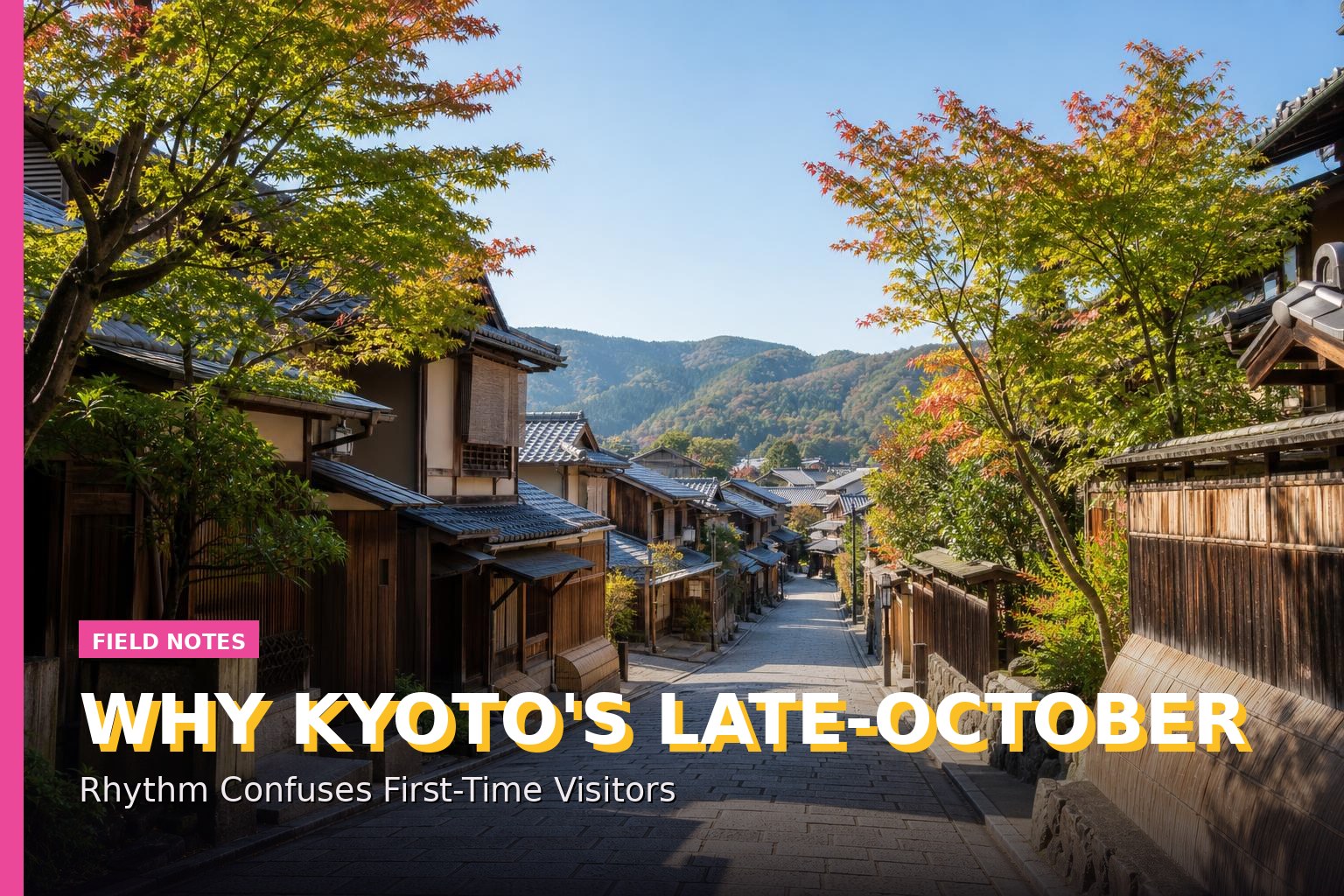
A guest asked us last Thursday, standing on a quiet lane just north of the bamboo grove, where everyone was. It wasn't a complaint. It was genuine confusion. She'd booked for late October specifically because a friend had warned her Kyoto would be impossible this time of year, and she'd arrived braced for shoulder-to-shoulder crowds and blazing maples. Instead she was looking at a side street with four other people on it and a maple tree that was still, essentially, green.
She wasn't wrong to expect either of those things. She was just a week or two early for both. And that gap — between what late October in Kyoto looks like in people's heads and what it actually delivers on the ground — is one of the most reliable misreadings of the year.
The colour isn't where you think it is
Here's the thing nobody tells you about Kyoto's autumn: the famous photos are mostly taken in the back half of November, sometimes bleeding into early December. Late October is not peak koyo. It is barely the opening act. The maples around the big temples — Tofukuji, Eikando, the Arashiyama hillsides — are still mostly green, with a few early branches turning at the tips.
If you came specifically to see red maples and you're here now, you have two options. You can hunt elevation, because the colour starts higher up and moves down. Mountain areas turn earlier than the city floor. Or you can accept that you're here for a different Kyoto — the one with comfortable walking weather, lower crowds at most sites, and the particular quality of light that late October has before the trees commit.
Neither option is a loss. But choosing the wrong expectation makes the week feel wrong, and that's avoidable.
The crowd expectation is also off
Guests arriving in late October routinely expect the kind of density you get in cherry blossom week. They don't get it. The city is busier than September, certainly, but the peak-autumn surge hasn't landed yet. The tour buses are warming up, not at full volume. Kiyomizu is manageable before mid-morning. Even Fushimi Inari, further up the mountain past the first photogenic tunnels, has space to breathe.
This matters because it changes what's possible. Routes that would be miserable in mid-November are genuinely pleasant now. Side streets we use year-round feel almost private. The bamboo grove, if you approach it through the back lanes rather than the main entrance, is a different place entirely at this moment in the calendar — closer to how it felt a decade ago than it will feel again until February.
What the weather is actually doing
Late October in Kyoto is, for a visitor who plans to walk a lot, close to ideal. Mornings have a real coolness to them. Afternoons warm up but rarely into discomfort. The summer heat that makes the monkey park hike in Arashiyama a genuine physical challenge is gone. The winter wind that cuts through temple courtyards hasn't arrived.
This is the window where guests notice things. In August, people are managing their body — looking for shade, water, somewhere to sit. In February, they're managing cold. In late October, there's nothing to manage, so attention is free to land on the actual place: the moss, the stonework, the way a particular garden was laid out to be read from one specific angle.
We lean into this. Our full-day routes run five to six hours. In peak summer that's demanding. Right now, it's the length of a long and genuinely enjoyable walk, and guests finish it tired in the good way rather than depleted.
Timing within the day still matters
The light shifts earlier this time of year. Afternoon takes on a slanted, honey quality by around three, and the hour before closing at many temples is the best hour to be inside them. The flip side is that temples, gardens and shops close earlier than visitors expect — often well before dinner. Advice to "go late to avoid crowds" ignores the fact that going late often means going to a closed door.
Our morning tours start at 9:00, 9:30 or 10:00. The reason is unglamorous: that's when the places along the route open. Starting earlier doesn't buy you solitude, it buys you locked gates. If you're planning your own day in late October, work backwards from closing times, not forwards from sunrise.
Why the month gets misread
Travel content runs on photographs, and the photographs that sell Kyoto autumn are from the peak. The peak is roughly three weeks long, and it's late. So people searching "Kyoto autumn" see November 20th imagery and book October 25th flights and expect them to be the same trip. They aren't.
There's also a general assumption that Japanese seasons run on a Western calendar. They don't quite. Autumn in Kyoto is a late-arriving guest; it shows up around the time the rest of the northern hemisphere is already into bare branches. The upside is that the window stretches further into December than most visitors expect. The downside is that late October, which sounds like it should be deep autumn, is really the shoulder before.
The honest cost of getting it wrong
The failure here isn't dramatic. You spend a week in Kyoto, see green maples, think "I guess this was overrated," and go home. The city was ready to show you something — a quieter, more comfortable, more walkable version of itself than the one in the brochure — and you were looking past it toward a photograph that was still three weeks away. You don't realise what you had, because you were measuring it against the wrong thing.
Reading a Kyoto week against the right calendar is most of what makes the week work. The month is the month it actually is, not the one in the search results.