
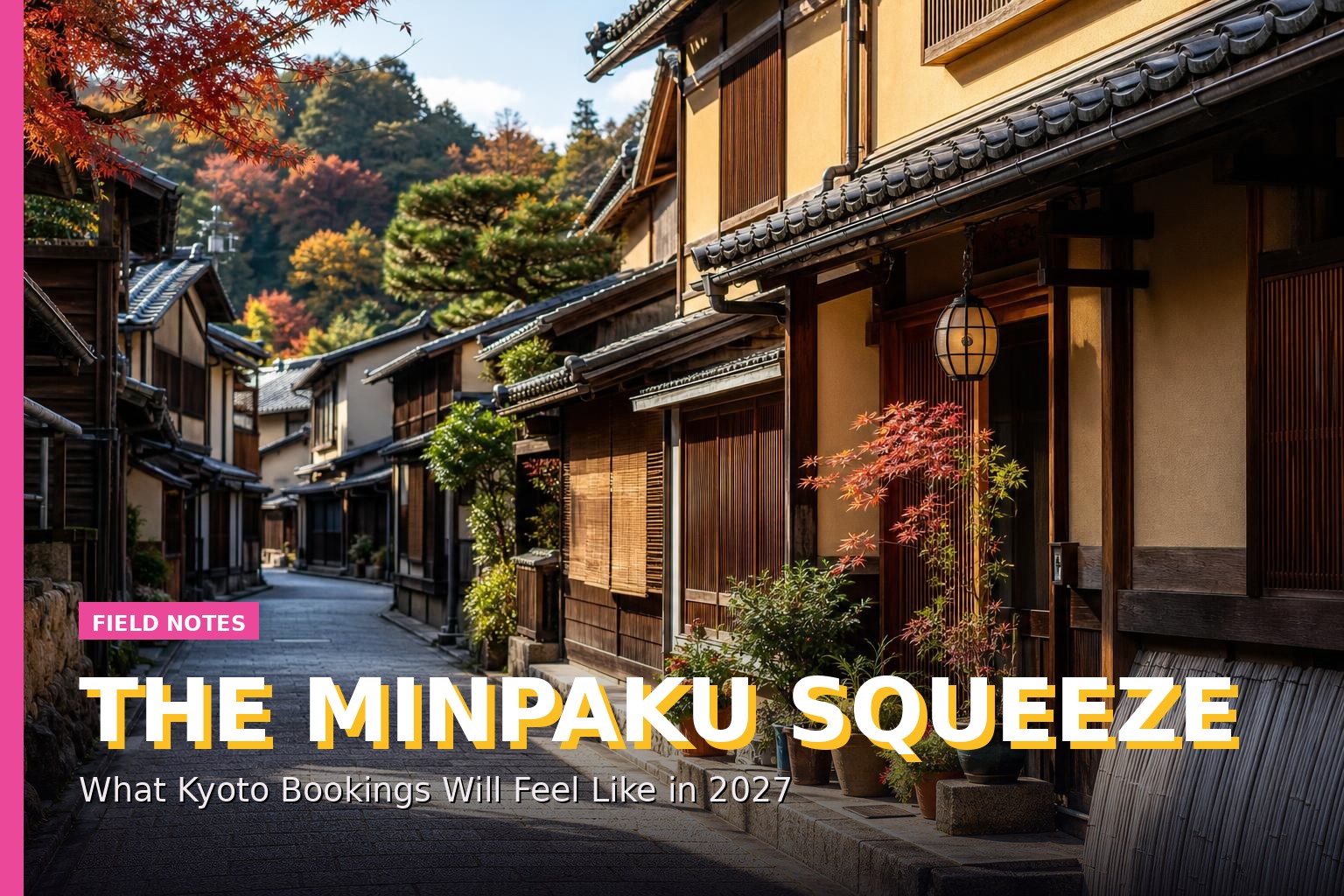
A guest last week held up her phone at our meeting point in Arashiyama and asked, gently, whether the apartment on her screen looked legitimate. She had booked it for a Kyoto stay the following spring. The listing showed a machiya interior, a narrow lane, no street number, and a host whose profile had been created two months earlier. She wasn't asking us to verify it — she already knew the answer. She was asking whether this was going to keep happening to her whole trip.
It's a question we've started hearing more often, and it will get louder over the next year. The rules around short-term rentals in Japan — minpaku — are tightening. Not everywhere, not all at once, but enough that anyone planning a 2027 trip should understand what's actually shifting under their feet.
What's actually happening
Earlier this year, the Japan Tourism Agency gave local governments more room to restrict minpaku in residential neighbourhoods. Tokyo has moved first and most visibly: Shinjuku announced restrictions, and Taitō — the ward that contains Asakusa and Ueno — is moving to ban new minpaku in residential areas from early 2027. Other wards are watching, and other cities are watching Tokyo.
Kyoto is not Tokyo, and the specific rules being written for Taitō don't automatically apply here. But Kyoto has been ahead of Tokyo on this question for years. The city already has some of the strictest short-term rental rules in Japan, put in place after residents in central neighbourhoods pushed back against the sudden appearance of suitcase-wheeling strangers in lanes where their grandparents had lived quietly for decades. What's changing nationally is the direction of travel, and the direction is one way.
For a traveller booking a stay in 2027, the practical effect is not that Airbnb-style listings disappear. It is that the pool of legitimate ones shrinks, the pool of grey-area ones gets flagged and pulled with less warning, and the gap between "this looked fine when I booked it" and "this is not a legal rental" becomes something you can fall into a few weeks before your flight.
The judgment: book the accommodation first, then the flights
This inverts what most travellers do, and it's the single most useful shift we can offer on this topic. Flights to Japan in spring and autumn 2027 will get expensive, and the instinct is to lock those in before prices climb. Then people find lodging around the flights.
The problem with that sequence in the current environment is that it treats accommodation as the flexible variable. It isn't, not in Kyoto, not anymore. Licensed ryokan, established hotels and properly registered guesthouses in the neighbourhoods you actually want to stay in — Higashiyama, around Nishiki, the streets north of Shijō — are a genuinely finite supply, and they book out early for cherry blossom and autumn windows. If you buy your flights first and then discover that everything legitimate in your budget is gone, you are one step from a listing that may or may not still exist when you land.
Book the room first. Then book the plane to match. If the room you want isn't available in your preferred week, that is information — move the week, don't move to a sketchier listing.
How to tell a legitimate listing from a grey one
Legal minpaku in Japan are required to display a registration number. On Airbnb and similar platforms, this shows up in the listing details, often near the bottom, sometimes as a string of digits with a prefix indicating the prefecture or the specific licensing scheme. If a Kyoto listing has no such number visible anywhere, that is the flag. Not proof of anything illegal, but a flag.
Other signals: hosts who won't share the exact address until after booking, listings that describe themselves as "private residences" or "friend's apartments" rather than registered accommodations, and prices that undercut everything comparable by a wide margin. The Kyoto machiya rental market is mature. Real ones are not cheap. If it looks like a bargain, it usually is one in the sense that someone else is absorbing a cost — often the neighbours.
What a good Kyoto base actually looks like
The other thing worth saying, because it comes up constantly on our tours: you do not need to stay in a machiya for the trip to feel like Kyoto. Some of the best-run small hotels in the city are on unremarkable blocks near a subway line, and they give you exactly what a Kyoto base should give you — a hot shower after a long walking day, breakfast that appears on time, staff who will explain that yes, most of the temples you want to visit close earlier than you'd expect and yes, cash is still useful.
Guests routinely underestimate how much walking a Kyoto day involves. The romantic lodging in a lane twenty minutes from any station stops being romantic on day three, when your feet are done and it's raining. A functional hotel near a Karasuma line stop, with a bath and a laundry machine, will do more for your trip than the most photogenic rental with a key lockbox down an alley.
Why this is happening at all
The pushback against minpaku in Japanese cities is not really about tourism numbers in the abstract. It is about specific streets where specific people live, and what it does to a neighbourhood when a third of the houses on it turn into rotating suitcases. Kyoto's central wards absorbed a lot of that, quickly, in the years before the pandemic, and the city has been recalibrating since. The current tightening is part of a longer conversation the country is having with itself about what tourism is allowed to do to daily life.
For a traveller, the useful frame is this: the rules are not designed against you. They are designed for the person whose window your rented balcony overlooks. Booking legitimately is not just protecting your own trip — it's the version of the trip that doesn't quietly cost someone else something.
The honest cost of getting it wrong
The failure mode isn't losing your booking on the day of arrival, though that happens. It's the softer version: you arrive, the place is technically functional, but the host is evasive, the neighbours are unfriendly in a way you can't quite read, the check-in involves a keypad and no human, and something about the whole arrangement feels slightly furtive. Nothing goes catastrophically wrong. You just spend a week in Kyoto feeling like you're not quite supposed to be where you are. That feeling is hard to shake, and it colours the rest of the trip.
Booking the room right is not glamorous work. It's an hour with a spreadsheet, six months before the flight, comparing licensed properties against a calendar. It's the least travel-magazine part of planning a Japan trip and it does more for the actual week than almost anything else.
The parts of a Kyoto trip that need judgment aren't the famous ones — they're the quiet decisions made months earlier that determine whether the famous parts land. Booking a base you can walk out of at 8:45 and meet us on time is one of them.