
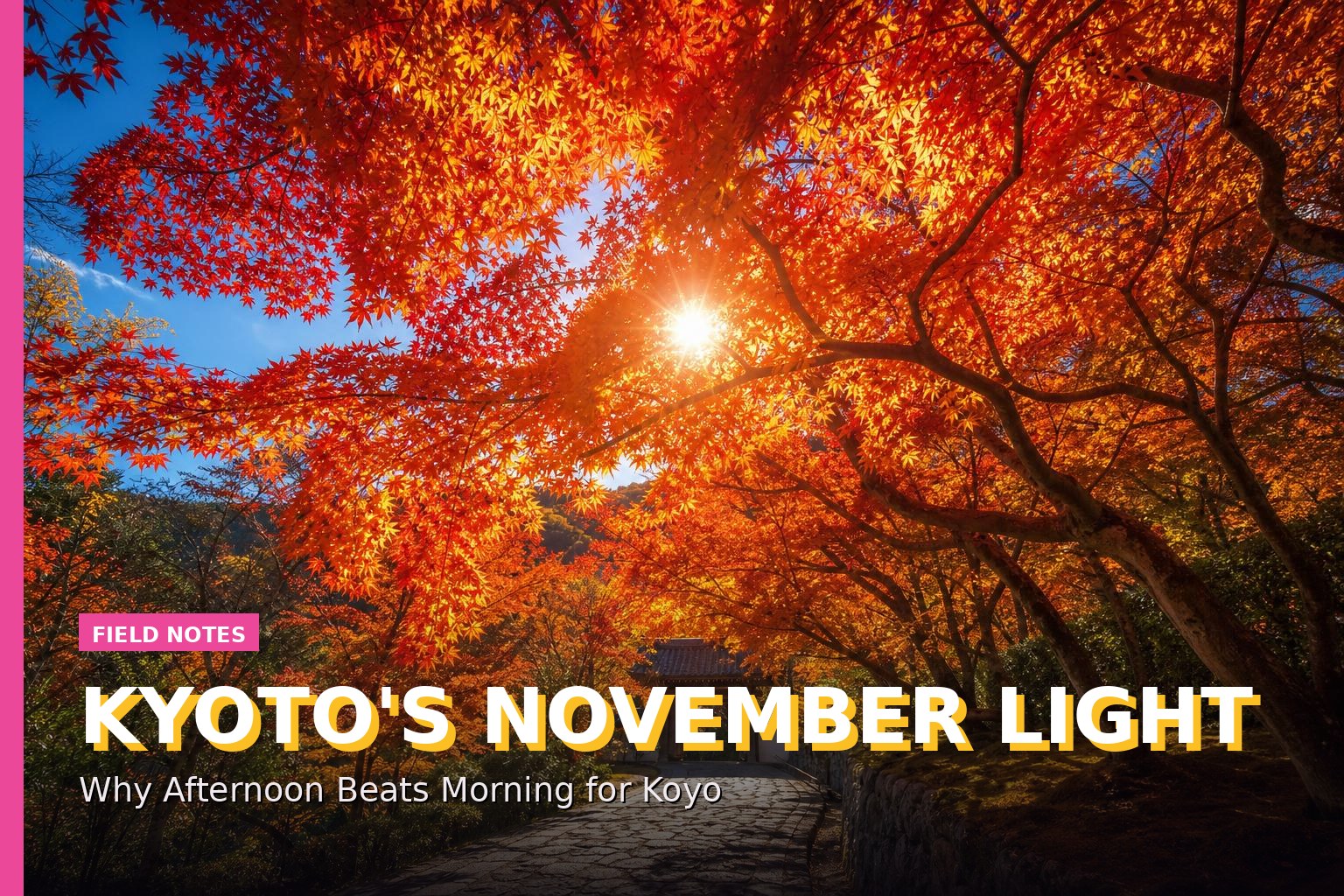
A guest asked me, halfway up a lane in Arashiyama last November, why the maples looked flat. It was a clear morning, maybe ten o'clock, and the leaves were doing what the brochures promised — red, orange, the whole catalogue. But flat. She was right. The colour was there and the picture wasn't. Two hours later, on the walk back down the same lane, she stopped on her own and said, oh. The light had moved. The leaves hadn't changed. The sun was now coming through them instead of landing on top of them, and the entire street had turned into a lantern.
That is November in Kyoto in one sentence. The leaves are the easy part. The light is the whole game, and most visitors are pointing their day at the wrong half of it.
What's actually happening to the leaves this month
Peak koyo in Kyoto drifts around. It is later than people expect — later than guidebooks printed years ago still suggest — and it varies by altitude and by temple. The maples at a mountain temple like Jingo-ji turn well before the ones on the Philosopher's Path. The ginkgoes do their own thing. By the time the city centre is fully red, somewhere up in the hills is already past it. There is no single peak weekend. There is a rolling two to three weeks where something is always at its best, and something else is either early or finished.
This is the part worth internalising: chasing a specific temple on a specific day because a photo from three years ago looked incredible there is a losing strategy. The better move is to walk a route where several things are at different stages, so one of them is always working.
Why afternoon light does more work than morning light
Autumn maples are translucent. That's the whole trick. A healthy momiji leaf in November is thin enough that light passes through it rather than bouncing off, and when it passes through, the colour saturates in a way that no amount of direct overhead sun will reproduce. This is why the same tree looks ordinary at eleven and extraordinary at three.
Morning light in Kyoto in November is often beautiful in its own right — low, cool, sharp — but it tends to light leaves from the side or the front. You see the colour. You don't see through it. By mid-afternoon the sun has swung around far enough that on a lot of Kyoto's famous walks, you're moving with the light at your back and the leaves between you and the sun. That's when the lane turns into a lantern.
The practical consequence: if you are picking one window for your maple walk, pick the second half of the day. If you are picking two, start somewhere that works in flat morning light — a dry garden, a mossy courtyard, something architectural — and save the trees for the afternoon.
The operational judgment, honestly stated
Here's where I have to be careful, because the honest version of this advice is less tidy than most blogs make it sound.
Our morning tours start at 9:00, 9:30 or 10:00. The driver of those start times is opening hours, not light. Shrines, temples and gardens open when they open, and starting earlier means arriving at closed doors. So we don't tell people to chase dawn light in November — in most places that light is landing on gates that are still locked.
What we do instead is sequence the day so the parts that benefit from late light land in late light. That means the leaf-heavy sections of the route come after the architectural and garden sections, not before. It's not that we delay the whole day; it's that we don't burn the best light on a stone garden that would look the same at noon.
You can apply the same logic without us. Do your enclosed spaces, your interiors, your gardens-with-walls earlier. Do your maple tunnels, your riverside walks, your anywhere-with-trees-above-you later. If you only remember one thing from this post, let it be that order.
What the famous November mistakes look like
The classic one is booking a sunrise entry to a famous maple spot, arriving in cold flat grey light before the gates open properly, taking photos that look like every other photo, and then being too tired by three in the afternoon to go back out. The light you paid a jet-lagged early alarm for was the worst light of the day for what you came to see.
The second one is treating a single temple as the destination. Kyoto in November rewards the walk between places more than any individual place. Half the best maples in this city are on lanes, in temple approach streets, in the gap between two famous things. If your plan is temple-to-taxi-to-temple, you've engineered the walking out of a city whose whole autumn case is the walking.
The third is assuming peak means crowded means miserable. Our routes stay largely the same in peak season because we built them around back streets in the first place. The quiet corners are still quiet if you know which corners they are. The famous corners are not quiet, and no amount of early-rising fixes that.
Why it works this way
Kyoto's maple walks were designed, over centuries, by people who were paying attention to light. Temple approaches point where they point for reasons. The old poetry about autumn in this city is not about the colour of leaves in the abstract — it's about leaves against evening sky, leaves with lanterns coming on behind them, leaves at the hour when the mountain shadow starts to climb the hillside opposite. The culture that built these places built them to be seen at a particular time of day, and that time of day was rarely nine in the morning.
Modern tourism inverted this because modern tourism optimises for crowd avoidance, and the easiest way to avoid crowds is to arrive before them. That's a real benefit. But it comes at a cost nobody tells you about, which is that you traded light for emptiness.
The honest cost of getting it wrong
The failure mode is quiet. You will see maples. You will take photos. The photos will be fine. You will go home and look at them and feel a small, hard-to-name disappointment, because the thing people describe about Kyoto in November is not in your pictures and you can't work out why. The answer is that you were there, but you were there at eleven, and the city was waiting until three to show you what it meant.
Reading November light in Kyoto takes a season or two of being in it. That's most of what you're paying someone else for when you walk this month with us.