
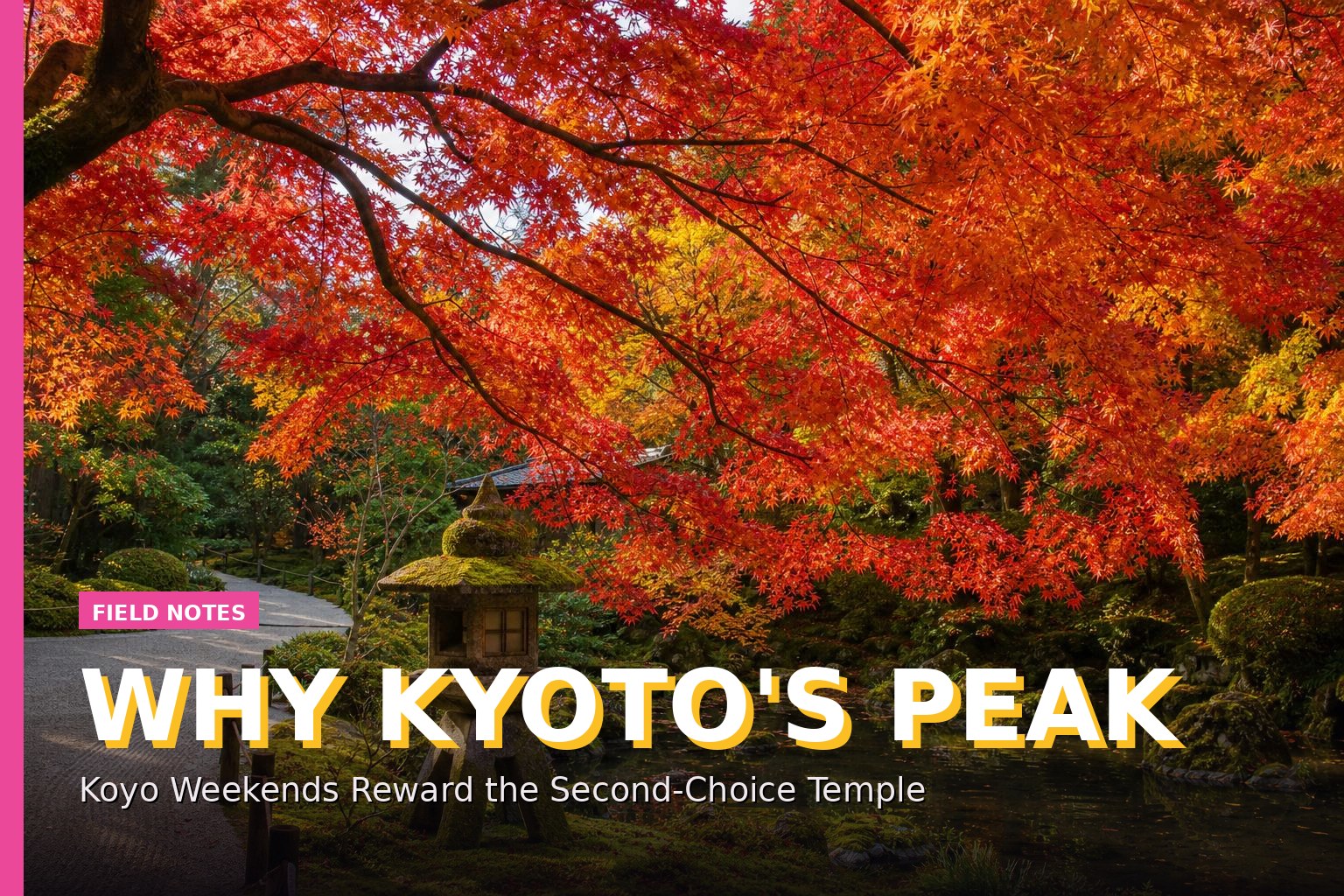
A guest last Saturday pulled out her phone on the walk between stops and showed me a list. Six temples, screenshotted from someone's blog, ranked by autumn-colour reputation. She wanted to know if we could add two of them to the day. It was already past eleven. We were in Arashiyama. The temples she wanted were in Higashiyama, on the other side of the city, on the first properly red weekend of the month. I watched her do the math on my face before I said anything.
This is the week where Kyoto starts to turn, and it's also the week where the gap between what visitors have planned and what the city will actually let them do opens up the widest. The list on the phone is almost never wrong about which temples are beautiful. It's wrong about how many of them fit in a day.
What peak koyo weekends actually feel like
The famous maple temples — the ones that appear on every list — share a problem in mid to late November. They are small. The paths through them are narrow, often one-way, and they were designed for a scale of visitor that no longer matches reality on a Saturday afternoon in colour season. You don't walk through them so much as shuffle, in a slow line, at the pace of whoever is in front of you taking photographs.
None of this is a secret. The temples know it, the city knows it, the guidebooks know it. What the guidebooks don't quite say is that the shuffle has a cost beyond time. You stop seeing the thing you came to see. Your attention narrows to the back of a stranger's jacket and the logistics of not stepping on anyone. The maples are above your head and you are looking at shoes.
The second-choice temple is often the better day
Kyoto has a long tail of temples with genuinely excellent autumn colour that are not on the top-five lists. Some are a short walk from the famous ones. Some are a neighbourhood away. They have maples, moss, a pond, a hall, a view — the full grammar of a Kyoto autumn garden — and on the exact same Saturday afternoon they are quiet enough that you can stand still in them.
The reason most visitors don't go to these places is not that they're hidden. It's that nobody has told them which ones are worth it, and the stakes of guessing wrong feel high when you've flown this far. So people default to the famous names and absorb the crowds as the price of certainty.
The operational judgment here is simple: on a peak weekend, the second-choice temple is usually the better choice. Not always. But often enough that it should be your default, not your fallback.
Why October expectations keep breaking in November
A related mistake lands this week too, from the other direction. Guests who booked for early November expecting peak colour sometimes find Kyoto still mostly green, and guests who booked for late November expecting empty temples find them full. Both groups are working from the same flawed model: that autumn in Kyoto is a fixed date on a calendar.
It isn't. The colour arrives when it arrives, and it depends on elevation, species, the specific garden, and the weather of the preceding three weeks. A temple at the base of the eastern mountains and a temple in the northwest can be a full week apart in the same November. Within a single garden, the maple by the gate can be red while the maple by the pond is still green.
What this means in practice: the list on the phone is not just over-packed, it's also wrong about which temples will be at their best on your particular day. The temple you were most excited about might peak three days after you leave. The temple you'd never heard of might be unimprovable the morning you arrive.
How we actually decide
Our full-day routes run five to six hours, deliberately. That isn't a compromise — it's a design decision. Cramming a sixth temple into the day doesn't give you more Kyoto, it gives you less of each place and more time on trains and in queues. Guests consistently say the pacing was right. That pacing is what lets a quiet corner stay quiet, because small groups fit into places large groups don't.
Our route in Arashiyama stays largely the same between shoulder season and peak, because crowd avoidance is built into the route itself — we approach the bamboo through back streets and use a lesser-known entrance rather than queuing at the main one. What changes in November is which gardens we weight the day around, based on where the colour actually is that week. We adapt to conditions, not to the calendar.
The monkey park, incidentally, is at its best in cooler weather, and November is cooler weather. It's also still a real uphill hike that guests underestimate every single week. If it's on your plan this month, wear the shoes you'd wear for a proper walk, not the shoes you'd wear for a temple.
Why it works this way
Kyoto's famous autumn temples became famous because they are, in fact, extraordinary. The problem is that fame compresses demand into exactly the weeks the temples are least able to absorb it. The gardens were built for contemplation at a speed that a crowd physically cannot produce. There is no version of a packed path through a small moss garden that delivers what the garden was designed to deliver. The design assumes a pace.
The second-choice temples work in November because the same design logic applies to them, and the demand hasn't found them yet. They aren't lesser. They're just less listed.
The honest cost of getting it wrong
The failure mode in peak koyo week isn't dramatic. You get to all your temples. The colour is there. The photos work. You go home pleased. What you don't know is that you spent the best light of the day in a slow line, that the garden two streets over was empty and better, and that your afternoon temple hadn't turned yet while your morning temple had already dropped half its leaves. There's no moment where it goes wrong. It just quietly doesn't go as right as it could have.
Reading a peak koyo weekend — which temple is at colour, which is crowded past the point of usefulness, which quieter one is three minutes away and currently perfect — takes a season of watching it happen. That reading is most of what you're paying for when someone else plans the day.