
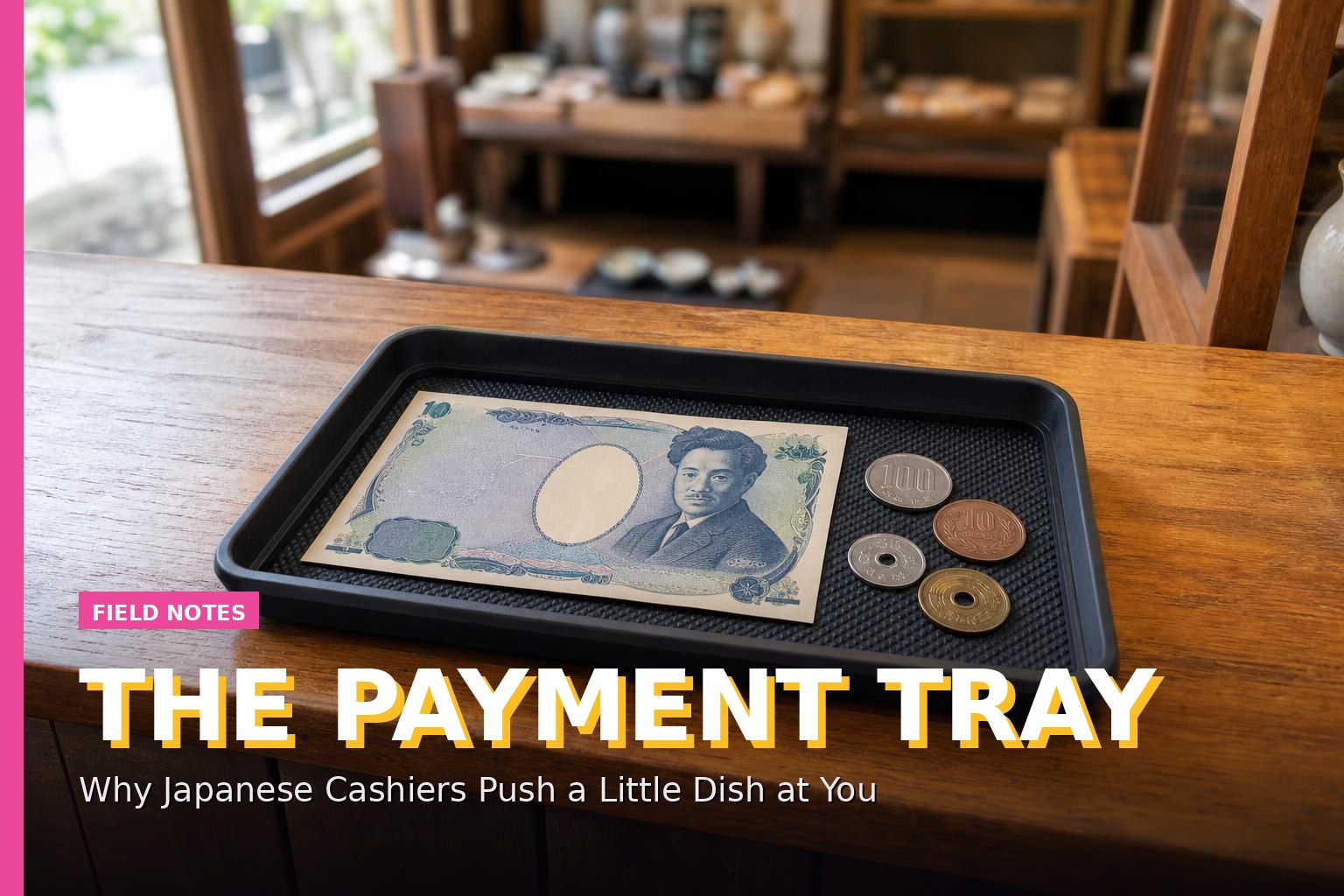
A guest on our Arashiyama route last week bought a bottle of water from a vending-adjacent kiosk near the bamboo entrance. She held out a thousand-yen note, pinched between two fingers, the way you'd hand cash to a bartender in New York. The clerk didn't take it. There was a two-second pause — long enough to notice, short enough to be polite — and then the clerk gently nudged a small plastic tray across the counter. The guest looked at the tray, looked at her note, looked at me. She put the note on the tray. The clerk picked it up and the transaction resumed as if nothing had happened. Afterwards she asked, genuinely: Did I just do something rude?
Not rude. Just off-script. And the script is worth knowing, because you will encounter this little tray roughly fifty times on a two-week trip, and the way you handle it quietly signals whether you've been paying attention.
What the tray is actually for
The small tray on the counter — usually plastic, sometimes rubberised, often with the shop's logo on it — is called a calton or more commonly just o-bon. It is not decorative. It is not a tip tray. It is the designated surface for money to change hands.
You place your cash on the tray. The cashier picks the cash up from the tray. The cashier places your change (and often your receipt) back on the tray. You pick the change up from the tray. Hands do not meet. Cash does not pass directly between people.
There are practical reasons. Coins are easier to count on a flat surface than in a palm. Notes don't flutter. Loose change doesn't get dropped. In a country that still runs a surprising amount of its daily economy on cash, the tray is a small piece of infrastructure that makes thousands of tiny transactions a day run a few seconds faster.
But the deeper reason is that the tray exists to slow the moment down. A transaction in Japan is not a hand-off. It's a small, structured exchange with a beginning, a middle, and an end — and the tray gives both parties a surface on which to perform it correctly.
When to use it, when to skip it
The rule is simple: if there's a tray, use the tray. Don't try to hand cash directly to the cashier if a tray has been placed in front of you — you'll be gently redirected, as our guest was, and the whole small ceremony stalls.
If there's no tray — a tiny food stall, a festival stand, a taxi — then direct hand-to-hand is fine. In those cases, the convention shifts to a different one: offer and receive with both hands, or at minimum support one hand with the other at the wrist. The two-handed gesture is the same signal the tray provides. It says: I am giving this to you deliberately, not tossing it.
Credit card payments follow the same logic. If a tray appears, put the card on the tray. If the terminal is turned toward you to tap or insert yourself, do that. Watch for the cue — the clerk will make it obvious.
The small details that mark you as paying attention
A few things that visitors routinely get slightly wrong:
- Notes go flat, not folded. If you've been carrying a crumpled note in your pocket, take the extra second to smooth it before placing it down. Not for ceremony — for the cashier, who has to count it.
- Face the notes the same way. If you're paying with several bills, line them up facing the same direction. This is a small kindness that regular customers do automatically.
- Don't scoop change off the tray in a rush. Coins first, then the note, then the receipt. The cashier is often still finishing their part of the exchange — a bow, a thank-you phrase — and sweeping everything away mid-sentence cuts them off.
- The receipt is not optional litter. It's handed to you as part of the transaction. Take it, then deal with it later. Waving it away is readable as impatience.
None of this is tested. Nobody is grading you. But cashiers notice, in the same low-key way a good waiter in Rome notices whether you know how to order coffee. It changes the temperature of the interaction by about two degrees, and over a two-week trip those two degrees add up.
Why it works this way
Japan's service culture is built on the idea that a transaction is a small relationship, not a transfer. The cashier has a role to play, and so do you. The tray exists because the alternative — hands meeting over a counter, cash crumpled from pocket to pocket — collapses the roles into something more casual than the moment is meant to be.
This is also why the omotenashi you hear so much about doesn't feel performative when you encounter it in person. It's not that staff are being extra nice to you. It's that the entire system assumes both sides are participating in a shared piece of choreography. The tray is one of its smallest, most visible props.
Once you see it this way, a lot of other small Japan things stop seeming mysterious. The way shop staff hold your bag with two hands when they pass it back. The way a taxi driver places your change on a small cloth. The slight pause before the receipt is handed over. All the same instinct: this is a moment, treat it like one.
The honest cost of getting it wrong
The failure mode here is not dramatic. Nobody will scold you. The cashier will absorb the awkwardness with a smile and the queue behind you will not visibly care. You will walk out of the shop with your water and your change and nothing bad will have happened.
But something small will have been missed. You'll have had a transaction instead of a tiny exchange, and over a trip made of hundreds of these moments, that's the difference between feeling like you visited Japan and feeling like you were briefly inside it. The country rewards travellers who notice the small shapes of things. The payment tray is the easiest one to start with.
The small ceremonies are the whole texture of a Japan trip. Noticing them is most of what makes the difference between watching the country go by and actually being in it — and that's the muscle a good day on the ground is really building.