
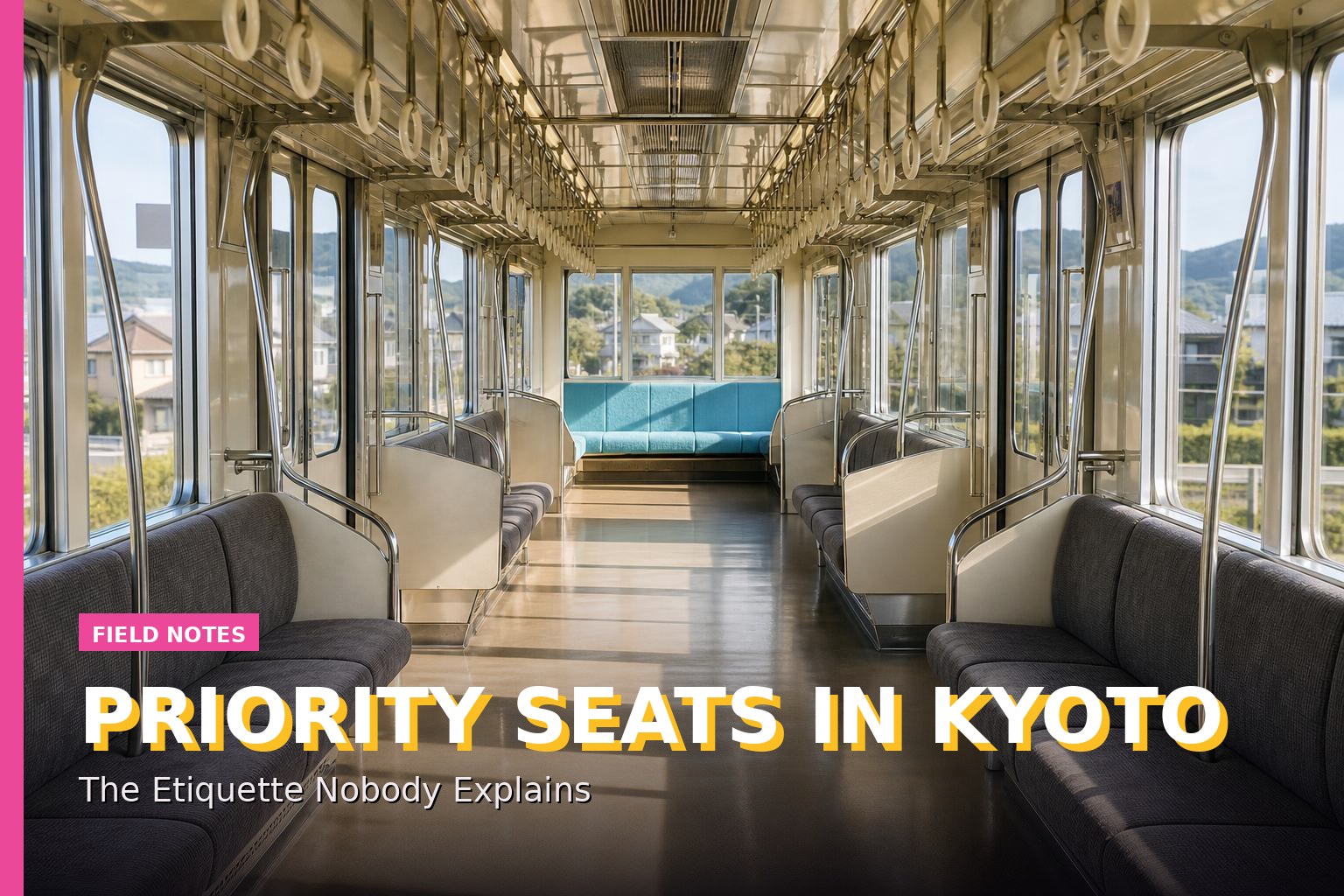
A guest on last week's Arashiyama tour asked me a question on the JR platform at Saga-Arashiyama that I've now heard dozens of times. She pointed at the two rows of pale blue seats at the end of the carriage — visibly empty, on a train that was otherwise packed shoulder-to-shoulder — and asked, quietly, whether she was allowed to sit there. She was in her early thirties, holding a folded coat, mildly tired from a morning on her feet. Nothing about her looked like she'd be judged for sitting down. And yet the whole carriage of Japanese commuters was standing.
She sat down. Nothing happened. She still spent the ride to Kyoto Station wondering if she'd done something wrong. That question — was that okay? — is one of the most common ones we get, and the honest answer is more interesting than yes or no.
What priority seats actually are
Priority seats — yūsen zaseki — are the pale-coloured seats at the ends of most train and subway cars in Kansai. The stickers above them show the four categories they're reserved for: elderly passengers, pregnant women, people with disabilities or injuries, and passengers with small children. In Kyoto you'll see them on JR lines, on the Karasuma and Tozai subways, on Hankyu, Keihan, and the Randen tram out to Arashiyama.
Here's the part guidebooks miss: they are not legally reserved. There is no fine, no announcement scolding you, no conductor who will move you along. In that sense, sitting there when the carriage is empty is genuinely fine and locals do it all the time. The etiquette is entirely social, and it operates on a sliding scale depending on how crowded the train is and who else is in the carriage.
The sliding scale, in practice
Empty carriage, mid-afternoon, no one boarding at the next stop: sit wherever. Nobody cares.
Half-full carriage, a few standing passengers, mixed ages: you can sit in a priority seat, but you're expected to be alert. If an elderly person boards, you stand. If a visibly pregnant woman boards, you stand. You don't wait to be asked. You don't make eye contact and offer — that's more awkward for the person you're offering to than you realise. You just stand up and step away, and they take the seat, and no one says anything. That last part is the whole point.
Packed carriage at rush hour: this is where visitors get it wrong most reliably. The priority seats are often the only ones still empty, and it looks like a gift. It isn't. On a packed train, taking a priority seat as an able-bodied adult is read as either not knowing better (forgivable, you're a tourist) or not caring (less forgivable). Locals will not say anything. They will notice.
Why locals pretend to sleep
There's a small ritual you'll see on any full Kansai train. Someone in a regular seat — not a priority seat, a regular one — closes their eyes when the train pulls into a station. They are not tired. They are opting out of the transaction where an elderly passenger boards, they see them, and social pressure requires them to give up their seat. Eyes closed, they can plausibly claim not to have noticed.
This looks cynical from the outside. It isn't quite. What it actually reveals is how strong the unwritten rule is. If giving up your seat were merely nice-to-do, nobody would need the fake nap. The nap exists because the expectation is real enough to require an exit.
For a visitor, the useful takeaway isn't to judge the sleepers. It's to understand that when a Japanese person does stand up and offer their seat, they are not performing kindness — they are meeting a baseline. And when you do the same, quietly, without fuss, you're not doing something special. You're just behaving like a normal adult on the train. That's the register to aim for.
The Kyoto-specific bit
Two things are worth knowing about Kansai trains specifically.
First, the Randen — the little tram that runs out to Arashiyama — gets extremely crowded on weekends and during peak seasons. It's a single car, no separation between priority seats and the rest, and it fills with tourists who have no idea the etiquette applies. If you're on it and an older Kyoto resident boards with shopping bags, you stand. This is one of the moments where being visibly considerate as a foreign visitor genuinely lands. People remember it.
Second, phones. The rule on priority seats has historically been stricter: phones off entirely, not just silent. In practice this has softened to "silent mode and no calls," which is the rule for the rest of the train anyway. But if you're in a priority seat and your phone rings, the seat you chose makes it worse. Move to the deck between cars to end the call.
Why the whole system works this way
Japanese public etiquette runs on a principle that's easy to state and hard to internalise: the goal is to avoid creating a situation where anyone has to be asked, corrected, or thanked. The priority seat system is a physical implementation of that. The coloured seats mean nobody has to make a request — the request is baked into the furniture. If you're sitting there and someone who needs the seat appears, the seat itself has already made the ask. You just respond.
This is why offering loudly, gesturing, or insisting can feel worse than not offering at all. It turns a smooth social transaction into a small event. The gold standard is: you stand, you step toward the door, you look at your phone. The other person sits. Nothing is said. Everyone gets off the train having had a slightly better day.
The honest cost of getting it wrong
The failure mode here is not dramatic. Nobody will scold you. You will not be removed from the train. What happens is subtler: you'll spend a week in Kansai with a low background hum of not being sure whether you're reading the room correctly, and you'll never quite find out, because the whole point of the system is that nobody will tell you. You'll go home thinking Japanese people are reserved. What actually happened is that you were being politely absorbed, over and over, by a system designed to prevent friction — and you never saw the mechanism working.
The trains are where a lot of Kansai's unwritten rules live in miniature. Reading them takes a while on your own. Walking a full day with someone who reads them automatically is most of what we're offering.