
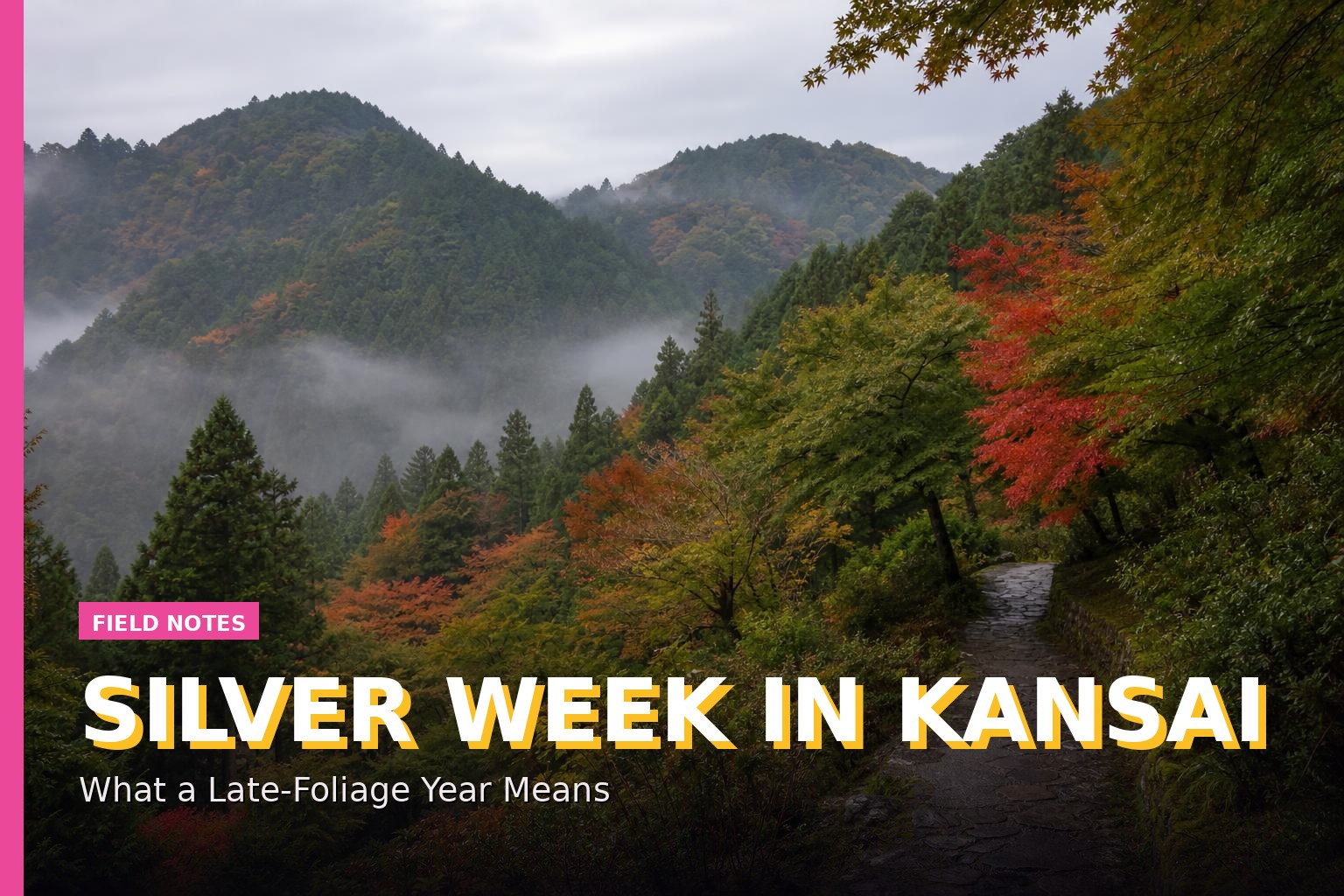
A traveller emailed us in late August. She'd booked a week in Kyoto for mid-September, chasing what she called "early autumn." She wanted to know which temples had the best red maples, and whether she should skip Arashiyama on a weekend or brave it. Both questions had the same answer, and it wasn't the one she wanted: in mid-September, there are no red maples in Kyoto. There are cicadas winding down, humidity that still catches you on the walk uphill to Kiyomizu, and a five-day domestic holiday that will fill every shinkansen car heading west. That's the trip. It's a good trip. It just isn't the trip she thought she'd booked.
This year that mismatch is going to happen more than usual, because two things collide in September 2026. Silver Week lands as a rare five-day run, and the first foliage forecast has already flagged that autumn colour is running late almost everywhere. If you're travelling this month, or thinking about November, it's worth understanding both.
Silver Week is a domestic travel event, not a foreign one
Silver Week is the September cluster of public holidays — Respect for the Aged Day and the Autumn Equinox — that occasionally line up with a weekend to produce a proper five-day break. It doesn't happen every year. The calendar has to cooperate. When it does, Japanese families travel, and they travel in the same patterns Western visitors do: Kyoto, Nara, Hakone, the shinkansen corridor. The result is a week that looks, from the platform at Kyoto Station, indistinguishable from Golden Week in May.
What this means in practice: reserved seats on the Tokaido Shinkansen sell out days in advance during the middle of the run. Popular ryokan in Hakone and Kinosaki fill months out. Kyoto's most photographed spots — Fushimi Inari, Kiyomizu-dera, the bamboo grove — hit their annual crush levels on the middle days of the holiday. And the domestic travellers doing this are, generally, better prepared than foreign visitors. They booked in spring.
If you're mid-trip during Silver Week and you haven't reserved shinkansen seats, do it as soon as you know your dates. Non-reserved cars exist, but on the middle days you may stand from Tokyo to Kyoto. If you're picking day trips, this is the week to invert the usual advice: go where the domestic tourists aren't. Ohara instead of Arashiyama. Uji instead of Fushimi. The smaller temples in northern Higashiyama instead of the headline three.
The foliage forecast, and why it matters this year
The Japan Meteorological Corporation puts out its first foliage forecast in early September, and this year's says autumn will land later than the long-term average across most of the country. Some places by a few days. Some by more than a week. The reason is straightforward — a hot summer that stretched deep into September — but the implication is what travellers should sit with.
Kyoto's koyo is not a fixed window. It shifts. In an average year, the city's maples turn through the second half of November and hold into the first week of December. In a late year, that whole curve slides right. Trips booked for mid-November on the assumption that colour will already be there can arrive to a green city with a few early trees turning near ponds and on north-facing slopes. Trips booked for early December on the assumption that everything will be past peak can walk into the best week of the season.
Reading the forecast without over-trusting it
Foliage forecasts are directional, not precise. They tell you whether the year is running early, average, or late, and roughly by how much. They do not tell you which weekend to be in Tofuku-ji. Two things move around underneath the headline number: micro-climate and elevation.
Kyoto is a basin. Cold air pools in it, but unevenly. The hills to the north and east turn before the flat city centre. Kurama and Kibune run ahead of Arashiyama. Ohara runs ahead of Gion. Within a single temple garden, the maples on the pond's north bank often turn a week before the ones on the south. If you're planning around a late year, this is useful: elevation buys you time in either direction. Go higher earlier in the season, lower later.
The second thing worth knowing is that peak isn't a single day. The good window in Kyoto is usually about ten days long, and the shoulder either side is genuinely beautiful — arguably more so, because the crowds are thinner and the light through half-turned leaves is softer than through the full red canopy everyone photographs.
Why the timing wobbles
Maples turn when night temperatures drop below roughly ten degrees for a sustained stretch, and when the tree has had enough dry, sunny days to build the sugars that produce red pigment. A hot late summer delays the first condition. A wet, cloudy November mutes the second. Kyoto's climate — humid, basin-trapped, tempered by the surrounding hills — makes the city both reliable for good colour in most years and unusually sensitive to the years that run off-pattern. The temples were, in many cases, built and gardened with this cycle in mind. The maples at Tofuku-ji weren't planted for tourists. They were planted because the monks liked looking at them, and they liked looking at them in a specific week that used to be more predictable than it is now.
What to actually do with this
If you're travelling in September, treat it as late summer, not early autumn. The heat is real, the colour isn't there yet, and Silver Week will shape your week whether you plan for it or not. If you're travelling in November, watch the forecast updates through October — they refine as the season approaches — and build flexibility into the koyo portion of your trip. A day you can shift by 48 hours is worth more than a day locked to a reservation. And if your dates are fixed, pick a range of elevations rather than a single famous spot, so at least one of them is inside the window when you arrive.
This is the sort of thing we build routes around — the planning is the boring part, the result is just a better week.