
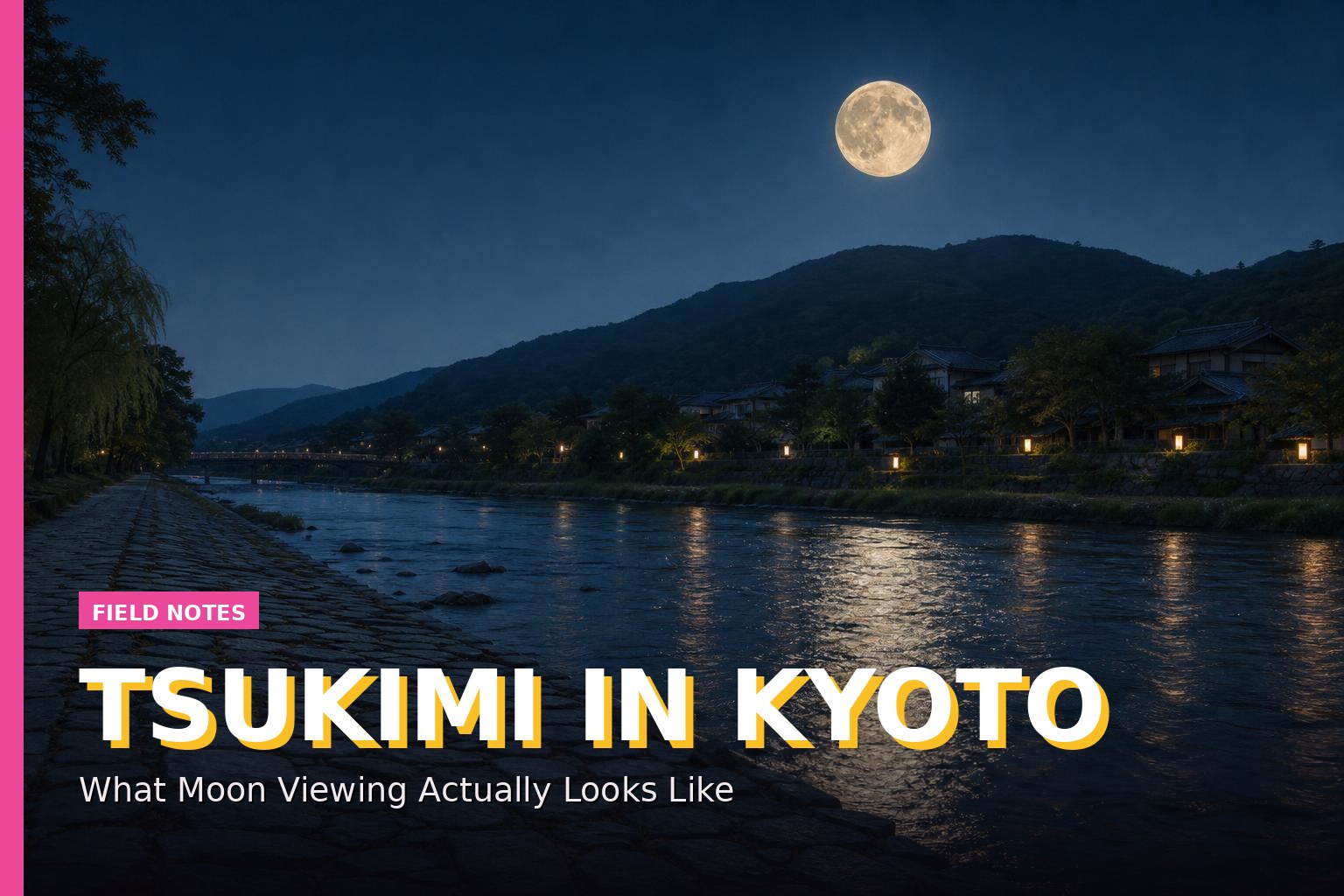
Every September, a certain kind of traveler arrives in Kyoto expecting tsukimi to look like a festival. Lanterns strung between trees. A crowd on a stone bridge. Someone playing a flute. They ask us where the moon viewing is, the way you'd ask where the fireworks are, and we have to gently rearrange the expectation.
Tsukimi isn't a festival. It's a mood. There are a handful of temples and shrines in Kyoto that hold formal moon-viewing evenings, and they are worth going to. But the tradition itself is quieter than that — closer to a shared national pause than to an event with a start time. If you understand what you're actually looking for, the harvest moon becomes one of the best reasons to be in Kansai in early autumn. If you don't, you spend the evening wondering where everyone is.
What tsukimi actually is
Tsukimi means, literally, moon viewing. The tradition centers on the full moon closest to the autumn equinox — the harvest moon, jugoya — and a second, smaller viewing about a month later. The exact date shifts each year with the lunar calendar, but it always lands somewhere in September or early October. Check before you commit to a specific evening; it's the kind of thing your hotel front desk will know off the top of their head.
On the night itself, families set out susuki (pampas grass) and small round dumplings called tsukimi dango on a windowsill or veranda. Some people drink sake. Some just step outside and look up. That's most of it. The tradition came from the Heian court, where aristocrats composed poetry by moonlight and looked at the reflection of the moon in lacquer bowls of sake rather than staring directly at the sky — the reflection was considered more refined. A thousand years later, the mood of the thing hasn't really changed. It's a night for noticing.
Where the formal moon viewings happen in Kyoto
A few temples and shrines do hold observances that visitors can attend, and Kyoto is unusually good for this because so many of its gardens and ponds were built with moon reflection in mind. Daikaku-ji, up in Sagano, is the classic one — its Osawa Pond was designed in the Heian period specifically as a place to view the moon from a boat. On the nights of the observance, the temple opens after dark and small boats go out on the water. It's the closest thing in Japan to what a Heian courtier's evening might have felt like, and it books out early. If you want to go, you need to know your dates well in advance.
Shimogamo Shrine and a handful of others also hold moon-viewing evenings with music and offerings. These tend to be free or close to it, and they tend to be busy in a gentle, local way — more families and elderly couples than tour groups. The programme is usually short. You arrive, you watch, you leave. Nobody is trying to keep you entertained.
The quieter version, which is often better
Here's the thing worth knowing: the formal events are lovely, but they aren't the point. The point is looking at the moon.
Kyoto is a city built for this. The Kamo River banks are wide open to the sky and full of people on any warm evening. Walk north from Sanjo along the river after dinner and you'll pass students, couples, older men with cans of beer, all of them out doing more or less nothing. On a full moon in early autumn, with the humidity finally breaking and the air starting to feel like something other than a wet towel, this is one of the best free things you can do in the city.
The eastern hills — Higashiyama — also give you clean sight lines. The stone paths above Kiyomizu and around the Philosopher's Path aren't lit for tourists after dark; they're lit for people who live there. Walk them on a bright-moon night in September and you'll understand why a thousand years of Japanese poets wouldn't shut up about this particular light.
Arashiyama works too, though it empties out early. The Togetsukyo Bridge — the name literally means "moon-crossing bridge" — was named for the way the moon appears to walk across it. Stand on it after the day-trippers have gone home and you'll see what they meant.
What people eat, and why it matters less than you think
Tsukimi dango are round white rice-flour dumplings stacked in a small pyramid. Bakeries and wagashi shops all over Kyoto sell them in the run-up to the full moon, and they're worth buying once for the ritual of it. Convenience stores also run tsukimi-themed items every year — the tsukimi burger at a certain fast food chain is a genuine national event, which tells you something about how the tradition has evolved.
But food isn't really the centerpiece here the way it is at other seasonal moments. Hanami is about the picnic. Tsukimi is about the moon. If you spend the evening hunting down the correct dumplings, you've slightly missed the assignment.
Why it works this way
Japan's seasonal calendar is unusually granular. There are the four seasons everyone knows, then the twenty-four sekki, then the seventy-two ko — micro-seasons of five days each, each with its own name. "Cotton flowers bloom." "Swallows return." "Cold dew." The whole culture is built around the idea that noticing is a form of participation.
Tsukimi belongs to this logic. It isn't a festival because it doesn't need to be. The moon does the work. Your job is to be outside, or near a window, and to acknowledge that something is happening. That the year is turning. That the heat has finally broken. That autumn, which in Japan is a real and specific and short thing, has arrived.
Once you understand that, you stop looking for the event and start experiencing the tradition the way most Japanese people actually do — as an atmosphere rather than a schedule.
What this means if you're here in September
Check the date of the harvest moon before you build your Kyoto evenings. If it falls during your trip, don't overprogramme that night. Eat somewhere with a view, or eat early and walk the river, or find a temple garden that stays open late. If one of the formal observances at Daikaku-ji or Shimogamo lines up with your dates and you can get in, take it. If not, the city itself is the observance.
Half of what a small tour is: someone who already knows which nights in the year deserve to be kept open, and which ones can hold a dinner reservation.