
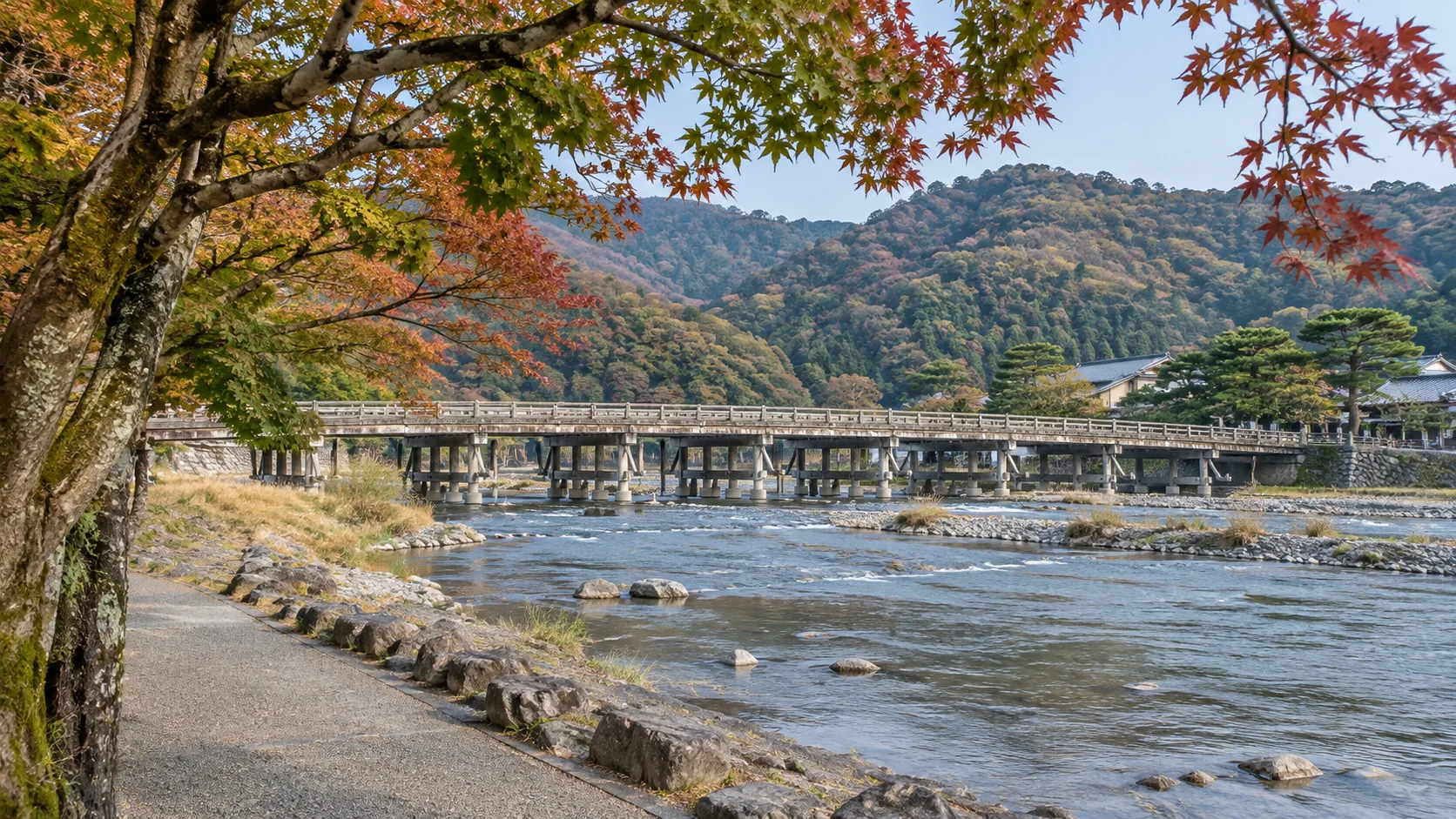
If Arashiyama is on your Kyoto itinerary for the coming two weekends, check your journey home before you leave. Temporary traffic arrangements are scheduled for November 21, 22, 23, 28 and 29, 2026. A familiar bus-stop name on your phone is not enough: the date, direction and actual boarding point matter.
Kyoto's official autumn visitor update, dated November 18, includes these measures. This is a practical heads-up for the approaching dates, rather than an announcement that all the arrangements were introduced this week. Monday, November 23 is included as a holiday, so do not treat it as an ordinary weekday.
What changes on the road
The city's autumn traffic plan, published October 15, sets out restrictions for both Arashiyama and eastern Kyoto. Read the Arashiyama section; the timings for another district are not interchangeable.
For the five dates above, the plan describes Nagatsuji-dori, between Sanjo-dori and Marutamachi-dori, becoming northbound-only for affected vehicles from 11 a.m. to 1 p.m., then a pedestrian road from 1 p.m. to 5 p.m. The earlier one-way period excludes motorcycles and light vehicles; the later pedestrian-road restriction covers all vehicles. These are specific road arrangements, not a closure of Arashiyama as a destination.
For visitors, the useful distinction is between choosing a place to visit and choosing how to reach it. A road set aside for walking does not mean your usual bus will continue to stop beside it.
City Bus diversions start before the pedestrian period
The Transport Bureau's November 9 City Bus notice and route map gives an approximate diversion period of noon to 5 p.m. on those five dates. Police decisions can change the implementation times. Do not assume buses follow their normal route until 1 p.m.
Among the suspended stops are the northbound Arashiyama Tenryuji-mae (Randen Arashiyama Station) and Nonomiya stops. Direction is important: this is not a blanket statement that every stop with either name disappears.
One useful example: Arashiyama-bound routes 85 and 93 terminate at a temporary Saga Shogakko-mae stop. In the opposite direction, route 85 for Kyoto Station and route 93 for Kinrin Shako-mae start from the southbound Saga Shogakko-mae stop.
The notice also covers routes 11, 28 and 109. Use its map for the complete route and temporary-stop details rather than extending the 85/93 example to another bus. The bureau warns that Pocket Location plus+ arrival information may differ from actual operations during diversions. Check the posted notice and destination display as well as your phone.
Weekdays have a separate notice
Visiting on Tuesday, November 24, instead? Consult the separate weekday City Bus notice, published October 23. It applies on weekdays from November 2 through 27 to services in the 10 a.m. through 4 p.m. departure hours. The Japanese wording includes the whole 4 p.m. hour; it does not mean everything returns to normal at exactly 4 p.m.
That notice concerns the southbound arrangements and lists changes for route 11 towards Sanjo Keihan and route 28 towards Kyoto Station. Its suspended stops include southbound Nonomiya and southbound Arashiyama Tenryuji-mae. This is why saving a screenshot headed only “Arashiyama bus changes” can be misleading. Keep the date range and direction visible.
Consider a rail-based journey
Our recommendation for an ordinary sightseeing visit is to compare a rail route before committing to a bus in both directions. Kyoto's official Saga and Arashiyama access guide sets out several options:
- From Kyoto Station, take the JR Sagano Line to Saga-Arashiyama Station.
- From Kyoto-Kawaramachi, take Hankyu to Katsura and change to the Arashiyama Line.
- A subway-and-Randen alternative goes via Karasuma Oike, Uzumasa Tenjingawa and the nearby Randen connection.
These involve different stations and different walks. Save the full station name and operator, rather than searching for “Arashiyama Station” and assuming every result is the same place.
Rail is not a promise of an empty carriage or a step-free journey. The official guide also flags crowding on the JR route. Choose according to your starting point, walking tolerance and any access needs, then check the current service information. We are recommending a way to reduce dependence on the diverted bus stops, not guaranteeing a faster trip for every hotel or destination.
A small amount of planning beats guessing at the stop
Before setting out, save the relevant official notice and its map. Write down your return route's destination, not just its number. If you have an evening reservation, leave room to find a changed boarding point rather than planning around the last possible connection.
For a family or a group, agree on the return plan while everyone is together. If someone needs a shorter walk, check that requirement before deciding that a train is automatically the answer. A transfer-heavy alternative can be inconvenient in a different way.
Finally, follow on-site instructions if they differ from an earlier screenshot. This update is checked on November 20 for the approaching dates; it is not a permanent Arashiyama transport guide. For a later trip, reopen the operator's current notice rather than reusing this month's stop arrangements.
Featured image: AI-generated Arashiyama-inspired illustration. It does not document current foliage, visitor numbers or temporary transport arrangements.