
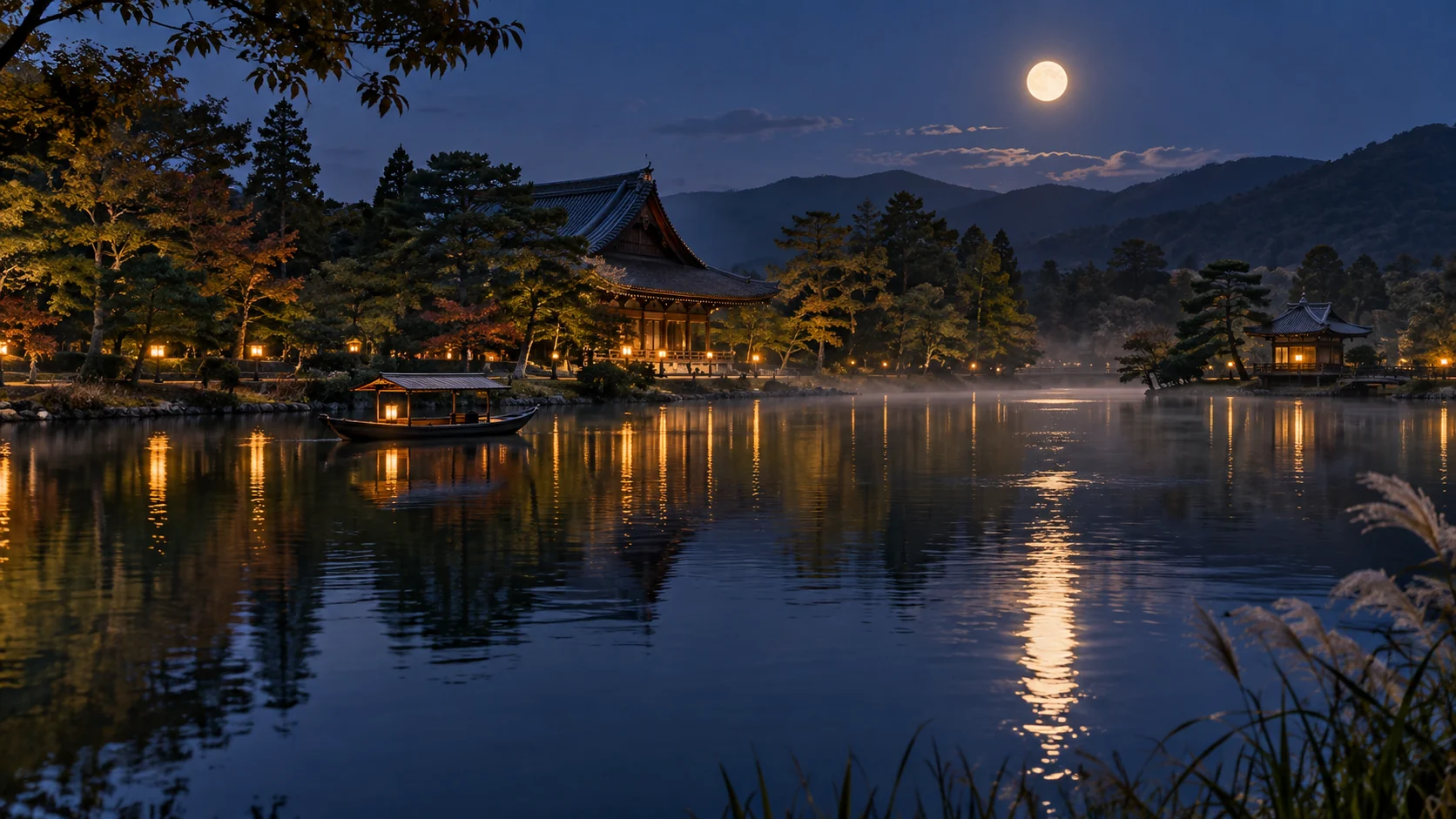
Kyoto’s harvest moon arrives on Friday, September 25, 2026. The city’s most atmospheric way to mark it is not a projection show or a pop-up photo set, but an evening beside the water at Daikaku-ji’s Osawa Pond in Saga. The temple’s three-night Kangetsu no Yube (harvest-moon evening) runs from September 25 through 27, with lanterns, a moon-viewing altar, and the possibility of a bright reflection on the pond if the clouds cooperate.
This is a useful Kyoto weekend update because the details are specific and easy to get wrong. It is a temple event with a fixed night-time window, a separate evening admission, and a boat programme that is not something you can simply decide to join at the gate. Here is what is confirmed, what is weather-dependent, and how to make the most of a visit without treating a working temple like a theme park.
What is happening at Daikaku-ji
Daikaku-ji, the former Saga Imperial Palace, holds its harvest-moon viewing at Osawa Pond from Friday, September 25 to Sunday, September 27, 2026. The official event hours are 17:30 to 21:00, with the last admission at 20:30. The temple’s evening programme is separate from daytime sightseeing: if you are already inside the temple or pond area during the day, the official instructions say to leave before 17:00 and pay the night admission if you return.
The focal point is the pond rather than the buildings. Kyoto Travel describes Osawa Pond as one of Japan’s three celebrated moon-viewing spots, a reputation tied to the old imperial estate and to the way the water opens a view toward the sky. On a clear night, the experience is simple: find a place along the pond, watch the moon climb, and let the reflection do most of the work. It is a better reason to come than chasing a guaranteed “perfect” photograph.
A Buddhist service is scheduled for 19:00–19:30. It is worth treating that half-hour as part of the event’s rhythm, not as background entertainment. The evening may feel busy, especially close to the entrance and the most obvious viewpoints, but the setting still rewards a slower pace once you move along the pond path.
Tickets, boats, and the detail people miss
Night admission is ¥700 for adults and ¥300 for elementary, junior-high, and high-school students. The general Osawa Pond area can be entered without an advance reservation according to Daikaku-ji’s current event guidance.
The dragon-head boat is different. Daikaku-ji treats the boat ride and tea experience as a special ticket programme, and the advance boarding registration reported for this year has already closed. In other words, do not arrive assuming that a spare boat seat will be available. You can still enjoy the pond-side event without the boat, and that is the sensible plan for a last-minute visit.
Daytime admission is not bundled into the night ticket. This matters if you are combining Daikaku-ji with Saga or Arashiyama earlier in the day: budget for the separate evening entry and leave enough time to clear the day-use area before the changeover. The temple’s own instructions are the best place to check any last-minute ticket or programme adjustment.
How to get there without making the evening harder
Daikaku-ji is at 4 Saga Osawa-cho, Ukyo-ku, Kyoto. Kyoto Prefecture’s tourism listing gives the Kyoto City Bus stop as “Daikakuji.” Another practical option is the Randen (Keifuku) line to Arashiyama, followed by roughly a 20-minute walk north. The latter is pleasant in daylight, but remember that a night event finishes at 21:00; check the return timetable rather than relying on the last train or bus you used on a previous Kyoto trip.
Daikaku-ji explicitly asks visitors to use public transport for this event. That is good advice even if you are comfortable driving in Kyoto: Saga’s narrow streets, limited parking, and a concentrated evening crowd can turn a short final leg into the least enjoyable part of the night. If you are staying elsewhere in the city, build in a buffer for an Arashiyama-area transfer and arrive before the 20:30 reception cut-off.
Weather is not a footnote
Moon viewing sounds weather-proof until you remember that the moon is the whole point. Daikaku-ji says the cancellation decision is made around 11:00 each day based on the forecast, and the event can also be cancelled for severe weather or other unavoidable reasons. Check the official event page on the day you plan to go; do not rely on a screenshot, an old social post, or the fact that the event is printed on a travel calendar.
A cloudy evening does not automatically make the visit pointless. Lanterns around the pond, the temple roofs in the dark, and the change from blue hour to night can still make a strong Kyoto evening. What you should not do is promise yourself a full-moon reflection before you have seen the sky. Treat the moon as a bonus, not a deliverable.
A considerate way to experience the pond
There is no need to invent a long list of “forbidden” behaviour to be a good visitor here. The basics are enough: keep voices low near the service, leave the pond edge clear for people moving through, and avoid setting up a tripod where it blocks a path or a view. Use a phone or camera without a bright flash, and never fly a drone over the temple grounds or crowd. Those are practical courtesies, not claims that every temple in Japan has the same written rule.
Wear shoes you can walk in and bring a light layer. Early autumn evenings can feel cool beside water, and some pond paths are darker than a daytime Arashiyama stroll. If you are travelling with children, explain that the boat and the moon-viewing altar are things to look at, not places to climb or touch. The best viewpoint is rarely the one worth rushing toward.
Is this the right Kyoto event for you?
Go to Daikaku-ji if you like seasonal traditions, old landscapes, and an evening whose appeal is mostly visual and atmospheric. It is especially good for travellers who have already seen central Kyoto’s major temples and want a reason to head west without pretending they have discovered a secret village.
Skip it if you need a guaranteed moon photograph, dislike weather-dependent plans, or cannot comfortably manage the return journey from Saga. Kyoto has plenty of excellent daytime choices; there is no prize for forcing a night event into an already exhausted itinerary.
For the confirmed dates, hours, admission, cancellation guidance, and any change to the boat programme, check Daikaku-ji’s official autumn event page and its 2026 moon-viewing instructions before leaving. Kyoto Travel’s moon-viewing guide explains the seasonal context, while the Kyoto Prefecture tourism listing confirms the practical access and fee details.
That is the useful version of Kyoto Now: one real event, a clear plan, and enough context to know what is confirmed before you make the trip. For more timely local updates, browse the Japanify Tours Kyoto Now archive.