
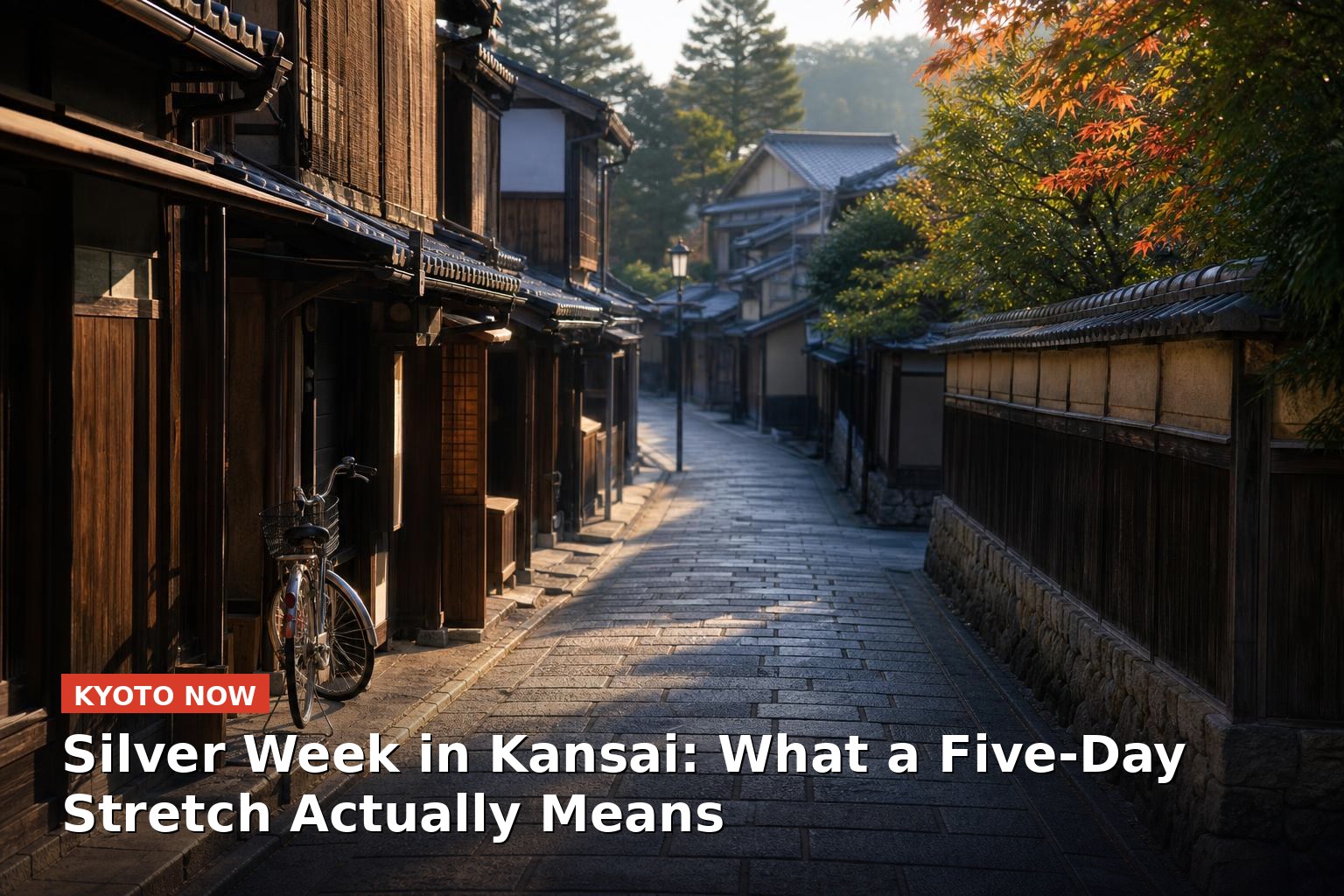
You booked September because someone told you it was the quiet shoulder. Warmer than ideal, sure, but you'd have Kyoto to yourself before the November crush. Then you get here and the Arashiyama bamboo path looks like a train platform at rush hour, the Kiyomizu approach is a slow river of people, and every second person is wearing a school uniform. What happened is Silver Week. It doesn't happen every year, and when it does, most foreign visitors have no idea it's coming.
This is one of those quirks of the Japanese calendar that quietly reshapes a trip. Not a disaster — just a thing worth knowing before you're standing in a ninety-minute line for a bowl of udon in Nishiki Market wondering why.
What Silver Week actually is
Japan has two clusters of public holidays that can, in the right calendar years, stack into a long consecutive run. Golden Week in late April and early May is the famous one. Silver Week is the September equivalent, built around Respect for the Aged Day and the Autumn Equinox. Most years those two holidays sit far enough apart that they just create a couple of separate three-day weekends. But every so often the calendar lines up and the weekday between them becomes a bridge holiday, producing a rare five-day run.
2026 is one of those years. It only happens roughly once a decade, which is why even seasoned Japan travelers can miss it — the last time this alignment turned up, you probably weren't planning this trip yet.
The practical result: domestic travel spikes hard. Shinkansen reservations tighten. Popular ryokan fill months ahead. Kyoto and Nara, always at the top of the domestic bucket list, absorb a serious share of that demand.
How it feels on the ground in Kansai
Silver Week is not Golden Week. It's shorter, less universal, and the weather in September is still hot enough that some families skip the whole thing. So don't panic — you're not walking into peak-sakura Kyoto in disguise.
But you will notice it. Here's what actually changes:
- The famous sites get domestic-tourist heavy. Fushimi Inari, Kinkaku-ji, Arashiyama, Nara Park. These places always have crowds; during Silver Week they get another layer on top, and the crowd tilts Japanese rather than international.
- Restaurants that don't take reservations develop lines. This is the bigger deal for most travelers. A place that's normally a five-minute wait becomes a forty-minute wait. Popular tonkatsu, ramen, and unagi spots are the ones to watch.
- Day-trip trains fill up. Trains from Kyoto to Nara, Osaka to Kobe, and anything heading toward Ise or the Kii coast get uncomfortably full, especially mid-morning outbound and late-afternoon return.
- Hotel prices climb. If you haven't booked yet, you'll feel it. Rates for the holiday nights themselves are noticeably higher than the days on either side.
What does not really change: the small neighborhood cafes, the temples nobody puts on a first-timer list, the residential stretches of northern Higashiyama, the backstreets of Nishijin. Silver Week crowds concentrate on the same twelve places that always concentrate crowds. Everywhere else is more or less normal.
Reading your own dates
The holidays themselves are the pinch points, plus the weekend attached to them. The days immediately before and after tend to be quieter than you'd expect — a lot of Japanese travelers front-load or back-load their trip and are already home, or haven't left yet.
If your dates fall squarely inside the run, you're not doomed, you just need to adjust tactics. If your dates bracket it — arriving before it starts, leaving after it ends — you may actually benefit from a lull on either side.
The one thing to check now, if you haven't: your intercity train reservations. Unreserved seats on shinkansen during a holiday stretch are a genuinely bad experience. Reserved seats sell out days ahead. This is the single booking task worth doing today rather than next week.
Why Japan does this at all
The stacked-holiday phenomenon is a byproduct of a law that turned certain fixed-date holidays into floating Monday holidays, plus a rule that any single weekday sandwiched between two holidays automatically becomes a holiday itself. The intent was reasonable: give workers real three-day weekends rather than random Wednesdays off. The side effect is that in specific calendar years, the machinery produces a five-day block, and the whole country moves at once.
Japan takes vacation timing seriously partly because taking vacation the rest of the year is culturally difficult. Long personal leave is still uncommon in many companies. When a public holiday block appears, people use it — genuinely, fully, with the entire extended family. Domestic tourism during these runs isn't a trickle; it's the wave.
Which is why September, of all months, can briefly feel like April.
What it means for your week
If you're in Kansai during the run, treat the marquee sights as early-morning-only propositions. Be at the temple gate when it opens, not at ten. Push your lunch either early (before noon) or late (after two). Save the famous restaurants for the days on either side of the holiday block, and eat neighborhood food during the pinch. Consider a day trip to somewhere that isn't Nara — the Kii coast, western Kyoto's less-walked temple districts, a working town like Uji.
The trip is still going to be good. Silver Week doesn't ruin September in Kansai; it just concentrates the friction into a few predictable days, in a few predictable places. Knowing it's happening is most of the fight.
Half of what a small tour is: someone who already knows which days to spend where, and which days to spend somewhere else entirely.