
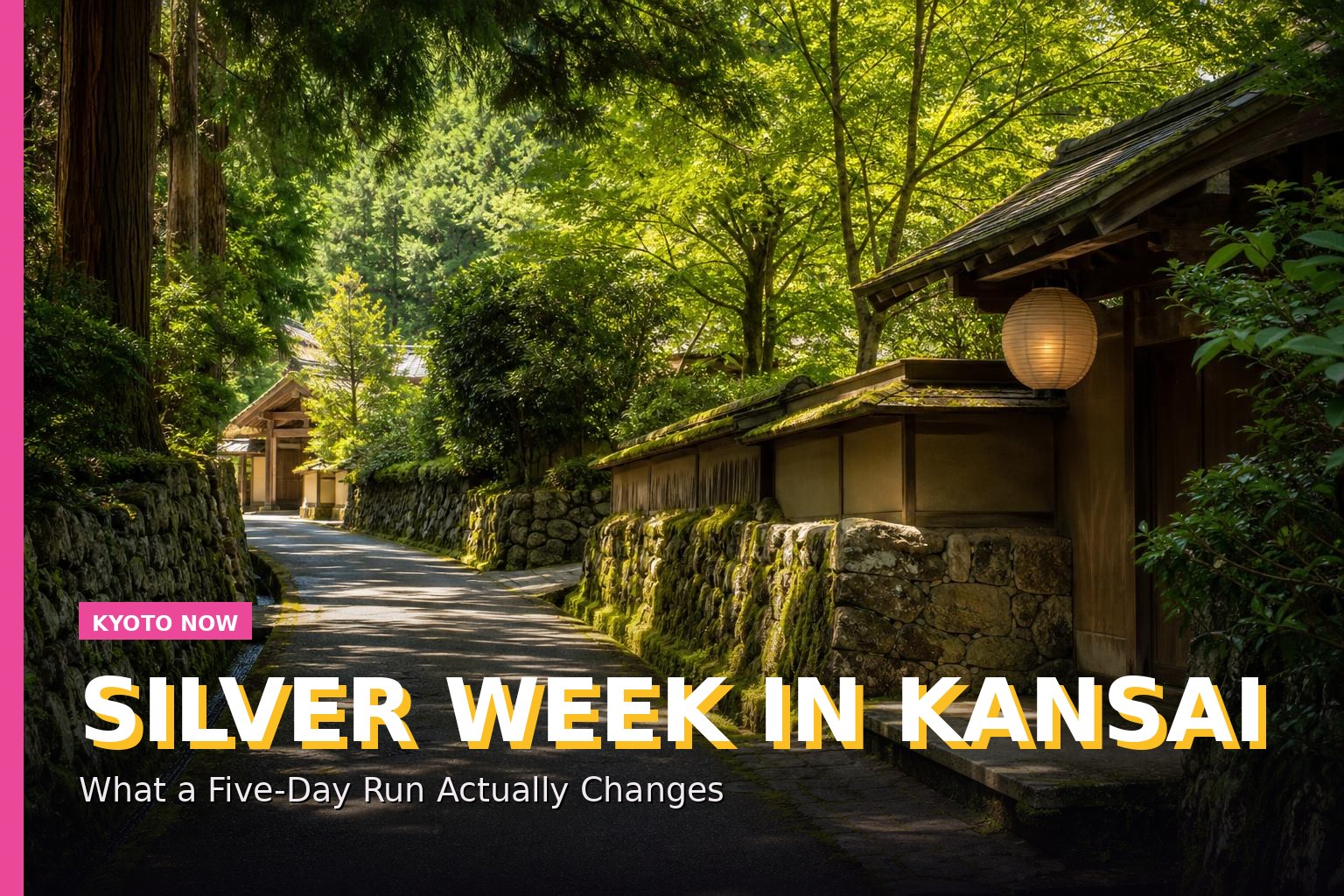
A woman stops in the middle of the Sanjo Bridge on a Saturday afternoon in September, phone up, trying to read a shinkansen reservation screen in the sun. She wants to swing down to Nara the next morning and back to Kyoto for dinner. Easy trip on any normal weekend. This is not a normal weekend. It's Silver Week, and every reserved seat between Kyoto and Shin-Osaka is already gone.
Silver Week is the autumn cousin to Golden Week — a cluster of public holidays that occasionally line up with a weekend to produce a long domestic travel run. Most years it's a modest three-day weekend. This September, the calendar breaks a certain way and Japan gets a rare five-day stretch. If you're traveling in Kansai during it, or planning to arrive right after, the shape of your trip changes.
What Silver Week actually is
Two September holidays do the work: Respect for the Aged Day and the Autumnal Equinox. Most years they sit a few days apart and produce two separate long weekends, or one long weekend and a midweek day off. Every so often the equinox falls in a way that bridges them, and the whole country gets five days in a row. That's what's happening now, and it hasn't happened in years.
For domestic travelers this is the last big travel window before the koyo rush in late November. Families take short trips. Couples book ryokan they've been eyeing since spring. Grandparents get visited. Everyone moves — and a large share of that movement runs on the Tokaido Shinkansen, which is the artery that also carries you between Tokyo, Kyoto, and Osaka.
What changes on the ground in Kansai
Three things shift at once, and they compound.
First, the trains. Reserved seats on shinkansen sell out days ahead in both directions. Non-reserved cars fill to standing-room by mid-morning. This is manageable if you're flexible on timing and willing to stand for the run between Kyoto and Shin-Osaka, but it can eat a half-day if you were planning a same-day dash to Hiroshima or Kanazawa. Book reserved seats the moment you know your dates. If the app says sold out, try again at a different time — cancellations trickle back in.
Second, the hotels. Kyoto's inventory is finite and Silver Week is one of the few times domestic demand runs shoulder-to-shoulder with international. Prices spike. What was a reasonable machiya rental in August becomes eye-watering. If you're arriving without a booking, widen your radius — Osaka and even Otsu become sensible bases, and the trains are short enough that the trade is worth it.
Third, the day-trip circuit. Nara, Arashiyama, Fushimi Inari, Himeji Castle, Miyajima — the greatest-hits list absorbs the entire country's long-weekend energy. Fushimi Inari at 10 a.m. during Silver Week is the closest Kyoto gets to a stampede. The good news: this all clears by mid-morning of the first working day after.
The counter-move: go where the crowd isn't going
Silver Week concentrates people in the same twenty places. The rest of Kansai empties out, because locals are the ones traveling.
Northern Kyoto — Ohara, Kurama, Kibune — stays walkable. The bus out there is slower than usual because of general road traffic, but the temples themselves feel closer to a normal Tuesday than a holiday. Same story with the western hills around Takao, which is early enough in the season that the maple crowds haven't arrived yet but late enough that the summer heat has broken.
Osaka's residential neighborhoods — Nakazakicho, Karahori, the long shopping streets of Tenma — run on their own rhythm. The tourists are all at the castle and Dotonbori. The coffee shops and secondhand bookstores are quiet.
And the smaller cities within Kansai reach — Hikone, Omihachiman on Lake Biwa, the pottery towns of Shigaraki and Tanba — get a fraction of what Kyoto absorbs. A day trip out that way during Silver Week is one of the better trades in Japanese travel.
Why the calendar does this
Japan's public holidays are unusually engineered. In the 2000s the government moved several holidays to Mondays specifically to create long weekends and encourage domestic tourism — the Happy Monday System. The Autumnal Equinox stayed anchored to the actual astronomical equinox, which drifts by a day or two each year. When Respect for the Aged Day and the equinox land far enough apart, a law about "citizen's holidays" fills the gap between them, converting the whole run into consecutive days off.
The result is a holiday that only fully materializes every several years, when the astronomy cooperates. Domestic media starts writing about it months out. Booking sites open reservations early. By the time it arrives, the infrastructure is running near capacity — not because more people exist, but because everyone moves in the same narrow window.
What this means if you're here now
If your Kansai days overlap with Silver Week, don't fight the crowds head-on. Move your marquee sights — Fushimi Inari, Kiyomizu, Arashiyama's bamboo — to the working days on either side. Use the holiday days themselves for neighborhoods, museums, coffee, and the corners of Kyoto that domestic tourists don't prioritize. Reserve your shinkansen seats early, and if you're going west toward Hiroshima or east toward Tokyo, build in a buffer.
If you're arriving right after, you've timed it well. The trains empty out overnight. Kyoto exhales. The weather in the days that follow is usually the first honestly comfortable stretch of the year — warm afternoons, cool mornings, no cicadas.
Half of what a small tour is: someone already worked out which days to spend where, so you don't lose an afternoon to a sold-out train and a stampeded shrine.