
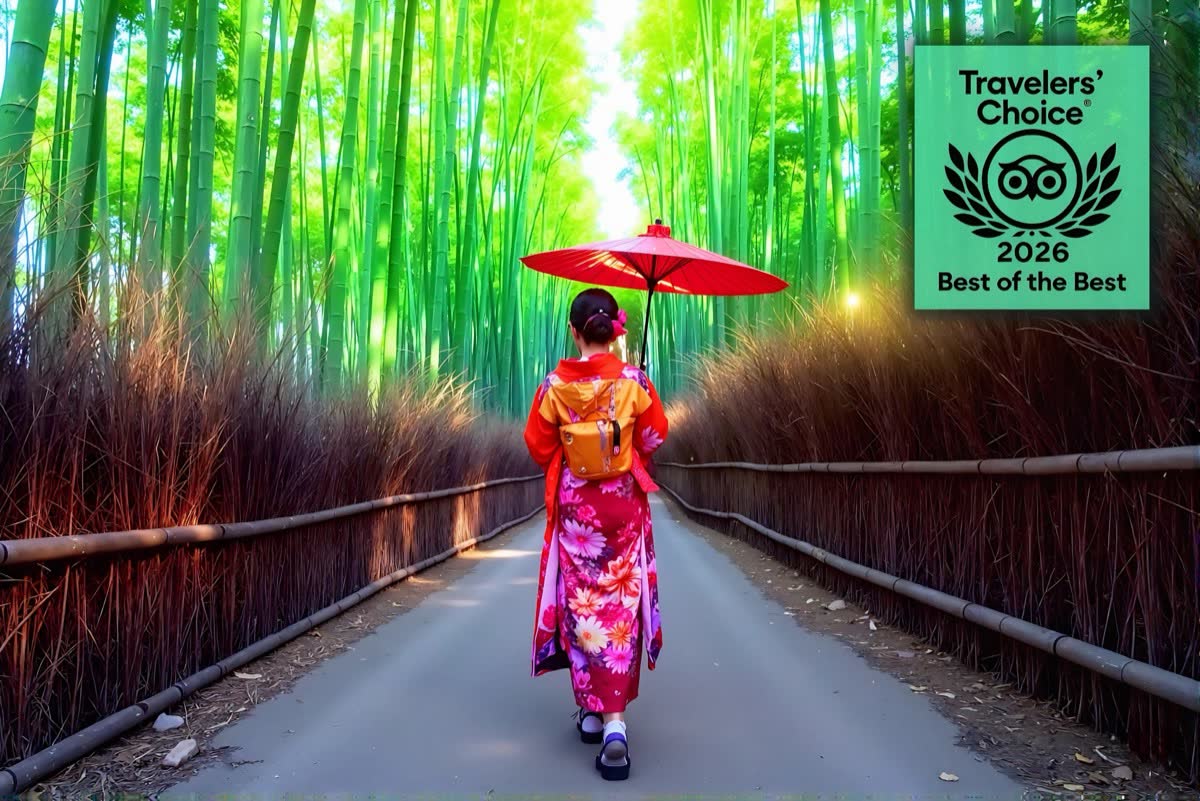
Kyoto's most famous sights are famous because they deserve to be. The problem is not that Fushimi Inari or the bamboo forest are overhyped — it's that most visitors spend all their time at the entrance and miss what's five minutes further in. Kyoto's best-kept places are not secret. They just require walking past where the tour buses stop.
Jojakko-ji temple, Arashiyama
Five minutes on foot from the bamboo forest, up a mossy stone staircase, sits Jojakko-ji — a small temple that almost no first-time visitors find. The grounds are covered in moss and maple trees, the stone lanterns lean with age, and the five-story pagoda above the main hall gives a view over Arashiyama that most people never see. Entry costs a few hundred yen. On a typical morning, you share the grounds with almost no one.
The reason visitors miss it is straightforward: it is not signposted from the main bamboo grove path, and the entrance is easy to walk past. It is one of the best examples of what happens if you simply keep walking when everyone else turns back.
Okochi Sanso garden, Arashiyama
Okochi Sanso is the private villa and garden of Denjiro Okochi, a famous silent-film actor who built it over 30 years. The garden connects multiple traditional styles — moss gardens, dry rock gardens, tea houses, and a hilltop viewing pavilion — across a surprisingly large hillside property. Entry includes a cup of matcha and a sweet, which most visitors drink while looking out over a view of Kyoto that takes in both Arashiyama and the distant city.
The garden gets overlooked because it sits just past Jojakko-ji, requires a slightly longer walk up the hill, and costs more than most Kyoto temples. The price filters out the casual crowd. What you get is a large, well-maintained garden with views that rival anything Kyoto offers, shared with very few other people.
The upper trails of Fushimi Inari
Fushimi Inari Taisha is one of the most photographed places in Japan. It is also one of the most misunderstood. Most visitors walk through the first section of the torii gate tunnel, take their photographs, and turn back. The mountain trail continues for several kilometers above that point, passing through progressively quieter sections of gates, smaller shrines, and eventually near-empty forest paths with gates that lean and moss that has grown over the inscriptions.
Twenty minutes above the main gate area, the crowds thin to almost nothing. Forty minutes up, you are essentially alone with the mountain. The full circuit takes two to three hours and returns you to the main entrance. Going beyond the first photo opportunity is the single most reliable way to have Fushimi Inari to yourself.
Japanify's Fushimi Inari + Arashiyama Combo Tour covers this route with a guide who knows the right trails and timing.
Adashino Nenbutsuji, Sagano
Most visitors to Arashiyama do not walk as far as Sagano. The neighborhood sits at the northern end of the tourist district, past the point where most people turn around at the bamboo forest. Adashino Nenbutsuji temple is there — a quiet, slightly eerie place established to perform memorial rites for the thousands of people whose bodies were left in the area over centuries without burial.
The grounds hold over 8,000 stone figures marking those remains. The temple holds candlelight memorial services in September. It is not a comfortable place to visit, but it is an honest one, and it puts the Arashiyama district's atmosphere in a context that changes how the whole area feels afterward.
The Philosopher's Path before 8 AM
The Philosopher's Path, a canal-side stone walkway lined with cherry trees between Nanzenji and Ginkaku-ji in eastern Kyoto, is beautiful and well-known — which means it is crowded from mid-morning onward. At 7 AM on a weekday it is a different place: mist over the canal, herons standing in the water, almost no other people, and a quietness that the name actually fits.
Pairing an early Philosopher's Path walk with a visit to Nanzenji before the tour groups arrive — the Sanmon gate is accessible from early morning and the garden opens at 8:40 AM — is one of the best ways to spend a Kyoto morning. Japanify's Nanzenji Zen Tour covers this area with a guide who knows how the crowds move by hour.
The back paths of Higashiyama
The main Higashiyama walking street (Ninenzaka and Sannenzaka) is the postcard version of old Kyoto — preserved wooden shopfronts, stone-paved lanes, tourists shoulder to shoulder. One street off the main path in either direction and the crowds disappear. The lanes parallel to Ninenzaka, particularly the uphill paths toward Kodai-ji and Ryozen Kannon, are quieter, equally atmospheric, and offer the same sense of preserved Kyoto without the volume.
The trick is simple: when you reach a junction on the main path, take the road less marked rather than the one with signs in five languages. The city is dense with temple sub-gardens, minor shrines, and old stone steps that nobody queues for.
Arashiyama after dark
The bamboo forest is not on this list as a daytime hidden spot — it is too famous for that. But after 7 PM, when the day-trippers have left for Osaka and Tokyo, Arashiyama becomes a different place entirely. The main paths are empty. The lantern-lit backstreets are accessible. The bamboo grove is dark, quiet, and genuinely atmospheric in a way that no photograph from the daytime crowd captures.
Japanify's Kyoto Ghost Tour is built around this version of Arashiyama — the one that exists after 7 PM, with ghost stories and yokai folklore to explain why the district feels the way it does after dark.
FAQ
What are the most underrated hidden places in Kyoto?
Jojakko-ji temple in Arashiyama, Okochi Sanso garden, the upper trails of Fushimi Inari above the main gate, Adashino Nenbutsuji in Sagano, and the Philosopher's Path before 8 AM are the most consistently overlooked places that deliver genuinely exceptional experiences.
How do you avoid crowds in Kyoto?
Timing and routing. Before 8 AM or after 5 PM at famous spots, and five minutes past any main entrance, the crowds thin dramatically. A local guide who knows the crowd patterns by hour is the fastest solution.
Is Fushimi Inari worth visiting if you only go to the main gate?
Yes, but the upper trails above the main tunnel are almost entirely empty even at peak hours and are the better experience. Going beyond the first 20 minutes of trail is the most reliable way to have Fushimi Inari to yourself.
What hidden places in Kyoto can you visit with a guide?
Japanify's Arashiyama Walking Tour, Fushimi + Arashiyama Combo Tour, and Kyoto Ghost Tour all prioritize quieter routes and off-peak timing rather than the same spots everyone else visits.