
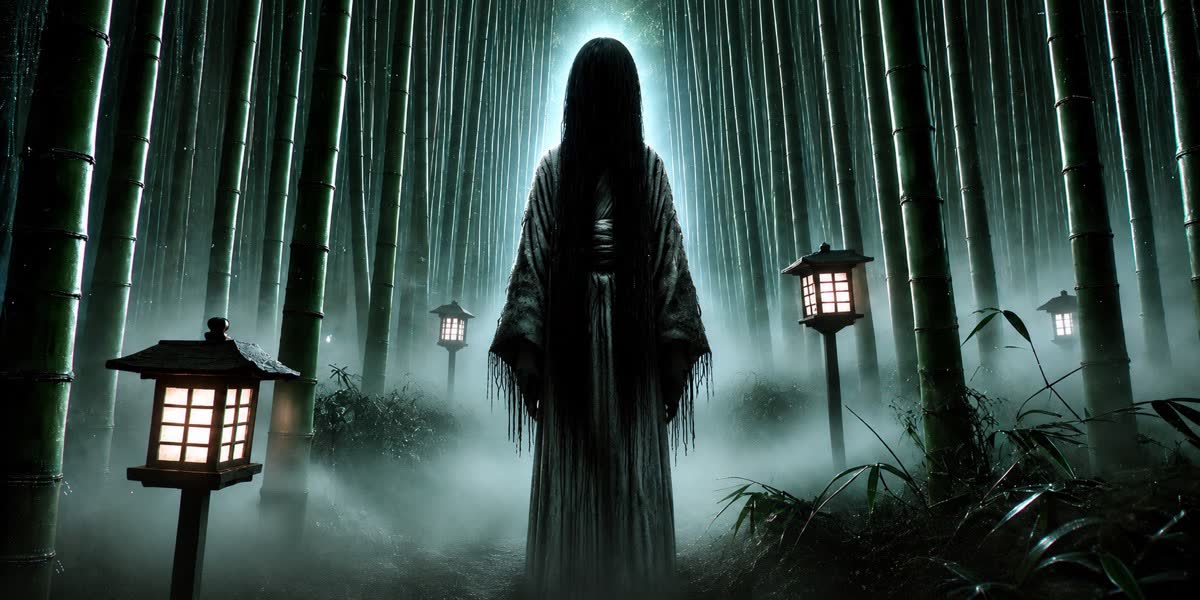
Arashiyama is haunted by Japanese standards — which is a more meaningful standard than it might sound. Japan has one of the world's most developed traditions of supernatural belief, and Arashiyama sits at the center of it. The area served as a burial ground for the unknown dead, a boundary zone between the city and the spirit world, and a landscape so acoustically and visually distinct from ordinary Kyoto that it generated centuries of disorientation folklore. The dark reputation is not invented. It grew from what the area was used for.
The boundary zone between the living and the dead
In Heian-period Kyoto (794–1185), the city was understood to have a spiritual geography. The center held the imperial palace and the structures of political order. The edges — the mountains, the river districts, the forests — were where that order gave way to something else. Arashiyama sat at the western edge of the city, where the mountains began, where the Oi River created a natural barrier, and where the formal rules of the city stopped applying.
Boundary zones in Japanese folk belief are places where the ordinary rules of the living world become unreliable. Spirits can cross more easily. The dead linger. Travelers lose their bearings. The specific supernatural traditions associated with Arashiyama grew directly from its function as a place where the city ended and the mountain wilderness began.
Adashino Nenbutsuji and the unburied dead
The most historically concrete reason for Arashiyama's haunted reputation is Adashino Nenbutsuji temple. For centuries, people who died without family, without money, or as strangers passing through Kyoto were left in the Arashiyama area without burial rites. Proper Buddhist burial required resources most people did not have. The bodies were left.
The monks Kukai and Honen held memorial services at the site to address this accumulated spiritual debt. The stone figures throughout the temple grounds — over 8,000 of them — mark the remains of those who died without ceremony. The temple still holds candlelight memorial services for the unburied dead twice a year, on the evenings of September 22 and 23.
Walking through Arashiyama knowing this changes the texture of the place. The cheerful bamboo-forest photographs do not capture what the area was used for.
The bamboo forest disorientation legend
The bamboo grove has generated its own body of supernatural folklore, separate from but connected to the burial-ground history. The legend is specific: travelers enter the grove and lose their sense of direction. The path seems to shift. The sound of the bamboo, which absorbs and redirects noise in ways that make orientation by ear unreliable, contributes to a feeling of spatial confusion that many people experience even today as a purely physical phenomenon.
In folk tradition, the explanation is the spirits of the unburied dead leading travelers astray — which is consistent with the historical use of the surrounding area. The experience of disorientation in the grove is real enough that it generates the same story independently across generations of visitors.
The Oi River and water spirits
Rivers in Japanese folk belief are places where the living world meets the spirit world. The Oi River running through Arashiyama has kappa traditions — the river creature that drags people underwater — and a longer history of reports about figures seen near the water at night. The weeping woman seen on the riverside path is one of Arashiyama's quieter ghost traditions: a woman in white, visible near the river after dark, who disappears when approached.
The kappa legends are treated lightly today — the river has warning signs that are more wry than serious — but the water-spirit traditions are real folk belief, not tourist invention.
Tengu in the mountains above Arashiyama
The mountains above the bamboo forest — the beginning of the Kitayama range — are associated in Japanese tradition with tengu, the mountain spirits with long noses and martial-arts connections. Tengu are proud, powerful, and dangerous if their territory is disrespected. The Arashiyama mountains, particularly the paths toward Kurama to the north, carry strong tengu traditions. The feeling that the forest is watching is not accidental — it maps onto a tradition of mountain spirits who take a dim view of humans wandering without sufficient reverence.
Experiencing Arashiyama's haunted history
Japanify's Kyoto Ghost Tour walks through Arashiyama after dark — the bamboo forest, the lantern-lit back paths, and the district's historically significant locations — with a local guide who covers the ghost stories and folk traditions connected to each place. The Arashiyama Walking Tour covers the same district in daylight with a different emphasis: the beauty, the temples, the history that visitors see. The ghost tour shows what the same landscape carries after dark.
Both tours are small-group (maximum 12 guests), English-language, and run year-round.
FAQ
Is Arashiyama haunted?
By Japanese standards, yes. The area has one of the densest concentrations of ghost legends and supernatural folklore in Kyoto, grounded in its historical use as a burial site for the unburied dead and its function as a boundary zone between the city and the mountain wilderness.
Why is Arashiyama associated with ghosts?
Because of what the area was historically used for: a disposal site for those who died without burial rites, a boundary zone where ordinary city rules gave way, and a landscape whose acoustic and visual properties generate genuine disorientation that folklore explains as supernatural.
What ghost stories are connected to Arashiyama?
The bamboo forest disorientation legend, the weeping woman near the Oi River, the Heike clan ghost traditions, and the accumulated folklore around Adashino Nenbutsuji temple and its thousands of unburied dead.
Can you do a ghost tour in Arashiyama?
Yes. Japanify's Kyoto Ghost Tour runs through Arashiyama after dark, year-round, in small groups of up to 12 with an English-speaking guide. Duration is 2.5 to 3 hours.